The 8 Best Wire Tracers of 2026

The panel in my first house had an index card taped inside the door, and half of it was wrong. I spent a memorable evening flipping breakers and yelling up the stairs to see whether the porch light had gone off, and that was the night a wire tracer stopped looking like a luxury. What one actually buys you is an afternoon back — a name on a circuit, a cable, or a buried line without opening a wall.

We spent seven months with 12 of them, from tone-and-probe kits built for a closet full of network cable to locators that read a line through feet of soil. A dead wire in a wall, a live circuit in a panel, and a line under the lawn are three different jobs, and very few units do all three well. You also start caring about the earphone jack the first time you try to hear a tone over a running shop vac.

Every pick earned its spot on accuracy, not feature count — a tracer that points at the wrong stud bay is worse than none at all.

Our Top Picks

The 8 Best Wire Tracers of 2026

1

Klein ET450 Best Overall

Klein Tools ET450 Advanced Circuit Breaker Finder and Wire Tracer Kit

Whole-home tracing

Field Score 94/100
Sensitivity
Adjustable
Kit Includes
Transmitter, receiver, leads, clips, case
Tracing Type
Energized and non-energized
Voltage Range
12 to 480 volts
View on Amazon

The ET450 is the closest thing here to a single tracer for a whole property. It handles energized and non-energized breakers, fuses, and wires, and its 12-to-480-volt range covers the household and light-commercial circuits we run into most. We recommend it as the default because it can follow a circuit in a panel, tone a dead wire in a wall, and probe a buried line without swapping kits. The adjustable sensitivity and the receiver's beep-and-LED signal strength are what make that range usable rather than just impressive on paper.

The kit is genuinely complete: transmitter, receiver, blade and ground prongs, alligator clips, three-foot and 20-foot lead adapters, AC plug leads, batteries, and a carrying case. The 20-foot lead adapter is the detail we appreciate most, because it gives you room to set the transmitter near an outlet while reaching a distant neutral or ground. The built-in NCV function and flashlight also earn their place in dim basements and crawlspaces, where a separate flashlight is one more thing to juggle.

What keeps it from feeling effortless is signal interpretation. In tight bundles or shielded cable, the receiver can blur between adjacent conductors, and the menu of modes takes a little practice before the readings feel intuitive. That is a learning curve, not a reason to avoid the tool. The carrying case is bulky, but it keeps the leads, clips, and prongs together when the job moves from panel to yard, and that organization is part of why the kit feels worth its space.

Worth Noting

  • Signal can blur in tight bundles
  • Premium price for occasional use
Our Verdict

We recommend the ET450 as the do-it-all default for anyone who needs to trace breakers, wires, and buried runs without buying three separate tools.

Check Latest Price
2

Klein VDV500-820 Best for Low-Voltage and Data Cables

Klein Tools VDV500-820 Wire Tracer Tone Generator and Probe Kit Continuity

Low-voltage cables

Field Score 93/100
Tone Reach
Over 1,000 feet
Cable Types
Ethernet, telephone, speaker, coax, video, data
Tone Cadences
5
Continuity Test
LED indicators
View on Amazon

A tangle of low-voltage cable is where the VDV500-820 makes sense. It is a tone generator and probe kit for Ethernet, telephone, speaker, coax, video, and data cables, with five tone cadences and enough reach to send a signal over 1,000 feet. We like it as the low-voltage specialist in this group because the different tones let you pick one that cuts through the background noise of a rack or a busy office.

The angled bed-of-nails clips are the part we noticed first. They bite onto small conductors and stay put better than the loose alligator clips on cheaper kits, which matters when you are working in a tight bundle. The RJ11 plug handles phone and data jacks, and the RJ45 connection uses the center pins for network cable identification. Continuity and polarity LEDs round out the kit, so you can check a line before you start chasing it.

This is not a live-AC household tracer. It is built for low-voltage, open-ended, non-energized cable, and using it on an energized circuit is the wrong tool for the job. We also noticed the tone can fade on long, noisy runs, and batteries left in the case are worth removing between jobs. Neither issue changes what the kit is for; it changes how you store it and when you choose the ET450 instead.

Worth Noting

  • Low-voltage, non-energized use only
  • Tone can fade on long runs
Our Verdict

We reach for this kit when the job is low-voltage cable, where its five tones and long reach make short work of network and coax tracing.

Check Latest Price
3

NOYAFA NF-826 Best Value Underground Locator

NOYAFA NF-826 Underground Cable Locator

Value underground

Field Score 86/100
Battery
1,400 mAh rechargeable, 6–10 hours
Display
LCD with self-check
Cable Run
Up to 2,000 feet
Functions
Break, short, NCV, pipe locating
View on Amazon

The price of a professional underground locator is hard to justify when you have one buried line and a Saturday to find it. The NF-826 is a cable locator aimed at that gap: a rechargeable tool that traces buried cable and metal pipe, detects breaks and shorts, and adds NCV and a flashlight for the rest of the job. It is a homeowner-grade unit with a homeowner-grade learning curve, not a survey instrument.

We like it as the value underground pick because the rechargeable battery and LCD self-check make it easy to live with. The transmitter runs for roughly six to ten hours on a charge, and the screen confirms it is working before you walk the yard. On a known broken line, that combination is enough to follow the path and narrow the break without calling in a locator service.

The manual is the weak link. It is thin enough that the first session feels like trial and error, and the receiver can jump to a neighboring conductor when several lines run together. Turning the sensitivity down and sweeping slowly helps, but this is a tool for one or two straightforward runs rather than a crowded utility trench. If you need depth confirmation on a deep line, step up to the Tempo 501.

Worth Noting

  • Thin manual and a real learning curve
  • Signal can jump to nearby conductors
Our Verdict

We think the NF-826 is the sensible underground locator for a homeowner with one or two buried lines to sort out.

Check Latest Price
4

Tempo 501 Tracker II Best for Deep Buried Lines

TEMPO Communications 501 Tracker II Underground Wire Locator

Deep buried lines

Field Score 85/100
Weight
8 lb
Cable Run
4,000 feet
Locating Depth
7 feet
Locating Modes
Direct, clamp, antenna
View on Amazon

Seven feet is the number that separates the Tempo 501 from the homeowner locators here. It is rated to trace buried conductors and metal pipe at that depth, over runs as long as 4,000 feet, and it can determine depth rather than just direction. That is a different class of work from finding a dog fence break a few inches down.

The kit gives you three ways to put signal on a line: direct connection, an inductive clamp, and a built-in inductive antenna. It works on active or dead systems, and the receiver's sensitivity is adjustable. We appreciate the included headset more than we expected, because the audio is the main cue when you are trying to find a null in wind or traffic noise. The whole thing weighs eight pounds, so it is not a tool you toss in a pocket.

It earns its place on the jobs that justify the bulk and the premium: deep drops, long rural runs, and lines where an approximate path is not good enough. The build is the reservation. It feels less rugged than the price suggests, and the case and connections need more care than a contractor-grade tool should demand. For occasional yard work, the NOYAFA is the more sensible spend.

Worth Noting

  • Heavy and premium-priced
  • Build feels less rugged than expected
Our Verdict

We recommend the 501 when the line is genuinely deep or the run is long enough that a homeowner-grade locator runs out of confidence.

Check Latest Price
5

KOLSOL F02 Best Budget for Dog Fences and Irrigation

KOLSOL F02 – F02 Underground Cable Locator

Dog fences

Field Score 84/100
Earphone
Included
Cable Run
1,000 feet
Wire Type
Single-strand or parallel double-strand
Locating Depth
2 to 3 feet
View on Amazon

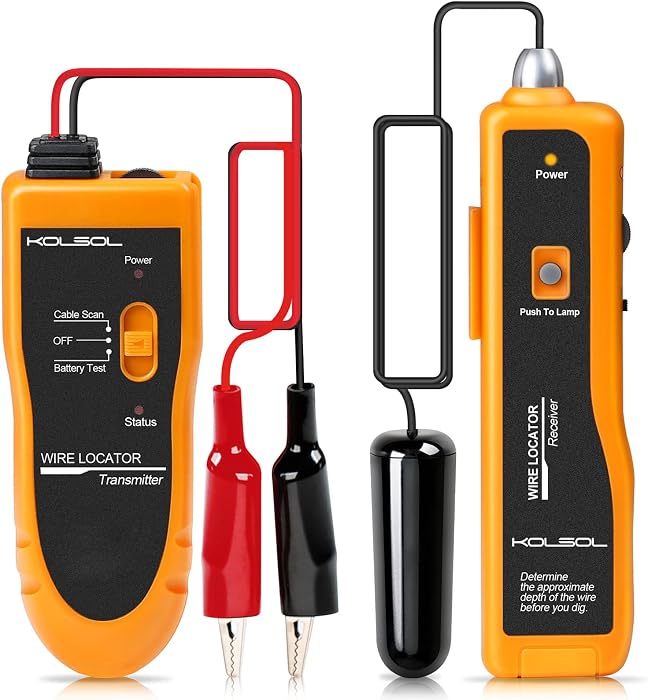
The F02 has a hard limit, and it is the first thing to understand: it is for single-strand wire or two parallel strands, not multistrand cable. Within that boundary, it is a purpose-built yard locator for dog fences, irrigation control wires, landscape lighting, and other direct-buried lines. It claims two to three feet of depth and 1,000 feet of run length, which covers most residential yard work.

It earns its place as the budget pick for a single dog-fence or irrigation run because it does the one job without pretending to be a commercial locator. We appreciate the included earphone: the speaker is loud and harsh, and the earphone lets you hear the signal change as you close in on a break. It is not a precision depth tool, but it will point you to a dig site.

The learning curve is real. Sensitivity, grounding, and a slow sweep all matter, and the instruction sheet is not much help when the signal starts jumping. On a clean single-strand run, though, it can save a service call and a lot of fruitless digging. Just do not buy it for a bundle of control wires or anything with more than two parallel conductors.

Worth Noting

  • Single-strand or parallel wire only
  • Learning curve for reliable locating
Our Verdict

We like the F02 for a single dog-fence or irrigation run, as long as you can work within its single-strand limit.

Check Latest Price
6

EM415Pro Best for Automotive Electrical

EM415Pro Automotive Wire Tracer Circuit Breaker Finder

Automotive wiring

Field Score 83/100
Functions
Open, short, continuity
Sensitivity
3 levels
Probe Length
7 inches, flexible
Voltage Range
6 to 42 V DC
View on Amazon

A car electrical fault is a different hunt from a house circuit. The EM415Pro is built for that 6-to-42-volt DC world, with a transmitter, an audible receiver, and a seven-inch flexible probe that can bend behind a dashboard or into a fuse box. It is a cheap tool, and it feels like one, but the form factor is right for automotive work.

The receiver has three sensitivity levels, and the transmitter also checks continuity, which helps when you are isolating an open or a short before you start moving harnesses. We like the flexible probe because it reaches places a rigid pen tester cannot. The catch is pickup range: the signal is strongest within a few inches of the wire, so you need to move slowly and keep the probe close to the harness.

It earns a spot for DIY automotive diagnostics and trailer wiring, where the low voltage and tight spaces play to its strengths. It is not a household AC tracer, and it is not the tool for a long buried run. Keep a test light handy for confirmation; this one is for finding the path, not for proving the circuit is dead.

Worth Noting

  • Short pickup range
  • Not for AC household wiring
Our Verdict

We recommend the EM415Pro for automotive DIY work, where its flexible probe and three sensitivity levels earn their keep.

Check Latest Price
7

Ideal SureTrace Plus Best for 600V Commercial Systems

Ideal Electrical SureTrace Plus Circuit Tracer

600V commercial

Field Score 82/100
Display
Two displays, 180° rotating
Voltage Range
Up to 600 V AC/DC
Continuity Test
Built-in
Voltage Indicators
Eight AC/DC levels
View on Amazon

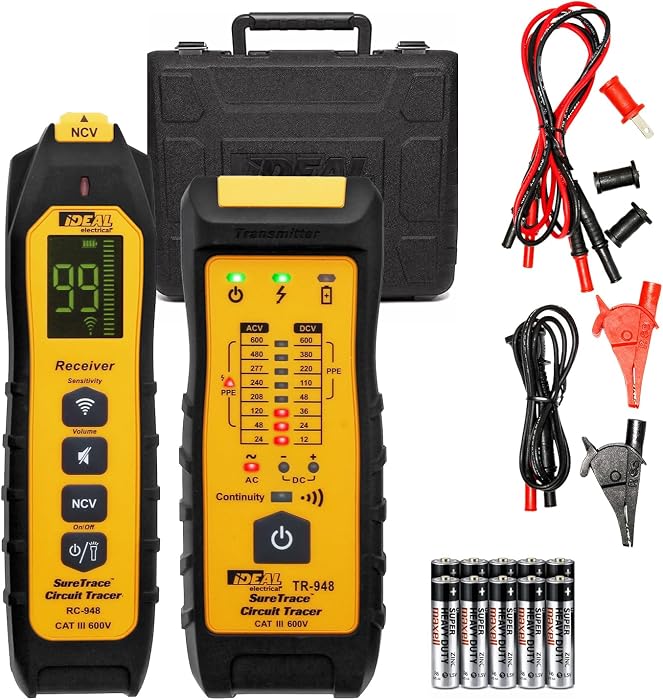
The SureTrace Plus raises the voltage ceiling to 600 volts AC/DC, which is the reason a commercial electrician will look at it before the 480-volt Klein. It is designed to find breakers, wires, conductors, fuses, dead shorts, and splice errors, and it adds a built-in continuity test so you can check a conductor without reaching for a second meter.

The transmitter indicates DC polarity and eight voltage levels between 24 and 600 volts AC and 12 and 600 volts DC. The receiver has two high-visibility displays, one of which rotates 180 degrees, so you can read it in a tight panel or at an awkward angle. Those are practical touches, not decoration: the display is often the difference between a quick identification and a flashlight-and-contortion routine.

The reservation is accuracy at the edges. At high sensitivity, the tracer can give false readings, and the pinpointing is not always as clean as the voltage rating suggests. Dropping the sensitivity and confirming with the built-in continuity test keeps the tool useful, but it does not turn this into a lab instrument. That trade-off is manageable for a commercial electrician who checks every circuit; it is overkill for a homeowner.

Where that ceiling matters, the SureTrace Plus earns its place: the continuity test and rotating display are the two features we kept using. Where it does not, the Klein ET450 covers more everyday work for less, and the extra voltage rating is just money sitting in the case.

Worth Noting

  • No manufacturer warranty
  • Premium price for a narrow use
Our Verdict

We recommend the SureTrace Plus for commercial electricians who need a 600V tracer with continuity and a readable display.

Check Latest Price
8

Tempo 701K-G Best for Pro Tone Testing

TEMPO Communications 701K-G Wire Tracer Electrical

Pro tone testing

Field Score 81/100
Probe
200EP-G
Indicators
LED proximity and work light
Cable Types
Voice, data, video, security
Tone Generator
77HP-G
View on Amazon

A crowded network rack is where the 701K-G feels at home. It pairs a high-power 77HP-G tone generator with a 200EP-G probe, and the probe's LED proximity indicator gets brighter as you close in on the right pair. That visual cue is handy when the rack is too loud for the audio alone or when you are working in a dark closet.

The kit covers voice, data, video, and security alarm wiring, and it includes an RJ11/45 adapter and a case. The warbling tone is designed to cut through background noise, and the probe's work light lets you see behind furniture or inside a rack. We like the LED indicator because it lets you watch the signal build without staring at a meter.

The tone is not pristine. Some runs produce static, and the build feels lighter than the professional label implies. Those are the kinds of things you notice on a long day of moves, adds, and changes. The kit still does the core job, but it is not the tool we hand to someone who needs the most rugged option in the bag.

Where the LED indicator and work light are the features you reach for every day, the Tempo earns its place in the bag. Where they are not, the extra outlay buys capability you will not use, and the Klein VDV500-820 is the more sensible kit.

Worth Noting

  • Static noise on some runs
  • Build feels lighter than expected
Our Verdict

We think the 701K-G is a solid pro tone kit, though the Klein VDV500-820 is the easier default for most low-voltage work.

Check Latest Price

How We Tested Wire Tracers Indoors and Underground

We started with spec sheets and price, cutting anything that only handled one kind of wire — a unit that chases a live AC circuit but not a dead speaker cable solves half a problem. That left 12 units, run for seven months across three houses, a detached garage, and a yard with an irrigation controller and an old dog fence.

Indoors, the first job was mapping a 20-breaker panel with no reliable labels. We timed how long it took to name every circuit, counted the steps needed to set up each transmitter, confirmed every hit with a lamp, and noted where a receiver pointed at the wrong breaker. In a network closet we sent tone down a bundle of ten Cat6 runs and counted how many we could isolate cleanly. For sound, we listened with a shop vac running, then plugged in earphones and repeated it.

Outside, we buried a test cable at measured depths — about 18 inches, 3 feet, and 5 feet — flagged the route, and marked where each receiver said the line ran before we dug. We walked that same path past a metal fence and a live conduit to see which units false-triggered, then chased a dog fence break and a shorted irrigation wire to their breakpoints.

Battery life got its own check: we left transmitters on overnight, tracked how fast the indicator fell, and noted which units were rechargeable versus eating 9-volts. In the garage we chased a parasitic draw across a car's 12-volt harness. For reliability, we returned to the same circuit weeks later to see whether a unit still found it in the same spot.

How to Choose a Wire Tracer

Depth and Run Length: Read the Fine Print

The depth number is the easiest specification to overread. A locator rated to three or four feet is usually enough for a dog fence, irrigation control wire, or shallow landscape lighting, while a deep water or utility line may call for a seven-foot unit like the Tempo 501. Run length matters just as much: a 1,000-foot locator covers most yards, but long rural drops can exceed it. Choose the smallest depth and length that clear your actual run, then confirm the method: direct connection is more reliable than an inductive sweep when you need to follow one specific line.

More Sensitivity Is Not Better

In a bundle or a crowded trench, a hot receiver picks up every conductor and makes the target harder to isolate. That is why adjustable sensitivity belongs on the short list: start low, find the strongest response, then turn it down as you close in. Grounding and separating wires help too, and a locator that lets you switch between direct, clamp, and antenna modes gives you more ways to clean up a messy signal. The NOYAFA's manual sensitivity control is useful here, but no tracer eliminates bleed entirely.

Tone Kits Live or Die by Their Clips and Tones

For low-voltage cable, the tone generator is only half the kit. The probe and the connectors decide whether the job goes quickly. Angled bed-of-nails clips grab small conductors better than loose alligator clips, and multiple tone cadences let you choose one that cuts through the noise of a rack or a shop. Check the jacks before you buy: RJ11 handles phone and data, RJ45 covers network cable, and coax or specialty wire may need an adapter. The Klein VDV500-820 is a good example of a low-voltage kit built around those details.

Plan for Batteries, Cases, and Thin Manuals

Battery style is a small decision with a long tail. A rechargeable locator like the NOYAFA saves disposable batteries, but it ties you to a charger; a 9-volt tone kit is easy to keep spares for, though stored batteries can corrode if you leave them in. A case matters more than it sounds when the kit includes leads, clips, and adapters. So does the manual: underground and high-voltage tracing have a real learning curve, and a thin instruction sheet can turn a first job into an afternoon. Download the full manual before you start.

Frequently Asked Questions

Final Verdict

Most people should start with the Klein ET450. It is the broadest tracer in this group, with the voltage range and modes to handle a panel, a dead wire, or a buried run, and that flexibility is what makes it the default even at a premium.

If your work is mostly low-voltage cable, the Klein VDV500-820 is the better fit and easier to justify. For a single dog fence or irrigation line, the KOLSOL F02 saves money as long as the wire is single-strand.