The 8 Best Automatic Wire Strippers of 2026

The moment you decide to swap an outlet yourself is usually when you learn what a utility knife does to 12-gauge wire. One slip, a nicked strand, and a two-minute job becomes a redo. An automatic wire stripper takes the guesswork out of it: the jaws clamp and score the insulation at a preset depth, then pull the sleeve free in one motion. We've spent four months with 14 of them, wiring outlets, replacing lamp cords, and terminating a long run of low-voltage LED strip.

The spec that trips people up is the gauge range — there are usually two. A tool rated for 10-20 AWG solid may only handle 12-22 AWG stranded, and stranded is what most automotive and hobby work uses. Reach matters just as much: a short jaw slips into a crowded box where a long handle won't fit, and a depth stop that holds its setting saves you from remeasuring every strip.

The picks below are the ones still in the tool bag — clean strips on the first squeeze, an adjustment that stays put, no parts left on the bench.

Our Top Picks

The 8 Best Automatic Wire Strippers of 2026

1

Klein Tools 11063W Best Overall

Klein Tools 11063W 7-Inch Heavy-Duty Automatic Wire Cutter/Stripper

General wire stripping

Field Score 96/100
Length
6.63 in
Wire Range
8-20 AWG solid, 10-22 AWG stranded
Strip Length
Up to 1 in
Cutter Capacity
Up to 8 AWG solid
View on Amazon

One squeeze does all of it. The jaws close on the insulation, grip it, and pull it free as the handles come together, and an internal spring opens the tool again for the next wire. There's no tension dial to set and no second hand needed on the wire, which is why this is the automatic wire stripper we recommend to most people. On a long run of receptacles you feel that in your forearm before you notice it in the clock.

The stripping holes are machined for specific sizes rather than adjusted to them — 8 to 20 AWG solid, 10 to 22 AWG stranded — so you match the wire to the slot and squeeze. They also pull up to an inch of insulation in a single step, which is more exposed copper than most strippers give you without a second bite, and the cutter at the nose takes up to 8 AWG solid so trimming stays in the same hand.

What you give up is compactness. At 6.63 inches and 12 ounces it's a full-size tool, and the cast-alloy handles take up real room in a pouch. The weight buys something, though: that leverage is what makes one-handed stripping work on stiff 12 AWG while your other hand holds a box in place.

Set it beside the IRWIN and you're paying a little more for a cleaner pull and jaws that reopen themselves; set it beside the Klein 11061 and you trade the Romex slot for speed on single conductors. For a bag that sees house wiring, automotive work, and the occasional lamp cord, this is the one that covers the most of it.

Worth Noting

  • Range stops at 20 AWG solid wire
Our Verdict

For everyday stripping from 8 to 20 AWG, this is the one we recommend first: one squeeze, clean pulls, and a cutter in the same hand.

Check Latest Price
2

IRWIN Vise-Grip 2078300 Best Value

IRWIN Vise-Grip Wire Stripper

Stripping and crimping

Field Score 95/100
Jaw Width
2 in
Wire Range
10-24 AWG
Crimping Range
10-22 AWG insulated and non-insulated, 7-9 mm ignition
View on Amazon

The IRWIN strips like the Klein — squeeze, grip, pull — and then keeps working: the same head carries crimping nests for 10 to 22 AWG insulated and non-insulated terminals and for 7 to 9 mm ignition terminals. A swivel knob micro-adjusts the jaws for gauges below 20 AWG, and a sliding stopper sets how much insulation comes off.

That combination is why it stays in the bag for mixed work. Wiring a trailer plug or a run of connectors means stripping, crimping, and trimming inside the same minute, and reaching for one tool instead of three is a convenience you notice at the end of a job rather than the start. The stopper is the part we came to rely on most: set it once and every strip in the run comes out the same length, which matters when the wires land in a terminal block.

It's a self-adjusting wire stripper rather than a precision one. On soft insulation the jaws can stretch the sleeve instead of releasing it, and the pull runs short unless you back the stopper out and check the first strip of a run. For terminal work, where a quarter inch of copper is all you need, neither matters. For long pigtails in a panel, it's the slower tool.

Worth Noting

  • Short default strip bite
Our Verdict

If you want one tool for stripping, cutting, and crimping terminals without spending much, this is the value pick of the group.

Check Latest Price
3

Klein Tools 11061 Best for Romex

Klein Tools 11061 8-Inch Self-Adjusting Wire Stripper/Cutter

Romex and panels

Field Score 94/100
Length
8.25 in
Weight
12.6 oz
Wire Range
10-20 AWG solid, 12-22 AWG stranded, 12/2 and 14/2 NM-B
Cutter Capacity
Up to 8 AWG solid
View on Amazon

NM-B cable is the reason this tool exists. The 11061 has a dedicated slot for sheathed Romex, so you clamp the cable, squeeze, and the jacket comes away in one piece instead of a knife blade traveling down the conductors — the step where most cable damage happens.

Past the jacket it strips 10 to 20 AWG solid and 12 to 22 AWG stranded, with a tension dial that softens or sharpens the bite for different insulation and a length stopper for repeat strips. The cutter at the nose takes up to 8 AWG solid, so it does the same trimming work as the Katapult.

The fussy part is individual conductors pulled out of the jacket. The jaws are happiest with sheathed cable and clean single sizes, and thin, slick insulation sometimes needs a second squeeze before it lets go. Set the tension dial too tight and the blades score copper; too loose and they skate over the sleeve. Neither is a dealbreaker in a house full of 12/2 and 14/2, where you calibrate once and leave it.

Where that leaves it: this is the Klein that goes to a panel or a remodel, and the Katapult is the one that goes on a bench full of loose wire. If your work is mostly sheathed cable — outlets, switches, a subpanel — the trade runs the other way and this is the one to buy.

Worth Noting

  • Stopper screw can creep between cables
Our Verdict

Buy this one if your work is sheathed cable: the Romex slot and tension dial take the jacket off cleanly, and the cutter handles the rest.

Check Latest Price
4

Knipex 12 62 180 Best for Tight Spaces

Knipex 12 62 180 7

Tight box work

Field Score 93/100
Length
7.09 in
Weight
5.33 oz
Wire Range
0.2-6 mm², about 24-10 AWG
View on Amazon

At 7.09 inches and 151 grams, the Knipex is the tool that fits where plier-style strippers don't. The head is narrow enough to open inside a crowded device box, and the body is light enough that holding it overhead in a ceiling box isn't a chore.

What we like most is that the automatic adjustment covers 0.2 to 6 mm² — roughly 24 to 10 AWG — without a dial, so the same jaws handle a 24 AWG control lead and a 10 AWG feed in the same session. The length stop holds its setting between wires, and the whole tool is short enough to keep in a pocket while you're up a ladder.

If your stripping happens inside boxes and cabinets, the reach is worth paying for; if it happens at a bench, the Klein gets you there for less. It's a stripper and nothing else, so buy it for the shape and the mechanism rather than a toolbox's worth of functions.

Worth Noting

  • No latch holds the handles closed
  • Range stops near 10 AWG
Our Verdict

For stripping inside crowded boxes and panels, this is the pick: a short, light body, automatic adjustment, and a length stop that stays put.

Check Latest Price
5

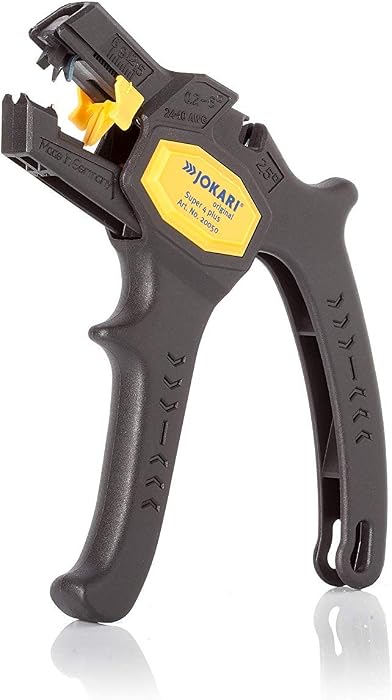
Jokari 20050 Super 4 Plus Best for Fine Wire

Jokari 20050 Ergonomic Super 4 Plus Automatic Wire Stripper for Wires from

Fine wire

Field Score 92/100
Length
6.5 in
Weight
3.17 oz
Wire Range
0.2-6 mm²
Cutter Capacity
Up to AWG 14 (2.5 mm²)
View on Amazon

Fine wire is where the Jokari earns its slot. The jaws close down to 0.2 mm², finer than most of the strippers here will touch, and the plier-style handle locks shut, so it rides in a shirt pocket without snagging on anything else in there.

It works like the rest of them: squeeze, the jaws grip and score, and pulling the tool away takes the insulation with it. The length stop adjusts for repeat work, and Jokari sells spare blades, which matters on a light tool — the cutting edges are what wear, and a stripper you can re-blade is one you keep.

Against the Knipex, which covers the same 0.2 to 6 mm² spread, the Jokari is lighter at 90 grams and carries a small cutter in the head. The Knipex is the better shape for reaching deep into a box. Where the Jokari wins is the wire you can barely see: thermostat leads, LED pigtails, and bench work where the whole run is 22 to 24 AWG.

Worth Noting

  • Cutter tops out at 2.5 mm²
Our Verdict

If your work is fine wire — control leads, LED runs, bench repairs — this is the one that closes down far enough and disappears into a pocket.

Check Latest Price
6

VCELINK Quick Strip Best Budget

VCELINK Wire Stripper and Cutter

Occasional light jobs

Field Score 91/100
Length
6.89 in
Weight
7.41 oz
Wire Range
14-24 AWG
View on Amazon

This is the least expensive tool we recommend, and the smallest: a 6.89-inch body with an eagle nose that tapers to reach into a backbox or the shell of a connector. It strips and cuts 14 to 24 AWG solid or stranded, which covers lamp cord, speaker wire, and most low-voltage work around a house.

The action is spring-loaded rather than the plier-style squeeze of the bigger picks — press the handles, the jaws grip and pull, and a pressure knob adjusts how hard the blades bite. That knob is the feature worth having at this size: soft silicone insulation and stiff PVC want different amounts of bite, and without an adjustment you're guessing at both.

It's a two-function tool. There's no crimper, so terminals stay a separate job, and the frame is polypropylene rather than cast metal. For the occasional strip, that's the right amount of tool, and the light body is part of why it's pleasant to use on a small job.

We treat it as the household drawer tool rather than a bag tool, and that's the honest summary: it's the one you buy for the job in front of you, not for the rewiring you might start next spring.

Worth Noting

  • Plastic frame is the weak point for daily use
Our Verdict

For a few strips a year — a lamp, a trailer plug, speaker wire — this does the job for the least money and takes up almost no room.

Check Latest Price
7

WEICON Wire Stripper No. 5 Best for One-Handed Bench Work

WEICON TOOLS Wire Stripper No. 5

One-handed bench work

Field Score 90/100
Length
8.66 in
Wire Range
0.2-6 mm²
Side Cutter
Cable up to 2 mm
Strip Length Stop
5-12 mm
View on Amazon

The WEICON No. 5 is the certified one: TÜV and GS marked, made in Germany, with blades cut from Solingen knife steel and a body of glass-fiber-reinforced polyamide. It strips 0.2 to 6 mm² automatically and carries a side cutter in the head for cable up to 2 mm in diameter.

Two details stand out. The length stop runs from 5 to 12 mm, which covers terminal work without moving the tool, and at 4.8 ounces the stripper is light enough that one-handed work from a ladder doesn't wear out your forearm. The side cutter earns its place too — trimming small cable without a reach for the diagonal cutters keeps a run moving.

Where it lands: the same 0.2 to 6 mm² coverage as the Knipex, a friendlier price, and a longer body, which is the difference that matters. On a bench or in front of a panel with room to work, the WEICON is the sensible buy. Inside a packed device box, the shorter Knipex is worth the extra.

Worth Noting

  • Long body is awkward in a crowded box
Our Verdict

A certified one-hand stripper covering 0.2 to 6 mm², comfortable on a long run, and happiest where you have room to swing it.

Check Latest Price
8

haisstronica HS-8327 Set Best for Heat-Shrink Auto Work

haisstronica Wire Stripper and Crimper Set

Heat-shrink auto work

Field Score 89/100
Weight
2.23 lb
Crimper Range
26-10 AWG
Stripper Range
24-10 AWG
View on Amazon

This is a pair, not a single tool: an automatic stripper rated 24 to 10 AWG and a ratcheting crimper rated 26 to 10 AWG for heat-shrink connectors. Each tool has its own gauge controls and pressure adjustment, and the crimper has a quick release for a crimp that starts to go wrong.

The stripper is a familiar self-adjusting design with a dial for the bite, and it handles the wire sizes a vehicle actually uses. The crimper is the reason to buy the kit: ratcheting action, dies across the heat-shrink range, and a body that feels more substantial than the money suggests.

What to watch: the ratchet can stick mid-crimp and needs the release worked, and crimp quality tracks the terminal as much as the tool, so wires pull out of some brands of connector and hold hard in others. Run a handful of scrap terminals through it before you commit a harness. When the terminal matches the die, the result looks like a shop crimp.

Worth Noting

  • Ratchet can stick mid-crimp
  • Crimp results vary by terminal brand
Our Verdict

For heat-shrink connector work on a vehicle, this kit covers the strip and the crimp in one box and saves assembling two separate purchases.

Check Latest Price

How We Put 14 Wire Strippers Through Four Months of Real Wiring

We started with roughly 40 strippers and cut the field to 14 by reading spec sheets and owner reviews, then checking the basics: whether the tool self-adjusts or makes you dial in a gauge, what range of solid and stranded wire it genuinely covers, how far the jaw reaches into a crowded box, and whether it also cuts and crimps. Anything that couldn't handle 12-gauge house wire and 22-gauge control wire in the same session was out.

Testing ran four months, mostly at a garage bench with a kitchen remodel going on in the background. Every pair stripped the same set of wires: 12/2 and 14/3 Romex, 18-gauge lamp cord, 22-gauge thermostat wire, stranded automotive wire, and a little silicone-insulated hookup wire.

We counted how many squeezes it took to get a clean strip and checked each conductor under a work light for nicked strands. Twenty strips in a row per tool told us about hand fatigue and speed; switching between gauges told us whether the adjustment held or drifted. We also weighed what came in the box — cutter, crimper, replaceable blades — against what the tool cost.

Durability got the least gentle treatment: each tool was dropped from bench height onto concrete, carried loose in a tool bag for the length of the test, and run past 200 strips to see when the blades dulled. Where a pair claimed a crimping function, we squeezed terminals and pulled the finished crimps with pliers to see whether they held.

How to Choose an Automatic Wire Stripper

Start With the Wire You Actually Strip

Ranges are quoted in AWG or in square millimeters, and both ends of the range matter. A self-adjusting wire stripper that stops at 20 AWG solid will not touch the 22 and 24 AWG wire behind a thermostat or a doorbell, and one that stops at 10 AWG has nothing for a heavy feed. The 0.2 to 6 mm² range on the Knipex, Jokari, and WEICON tools works out to roughly 24 to 10 AWG, which is broader than most of the AWG-labeled tools in this group.

Write down the three sizes you strip most before you shop, then check that solid and stranded are both covered. Many tools quote a different range for each, and stranded is the one that catches people out.

The Grip Is the Mechanism

Automatic heads all work the same way: jaws close on the insulation, blades score it to a set depth, and the jaws pull the sleeve off. If the grip slips, everything downstream fails, which is why the pressure and tension adjustments on these tools matter more than the number of functions on the package.

Test a new stripper on the smallest and largest wire you keep around during the first week. If the insulation stretches into a rubber band instead of releasing, the bite is too light for that wire, and technique will not rescue it.

Strip Length and Repeat Work

A stopper or stop screw sets how much insulation comes off, and on a run of connections the stopper is what makes every strip identical — the difference between wire that lands in a terminal block neatly and wire you re-cut twice.

Check that the stop holds its setting. Screw-type stops can creep as the tool gets handled, so glance at the setting between cables rather than assuming it held. A stripper with no stop at all is fine for one-offs and irritating by the twentieth wire.

Cutters, Crimpers, and What You Carry

Built-in cutters are not the same claim from tool to tool. The Klein models take up to 8 AWG solid, the Jokari's head is rated to 2.5 mm², and the WEICON's side cutter handles cable up to 2 mm. None of them replaces linesman pliers for cutting cable, and all of them save a reach across the bench.

Crimping nests are worth having if you terminate as you strip — the IRWIN covers 10 to 22 AWG insulated and non-insulated terminals plus 7 to 9 mm ignition terminals. For heat-shrink connectors, a dedicated ratcheting crimper does a more consistent job than a nest in a stripper's jaw.

Size, Reach, and Hand Fatigue

The difference between a 7-inch tool at 151 grams and an 8-inch tool at 12.6 ounces shows up in two places: a crowded device box, where the short head can open and the long one cannot, and the fiftieth wire of the day, where a self-opening spring does work your hand would otherwise do.

If most of your stripping happens inside boxes and panels, put reach and weight first. If it happens at a bench, take the heavier tool with better leverage — you will not notice the ounces, and the extra length makes one-handed work easier.

Frequently Asked Questions

Final Verdict

Buy the Klein 11063W. It covers the widest stretch of real work here — 8 to 20 AWG solid, 10 to 22 AWG stranded, one squeeze, a cutter in the nose — and the self-opening spring is what makes a long run of connections tolerable rather than tedious.

Two exceptions worth naming. If your day happens inside crowded boxes or on 0.2 to 6 mm² wire, the Knipex 12 62 180 is shorter, lighter, and reaches where the Klein cannot. If the tool comes out a few times a year, the VCELINK strips 14 to 24 AWG well enough for lamps, trailer plugs, and speaker wire at the lowest cost of anything here.