The 6 Best Backpacking Backpacks of 2026

A backpacking pack has one job: make 30 pounds of gear feel like 20 by the time you stumble into camp. The wrong one introduces itself at mile six, when the hip belt has gone soft, the shoulder straps are boring in, and the water bottle you need is wedged somewhere under your rain shell. I've had a pack quietly soak through on a three-day trip and spent the night in a damp sleeping bag, which is a lesson you only need once.

Two things surprise first-time buyers. The hip belt carries the load, not your shoulders, so a pack that fits your torso matters more than the liter count on the tag. And a rain cover isn't a nice extra — it's the difference between a warm night and a cold one. We've spent the last six months hiking with 12 packs, from 40-liter day-and-a-half models to 85-liter haulers, loading each one with the same overnight kit and seeing which ones still felt good on the descent.

Some of these are built for weekend trips and some for a week out, so the right pick depends on how you pack and how far you walk. The ones below earned their place on the trail, not the spec sheet.

Our Top Picks

The 6 Best Backpacking Backpacks of 2026

1

Teton Scout 65L Best Overall

Teton 65L Scout Internal Frame Backpack for Hiking

Three-season weekends

Field Score 95/100
Weight
4.5 lb
Capacity
65 liters
Torso Fit
Multi-position adjustable
Rain Cover
Included
View on Amazon

Sixty-five liters is the volume most three-season backpackers land on, and the Scout is the pack that covers a whole season without a compromise you notice later. The harness is why it wins here. The shoulder straps move up and down the frame, so the hip belt lands on the hip bones instead of somewhere around the waist, and it is the rare pack in this group that shortens down for a smaller torso without a separate women's model. Add 600D ripstop, a rain cover in the box, and a lifetime warranty, and there is not much left to buy.

Organization earns its keep on a real trip: eight compartments, a lid pocket that swallows a headlamp and a day of snacks, bottle pockets on both sides, and a sleeping bag compartment at the bottom so you are not unpacking the whole load at camp. That compartment is the one place we push back. It is snug, and a big synthetic bag fills more of it than the 65-liter number suggests. A compression sack solves it, or pack the bag in the main compartment and put clothes in the bottom.

Two details to know before you order. The bottle pockets are tight, and a wide-mouth one-liter bottle is a fight every time. And under a genuinely heavy load the buckles can creep, so re-check the tension after the first mile and again when you stop for lunch. Neither changes the recommendation at this capacity. With a normal three-day load the pack carries quietly and the load stays settled where you put it.

Worth Noting

  • Sleeping bag compartment snug for bulky bags
  • Bottle pockets tight for wide bottles
Our Verdict

The pack we recommend first: 65 liters, a harness that adjusts to a range of torsos, and a rain cover and lifetime warranty included. Buy it for three-season weekends and short multi-day trips.

Check Latest Price
2

Teton Explorer 85L Best for Big Loads

Teton 85L Explorer Internal Frame Backpack for Hiking

Hauling winter gear

Field Score 94/100
Weight
5.8 lb
Pockets
5 pockets, 6 compartments
Rainfly
Included
Capacity
85 liters
View on Amazon

Eighty-five liters is more pack than most backpackers need, and this is the one place in the lineup where the honest advice is to size down unless the trip demands it. Buy the Explorer for a winter bag and pad, a week of food for two, group gear, or a teenager who has not learned to pack light yet. Empty, it weighs 5.8 pounds, and that is the cost of a frame and padding that hold up when the bag is full. Fill it and the trade pays off: the padded lumbar panel and molded channels keep air moving and the weight sits down on the hips.

The volume comes organized. Five pockets and six compartments, a bottom compartment sized for a mummy bag, compression straps running in several directions, and a rainfly included rather than sold separately. We think the compression straps are the underrated part, because a half-full 85-liter bag will wallow and shift without them. Run them down every time you close the lid, not just when the pack is stuffed to the seams.

Two things to plan around. The built-in rainfly covers the pack, not the pack plus a tent or pad lashed to the outside, so anything strapped on needs its own dry bag. And if you are on the smaller side, this much volume will overwhelm your frame, which is a build problem rather than a pack problem. The 65-liter Scout is the same design in a size that will not.

Worth Noting

  • 5.8 pounds empty is a real cost
  • Rainfly will not fit over outside-strapped gear
Our Verdict

Our pick when the trip is defined by volume: winter gear, group food, long carries between resupply. It is heavy empty and overkill for summer weekends, but nothing else here hauls as much.

Check Latest Price
3

Mardingtop 75L Best for Gear-Heavy Trips

Mardingtop 75L Molle Hiking Internal Frame Backpacks

MOLLE gear hauls

Field Score 93/100
Weight
4.5 lb
Capacity
75 liters
Material
600D polyester, YKK zippers
Hydration
3-liter bladder sleeve
View on Amazon

The webbing down the front is the reason to buy this pack. If you already own MOLLE pouches, an admin pouch, a rangefinder case, a spotting scope bag, the Mardingtop turns them into part of the pack instead of something you clip on and hope holds. Hunters, bushcrafters, and anyone hauling awkward gear get more out of that than a hiker will. Underneath the webbing it is a straight 75-liter internal-frame bag in 600D polyester with YKK zippers, a 3-liter hydration sleeve, and a rain cover.

Access beats most packs this size. The main compartment opens at the top and the front, so you can dig to the bottom without emptying everything onto the ground, and the two large side pockets, the bigger pair measuring 7.5 by 13.8 inches, take a stove or a pair of boots where you can actually reach them. Between those pockets, the side compression straps, and the zippered compartments, small gear stays findable, which is the difference between a big pack and a black hole.

Where it gives ground is the suspension. Once the load gets heavy, stabilization is the weak link. The pack shifts more than the Teton bags do, and the straps dig in when the hip belt is not carrying its share. Set it up carefully, keep the dense items close to your spine, and it behaves; pack it sloppy and you will know by the second hour. Our verdict: buy it for the webbing and the access, and accept that the carry is good rather than great.

Worth Noting

  • Stabilization weakens once the load gets heavy
Our Verdict

We reach for the Mardingtop when hunting season or odd-sized gear is the reason for the trip. Hikers who never touch the MOLLE get a better carry from the Teton packs.

Check Latest Price
4

WoneNice 50L Best Budget Pick

WoneNice 50L(45+5) Waterproof Hiking Backpack Outdoor Daypack w/Rain Cover

First weekend trips

Field Score 92/100
Weight
2.5 lb
Harness
S-curve padded shoulder straps
Capacity
50 liters (45+5)
Rain Cover
Included
View on Amazon

If you are not sure backpacking is going to stick, this is the pack to start with. It is the least expensive one we recommend, and it covers the basics without much fuss: 50 liters across a main compartment, two zippered front pockets, a bottom compartment for a sleeping bag or muddy shoes, mesh side pockets, and a rain cover that comes with it. At 2.5 pounds it is among the lightest here, which sounds like a small thing until you are carrying it uphill.

What it is not is a load hauler. Suspension is minimal, so the weight rides on those S-curve shoulder straps and the hip belt rather than transferring down into your hips. For a weekend with a light-to-moderate load it does the job, and we packed it for an overnight without drama, but add a bear can, a full water carry, and four days of food and you will feel every mile of it. That is the honest boundary of a pack at this tier.

The other thing to know is that the straps are the first part to give out if you overload it. Treat the 50 liters as a ceiling rather than a target and it will last through a season of weekends; stuff it past what the harness wants and the anchors and seams take the punishment. The fabric and zippers are fine for the job. The structure is what you are giving up, and knowing that is most of the decision.

Worth Noting

  • Minimal suspension puts load on the shoulders
  • Straps and seams give out if overloaded
Our Verdict

For a first pack, this is where we start people: light, roomy, and inexpensive enough to try backpacking without committing. Keep the loads moderate and it serves you well.

Check Latest Price
5

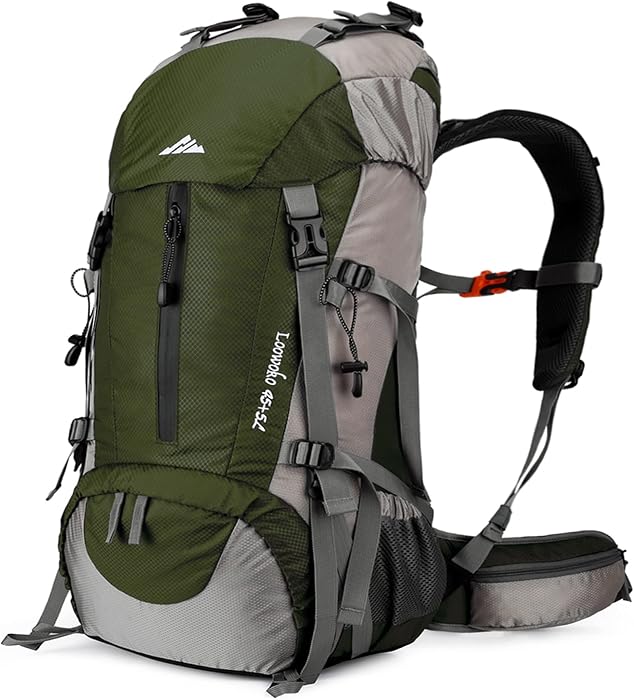
Loowoko 50L Best for Short, Light Trips

Loowoko 50L Hiking Backpack with Rain Cover for Both Men & Women

Short, light trips

Field Score 91/100
Weight
2.8 lb
Capacity
50 liters
Extension
External extension with compression straps
Rain Cover
Included
View on Amazon

At 2.8 pounds, this is a 50-liter pack that folds down small when it is empty and stays out of the way when it is not full. For travel that mixes trails with trains and hostels, that is a genuinely useful combination. The external extension collar and the compression straps let it shrink to daypack size for a summit push or open up for a full weekend load, and the rain cover lives in its own pocket at the bottom.

The trade for that weight is durability, and it is the part to take seriously. The fabric is light, the strap anchors are where the abuse lands, and the shoulder straps and seams are what give out when the pack is pushed. The failures show up early and under load rather than after years of hard use. We treat it as a light-load pack for exactly that reason. Keep it under a moderate weekend weight, do not haul it around by one strap, and it does what it is built to do.

Organization is better than the price suggests: zippered outside pouches you can get into without unbuckling anything, side pockets, and enough attachment points for a mat or a tent. The front pockets are shallow, though, and once the main compartment is full they are awkward to reach into. If you want a pack that shrugs off rock and brush for a decade, spend more. If you want a light, inexpensive 50-liter for short trips and travel, this is a sensible way to spend less.

Worth Noting

  • Strap anchors and seams fail under heavy loads
  • Shallow front pockets
Our Verdict

We like this one for short trips and travel: light, inexpensive, and easy to compress. It is the wrong choice for a heavy multi-day haul.

Check Latest Price
6

MOUNTAINTOP 40L Best for Overnight and Travel

MOUNTAINTOP 40L Hiking Backpack

Overnight and travel

Field Score 90/100
Fabric
Water-repellent 400D polyester
Weight
2.47 lb
Zippers
YKK
Capacity
40 liters
View on Amazon

This is not a multi-day backpacking pack, and it is worth saying plainly before we go further. Forty liters holds a sleeping bag, a pad, a stove, and a day of food if you pack tight. It does not hold a tent, a bear can, and four days of meals. What it does well is the fast overnight: a hut night, a summit push from base camp, a quick bothy trip, or a week of travel where the pack doubles as your daypack. At 1.12 kg it is the lightest thing on this list, and you notice that on a climb.

The build is better than the price tier suggests. Water-repellent 400D polyester, smooth YKK zippers, a hydration sleeve in the main compartment, and a padded mesh back panel that keeps air moving. The hip belt pockets take a phone and a handful of snacks, the bungee on the front holds a shell, and the whole thing feels tighter than most packs at this end of the range. There is also a padded sleeve for a 16-inch laptop, which tells you who it is really aimed at.

That sleeve is dead space on a trail, and the pack's ceiling shows up the moment you try to add a tent. As a second pack for overnighters, hut trips, and travel it earns its place. As the only pack for a backpacking season it does not. Judge it against what you actually do: if your trips are one night with light gear, 40 liters is plenty and the weight saving is real.

Worth Noting

  • Too small for a full multi-day kit
  • Laptop sleeve wastes space on trail
Our Verdict

We keep the MOUNTAINTOP 40L for overnighters, hut trips, and travel. It is a strong second pack and the wrong only-pack for multi-day backpacking.

Check Latest Price

How We Tested Backpacking Backpacks

Before a single pack arrived, I read through specs and customer reviews for more than 40 backpacking packs and narrowed them by frame type, capacity, and what actually comes in the box. Capacity was the easy filter — 40 to 85 liters covers everything from a fast overnight to a week out — so the harder question was whether the money went into the parts that touch you: the hip belt, the shoulder straps, the zippers, and whether a rain cover was included or sold separately. That left us with 12 packs, which we used over six months.

Each pack got loaded with the same overnight kit — tent, 20-degree bag, stove, cook pot, layers, and two days of food — and then I walked the same six-mile loop with hills. I paid attention to where the hip belt landed, whether I could get the load onto my hips instead of my shoulders, and whether the weight shifted forward on a climb. Testers ranged from 5-foot-2 to 6-foot-3, which showed us whose torso adjustment had real range and whose straps bottomed out early.

Around camp is where pockets and durability surfaced. I packed and unpacked the same kit at dusk, noted which pockets I actually reached for, and tried to pull a water bottle from a side pocket without taking the pack off. Rain covers went on in wind and stayed on through a five-minute hose soak, after which I checked the sleeping bag compartment for dampness. Packs were dragged over granite, shoved into truck beds, and loaded past their comfort zone to see how the fabric, seams, and compression straps held up over repeated trips.

At the end I compared what each pack gave you for the money — included rain cover, usable compression, pockets you can reach — rather than just the features listed on the tag.

How to Choose a Backpacking Backpack

Start With Volume, Then Add a Little

Fifty liters covers a light weekend. Sixty-five is the three-season sweet spot for two to four nights. Seventy-five to 85 liters is for winter bags, group food, and long carries between resupply. Buying the biggest pack you can afford is the classic mistake: an 85-liter bag that is two-thirds full carries worse than a packed 65, and you will fill the space with things you do not need.

The trap is the sleep system. Liters are measured to the seams, and a bulky synthetic bag swallows a sleeping bag compartment that looked generous on paper. If your bag does not compress small, plan on carrying it in the main compartment or step up a size rather than fighting the zipper at camp.

Fit Comes Before Features

The hip belt should sit on your hip bones and carry most of the weight. The shoulder straps should be balancing the load, not lifting it. That only happens when the torso length is right, which is why an adjustable harness is worth paying for: the Teton Scout moves its shoulder straps up and down the frame, so one pack fits a household of different bodies. Measure from the bony bump at the base of your neck to the top of your hip bones, and load the pack before you commit if you can.

Suspension Is What You Are Actually Buying

An internal frame and a padded hip belt move weight onto your legs, which is the only reason a heavy pack does not wreck your shoulders. Budget packs that skip that structure save a couple of pounds empty, and they are fine on a light weekend; add water, food, and a tent and you feel every missing piece. Settle your realistic loaded weight before you shop, then buy the pack built for it. Empty weight is a tiebreaker, not a headline.

Check the Straps, Then the Weather Gear

Packs fail at the harness, not in the middle of the fabric. Look at how the shoulder straps and hip belt are anchored, since bar-tacked webbing and reinforced stitching are what you want, and pull the buckles to make sure they hold tension. A rain cover is worth having included, but remember it is sized to the pack, not the pack plus a tent lashed outside. If you strap gear on top, bag it first.

Frequently Asked Questions

Final Verdict

The Teton Scout 65L is the pack we recommend first. Sixty-five liters covers a three-season weekend, the harness adjusts to a range of torsos, and the rain cover and lifetime warranty come in the box. If your trips run to winter bags and group food, the Explorer 85L is the same design with the volume those loads need. Hunters and anyone with a drawer of MOLLE pouches should look at the Mardingtop 75L, and for a first pack on a tight budget, the WoneNice 50L is where we start people.