The 4 Best Brush Cutters of 2026

Nobody buys a brush cutter for a lawn that's already under control. You buy one the summer blackberry canes swallow the fence line and the string trimmer starts smoking. A brush cutter is the tool that takes that ground back, and the gap between a good one and a frustrating one shows up in the first ten minutes.

We've spent seven months with nine of them, gas and battery, straight-shaft and walk-behind, and the deciding factors were rarely raw power. What mattered was whether the engine caught on the third pull after sitting a week, whether the harness put the weight on my hips instead of my shoulders, whether swapping string for a metal blade took two minutes or twenty, and whether the price matched what the thing could clear in an afternoon.

Buyers tend to overvalue attachment counts and undervalue the harness; a heavy head on a long shaft wears out your arms long before the engine quits. The picks below are the ones that cleared real brush without turning the afternoon into a wrestling match.

Our Top Picks

The 4 Best Brush Cutters of 2026

1

PROYAMA 51.7cc Brush Cutter Best Overall

PROYAMA 51.7cc Gas Powered Weed Eater Trimmer

Brush and saplings

Field Score 82/100
Blades
3T and 40T included
Engine
51.7cc 2-cycle
Weight
19 lb
Cutting Width
18 inches
View on Amazon

A 51.7cc two-cycle engine and an 18-inch cut are the numbers that separate this from a heavy-duty string trimmer, but the blades are what actually make it a brush cutter. PROYAMA includes a 40-tooth blade for woody stems and a three-tooth blade for softer growth alongside the string head, and each one turns the machine into a different tool.

Of everything here, this is the one we reach for when the growth has trunks. The engine holds its speed in a sapling instead of bogging down the way a smaller powerhead does, and the straight shaft gives you reach into a fence line or a ditch bank without stepping into it. It is a two-handed tool on a shoulder strap, and the anti-vibration mounts in the shaft are what let you finish a session rather than stopping to shake your hands out.

Two-cycle ownership is a rhythm rather than a switch: fresh mix, choke on, then a full pull through the stroke instead of a snatch at the cord. The engine is particular about that order, and a short, hard pull on a cold 51cc powerhead is what makes a good machine feel like a bad one.

Heads bolt on rather than click on, so a session goes better when you pick one and stay with it: the string head for the lawn edge, the three-tooth for green bramble, the 40-tooth for stems that have gone properly woody. Fit the 40-tooth, keep a spare blade sharpened, and the trimmer line becomes the accessory you rarely reach for.

Worth Noting

  • Heavy at 19 pounds for extended use
  • String head is the least durable part
Our Verdict

Our top pick because it is a real blade brush cutter: 51.7cc, an 18-inch cut, and metal teeth that handle saplings a string head will only bounce off.

Check Latest Price
2

BILT HARD Walk-Behind Trimmer Best Walk-Behind

BILT HARD Walk Behind String Trimmer

Large open lots

Field Score 81/100
Engine
170cc 4-cycle OHV
Weight
54.1 lb
Wheels
14 inches, flat-free
Cutting Width
22 inches
View on Amazon

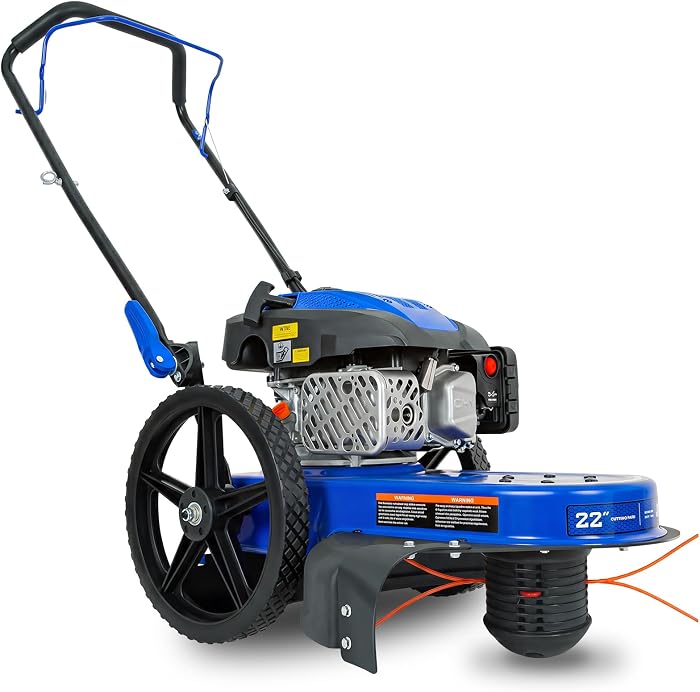
Everything the handheld picks here ask you to carry, this one asks you to push, and on flat ground with chest-high growth we think that is the better end of the trade. The 170cc four-cycle engine sits on a one-piece steel deck between two 14-inch flat-free wheels, and you walk behind it at whatever pace the weeds allow.

Four-cycle means straight pump gas — no measuring two-cycle oil into a can before every session, which is the chore that leaves a gas trimmer sitting in the shed. The 22-inch cutting swath covers ground quickly, and the nylon line takes grass, brambles, and weeds that have gone to seed. What it will not take is a metal blade, so saplings and anything with a woody trunk are out of its range.

Fifty-four pounds rides on the wheels until you have to drag it backwards out of a wet ditch, and that is when you feel all of it. The flat-free wheels are the right call for a rough lot — no flats to fix mid-job — and the handle folds down for storage against a wall.

Starting is a pull, and a hot restart after a fuel stop can take a couple of tries, which is ordinary for a big single-cylinder engine. Where this beats every handheld here is the day after: clearing a stretch of fence line on a strap is a workout, and doing the same stretch behind a walk-behind is a walk.

Worth Noting

  • Belt drive is the weak mechanical link
  • No metal blade, so saplings are out of range
Our Verdict

For flat ground and chest-high growth, this is the one: you push it instead of carrying it, it runs on straight pump gas, and it clears a lot in a morning.

Check Latest Price
3

VEVOR 33CC 6-in-1 Trimmer Best for Mixed Yard Jobs

VEVOR 33CC 6-in-1 Gas Trimmer

Mixed yard jobs

Field Score 80/100
Engine
33cc 2-stroke
Weight
33.1 lb
Attachments
Six heads including brush cutter and pole saw
Blade Speed
6,500 rpm
View on Amazon

Six tools hanging off one 33cc engine is the pitch, and for a property with hedges, low limbs, and a bramble patch all within sight of each other, it is an appealing one: one can of mix, one machine in the shed instead of a weed eater, a hedge trimmer, and a saw, and a head for whichever job is in front of you.

The kit is genuinely complete. Alongside the powerhead you get a pole saw with an extension, 16-inch hedge trimmer blades on a head that rotates 270 degrees, a grass trimmer head, and both a three-tooth and a 40-tooth metal blade, plus gloves, ear protectors, and a bag to keep the whole lot together. The two-stroke turns the blade at up to 6,500 rpm at the cutting head.

Where it gives up ground is specialization. Thirty-three pounds is heavy for a handheld before you add an extension pole and hang a hedge head off the far end, and a machine split across six jobs does not cut brush with the composure of the 51.7cc PROYAMA — it does the work, but you can feel the engine earning it. On a small property with mixed jobs that trade is worth making; on a job that is all brush, it is not.

We were skeptical of the storage bag and it turns out to be one of the better bits of the kit. Six heads, a bar and chain, and two blades have a way of migrating across a shed floor.

Worth Noting

  • 33 pounds before a pole and head go on
  • Brush cutting is one job of six, not a specialty
Our Verdict

One engine that trims, edges, shears hedges, and takes a metal blade to brush — the sensible buy when brush clearing is one job among several, not the whole weekend.

Check Latest Price
4

VOL2GO Cordless Brush Cutter Best for Small Yards

VOL2GO Cordless Brush Cutter – Cordless Weed Wacker Eater Brush Cutter Weed Trimmer with Blade Stringless

Small yards

Field Score 79/100
Weight
3.5 lb
Battery
Two 2.0Ah 21V batteries
Cutting Head
Metal blade, stringless
Cutting Width
6 inches
View on Amazon

The least expensive tool here, and the only one that is not really a brush cutter in the sense the others are. Six inches of cutting width and a 21-volt motor put it in the same class as a good cordless string trimmer, which is fine as long as what you are cutting is grass, weeds, and the odd bramble rather than a thicket with trunks in it.

Judged on that job, we are fond of it. At 3.5 pounds it is light enough to swing one-handed along a fence line, and the metal blade gets through the stringy stuff that wraps a line head — no bumping, no reloading, no fighting a spool. Two 2.0Ah batteries and a charger come in the box, so one pack charges while the other works.

Runtime is the constraint. A pack is good for a short session rather than an afternoon, and the charge is slow enough that the second battery is not a luxury, it is the reason the tool works at all. It is also the only machine here you can pick up without mixing fuel or pulling a cord, which counts for a lot on a Saturday morning.

The switch to edging is the sleeper feature: turn the head and it is tidying a sidewalk edge, which is the job it is genuinely good at.

Worth Noting

  • Short runtime on each 2.0Ah pack
  • 6-inch width limits it to light growth
Our Verdict

The one to buy for a small yard that never needed a brush cutter: light, stringless, and easy to hold, with battery life that caps it at trimming rather than clearing.

Check Latest Price

How We Tested the Best Brush Cutters

We started with owner reviews and spec sheets, then narrowed the field by engine displacement, cutting width, weight, how many attachments each unit could run, and price until the list was small enough to actually use. Nine machines made the cut: straight-shaft gas models, one walk-behind, and a battery-powered option aimed at smaller yards.

Everything was tested where these tools actually live, on a fence row that hadn't been cleared in three years, a steep ditch bank, and a stand of saplings an inch or two thick. We assembled each one out of the box and timed it, since some arrived nearly ready and others took an evening. Each gas unit then sat for a week between sessions so we could log how many pulls a cold start really took, and whether the choke and primer were reachable with work gloves on.

In the cut, we moved from tall grass to brambles to saplings and watched for bogging, vibration through the handles, and how much debris came back at our shins. We carried every unit up the slope with the harness adjusted to see whether the weight landed on the hips, swapped heads mid-session to check that blades and string spools still lined up, steered the walk-behind between trees and over rutted ground, and ran the cordless model down and back up again, counting the minutes each charge actually delivered.

Durability got checked the unglamorous way: torquing bolts after each session, watching for cracks around the shaft joint, and seeing whether a blade held its edge after hitting rocky soil. Value came down to how much ground each machine could clear on a tank or a charge relative to what it cost.

How to Choose a Brush Cutter

Blade or Line Decides Almost Everything

A metal blade is what separates a brush cutter from a heavy weed eater, and it sets the rest of the purchase: blades want a straight shaft, a clutch rated for the load, and a harness. Line is faster and safer in grass and soft weeds; a blade is what takes bramble, saplings, and stems that have gone woody. Set a line head against a thicket and it wraps and stalls; set a blade against gravel and it dulls and throws. Decide which one describes your ground before you compare engines.

How Much Ground, and How Flat

The format follows from the ground, not the budget. A handheld brush cutter on a shoulder strap is what reaches a fence line, a ditch bank, or a slope where wheels cannot go; a walk-behind takes every ounce of the weight off you and earns its keep on flat acreage with chest-high growth. We think most people overestimate the acreage they will clear and underestimate how long they will carry a 19-pound tool, so be honest about both. Cordless belongs at the small end: edging, touch-up, and a yard you can finish on one pack.

Weight, Balance, and the Strap

Displacement gets compared and weight decides whether you finish. A big engine at the top of a long straight shaft makes a machine feel nose-heavy, and moving the harness point an inch changes that more than another few cc would. Treat the harness as part of the tool rather than an accessory: a wide two-shoulder harness with a quick release carries far better than a single thin strap, and on a 19- to 33-pound machine it is the difference between a two-hour session and a short one. If the supplied strap looks thin, sort a replacement before the first big job.

Two-Cycle or Four-Cycle, and Starting

Two-cycle engines are lighter for the power they make and need oil measured into the gas; four-cycle engines run on straight pump gas, which is why they turn up on walk-behinds. Neither is inherently more reliable — the real difference is whether you want to mix fuel before every session. Use ethanol-free gas where you can, and run the carburetor dry before the machine goes into storage, because a cutter that will not start in spring usually sat all winter with old fuel in it. Check the return path before you order, too: gas-powered equipment commonly cannot go back through standard returns.

If You Go Cordless, Budget for Batteries

Runtime is the whole story on a battery machine. A 21-volt cutter with a 2.0Ah pack is a session tool, not an afternoon tool, and charge times in this class run to hours rather than minutes. Two packs are the practical minimum, and the packs are the cost that makes a cheap cordless trimmer less cheap in a few years. For a small yard and a fence line that is still the right trade; for anything with volume to it, it is not.

Frequently Asked Questions

Final Verdict

If the growth on your property has trunks in it, buy the PROYAMA 51.7cc. It brings the most displacement to a metal blade of anything here, and that combination is what turns a weekend of clearing into an afternoon.

If your ground is flat and the problem is volume — chest-high weeds across an acre rather than saplings along a fence — the BILT HARD walk-behind is the better tool, because it puts the work on wheels instead of your shoulders.