The 4 Best Walk-Behind String Trimmers of 2026

A walk-behind string trimmer is what you buy after the mower gives up on the fence line and the handheld trimmer eats a spool of line in one afternoon. It's a mower deck with a spinning string head where the blade should be, and the difference between a machine that chews through blackberry canes and one that bogs in tall fescue never shows up in a listing photo.

Engine first. These run 170cc four-cycle motors, so there's no mixing gas and oil, but a cold start still rewards a firm, fast pull and the right choke. A 22-inch swath clears a ditch fast, though a wider deck is heavier to pivot at the end of a row — exactly where the drive system starts to matter. My team and I spent eight months with seven of these to see which tradeoffs were worth living with.

Assembly sorted them too — some go from box to first pull in twenty minutes with one wrench, others want a second person and a file. The picks below held up on cutting, build quality, and the unglamorous stuff like belts.

Our Top Picks

The 4 Best Walk-Behind String Trimmers of 2026

1

BILT HARD Self-Propelled String Trimmer Best Overall

BILT HARD Self-Propelled Walk-Behind String Trimmer

Slopes and long runs

Field Score 84/100
Drive
Self-propelled, 1.9 mph
Engine
170cc 4-cycle
Cutting Width
22 inches
Cutting Heights
8 positions, up to 3.7 in.
View on Amazon

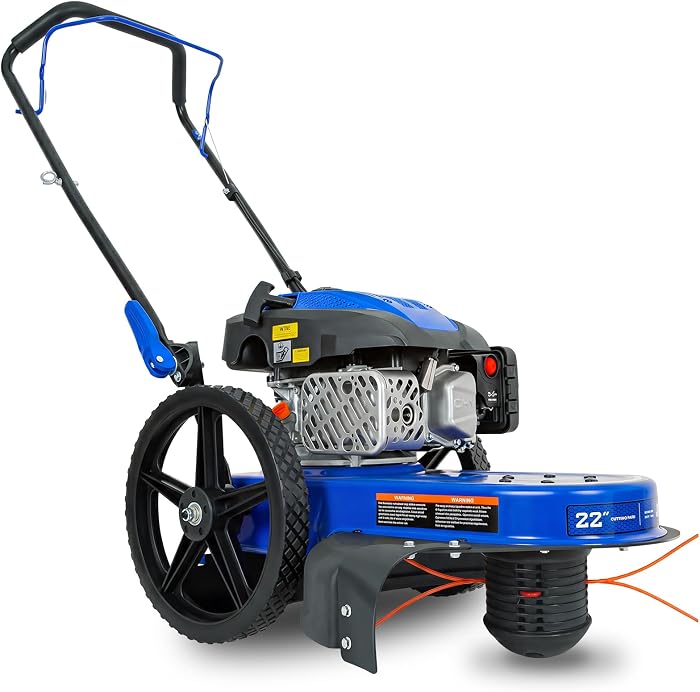
What earns this one the top spot is the drive. The self-propelled system moves at a steady 1.9 mph while you steer from the handlebar, and that is the difference between finishing a long ditch bank and quitting halfway down it. The other three machines here are push units between 54 and 62 pounds, and anyone who has dragged one of those through wet June grass understands why we put the drive ahead of displacement. On a flat strip behind a barn it is money you do not need to spend. On a slope, a roadside, or an acre of field edge, it is the reason to buy this one.

Behind the drive sits a 170cc four-cycle engine, a one-piece steel deck, and a 22-inch swath that matches everything else in the group. Where it pulls clear ahead is height adjustment: eight positions topping out at 3.7 inches, the finest spread here. That matters when a patch goes from mown in May to knee-high by July, because you can raise the head and skim the top without bogging the engine or cutting down to bare dirt. The side discharge throws clippings clear of your legs rather than back across them.

Smaller wheels are the compromise, and we noticed it. The 10-inch flat-free wheels roll fine on lawn and gravel, but they are smaller than the 14-inch wheels on the other three, so roots and rutted ground thump the deck harder than a YARDMAX or the push BILT HARD would. The drive carries a good share of the machine's weight, which softens that, and the handle folds down so the whole unit parks against a garage wall instead of owning a bay.

Line up service before you order rather than after. Gas equipment does not come back through the usual retail returns, so register the machine on arrival and find out where it goes if a belt lets go.

Worth Noting

  • Hot restarts can take several extra pulls
  • Drive belt can fray under sustained heavy cutting
Our Verdict

For long runs, slopes, and wet heavy growth, this is the machine we hand you: the drive does the pushing and eight height settings let you take tall stuff down in stages.

Check Latest Price
2

YARDMAX YL2250 String Trimmer Best for Fence Lines

YARDMAX YL2250 22 in. 170cc Gas Walk Behind String Trimmer Mower

Fence lines and edges

Field Score 83/100
Engine
170cc
Trimmer Head
Offset for fence lines
Cutting Width
22 inches
Cutting Heights
1.5 to 3.5 in., 5 positions
View on Amazon

Every walk-behind trimmer claims it gets under fences. The YL2250 actually solves the geometry. The cutting head sits offset from the wheels, so you walk a straight line along the wire while the line trims the strip a deck could never reach, with no stepping in and out and no second angled pass. On a place with a lot of fence, barn siding, or mulched beds, that single design choice is worth more than any number on the box.

Height adjustment is the other half of it, and we rate this one highly for it: five positions from 1.5 to 3.5 inches, changed without tools, in a band that handles a first spring cut as well as a summer of neglect. The 14-inch ball bearing wheels ride rough ground better than the 10-inchers on our top pick, and the onboard cord caddy means a spare coil rides on the machine instead of in a pocket. Sixty-one pounds is a lot to push through an afternoon, and that is the honest price of the bigger wheels and steel deck.

Where it lands for us is a property with plenty of edge and not much open slope. The 22-inch cut and 170cc engine put it on even footing for raw clearing, and a two-year limited warranty backs it. If your runs are long and open rather than along fences, the self-propelled BILT HARD earns the premium; if they are all edge work, this one is easier to live with week to week.

Worth Noting

  • Heavy at 61.7 pounds for a push machine
Our Verdict

Buy this one if your trimming is mostly edges: the offset head cleans a fence line in one straight pass and the tool-free height lever covers a season of growth.

Check Latest Price
3

BILT HARD Push String Trimmer Best Budget

BILT HARD Walk Behind String Trimmer

Flat, overgrown yards

Field Score 82/100
Engine
170cc 4-cycle
Weight
54.1 lb
Wheels
14-inch flat-free
Cutting Width
22 inches
View on Amazon

This is the least expensive machine here and the lightest at 54.1 pounds, a combination that makes it the sensible first walk-behind for someone who has been losing a back corner to weeds and does not want to spend self-propelled money to fix it. The engine and deck are the same 170cc and 22-inch steel as our top pick, so nothing about the cutting end is the cheap version. What changes is the drive, and the drive is what you are deciding about.

Cutting is where this one surprised us. Thick grass and five-foot weeds go down without the engine bogging, assembly takes minutes, and loading line into the head is simple enough that you will actually do it instead of putting the job off. The 14-inch flat-free wheels are genuinely better over roots and frozen ruts than the 10-inch wheels on the self-propelled model, which is not the direction most people expect the comparison to run.

What we minded is the leverage. The handle sits low and does not give you much to lean into, which shows up first on uneven ground where you are wrestling rather than walking. Plan a flat yard, or a slope you can take across the face at an angle, and it stays pleasant. Push it up a bank for an hour and you will feel the missing drive in your shoulders.

Worth Noting

  • Manual recoil start with no auto choke
  • Cutting-head belt can fray under heavy load
Our Verdict

The least expensive way into a wheeled trimmer that still cuts like the pricey ones, as long as your ground is flat enough to make pushing it reasonable.

Check Latest Price
4

PowerSmart DB6222 String Trimmer Best for Weeds and Grass

PowerSmart 22-inch 170cc Walk Behind String Trimmer

Weeds and grass

Field Score 81/100
Engine
170cc OHV with auto choke
Cutting Width
22 inches
Included Line
0.155 in., 10 packs
Cutting Heights
1.9 and 3.9 in., 2 positions
View on Amazon

Two cutting heights is the number to know here: 1.9 and 3.9 inches with nothing in between. That is coarser than the rest of this group, and it forces a choice between skimming low growth and riding over the tall stuff. For a buyer whose ground is either mown rough or genuinely overgrown, it is livable. For the in-between weeks of early summer, you will wish there were a setting in the middle.

The kit that arrives is more complete than most. Along with the 170cc OHV engine and 22-inch swath, the box carries ten packs of 0.155-inch line, a funnel, two wrenches, and a spark plug wrench, so the machine cuts the day it lands rather than after a second order. The auto choke and easy-start ignition are the parts we appreciate most, because a gas trimmer that balks on a cold morning gets left in the shed.

We stop short of a higher slot for two reasons that have nothing to do with cutting. The engine pulls through overgrown weeds and the folding handle stores neatly, but at the same money as the self-propelled BILT HARD, the missing drive is hard to argue past, and the two-position height adjustment will frustrate anyone cutting mixed growth. Buy it if you want a complete, easy-starting kit and your ground falls neatly into short or tall.

Worth Noting

  • Only two cutting heights, 1.9 and 3.9 inches
  • Premium price without a self-propelled drive
Our Verdict

A capable 22-inch gas trimmer with a genuinely helpful starter and a full kit of line in the box, though you get two cutting heights and no drive.

Check Latest Price

How We Tested the Walk-Behind String Trimmers

We started with every gas walk-behind trimmer we could find running a four-cycle engine in the 170cc class with a 22-inch cut, then dropped anything without a parts network, anything that took two people to load into a truck bed, and anything available in only one configuration. That left seven machines, and we ran them for eight months across a rough field edge, a ditch bank, and three overgrown yards.

Assembly happened in a driveway, alone, with a stopwatch running. I timed each one from box to first pull, noted whether the handle braces and cable routing lined up without drilling or filing, and flagged the points where I genuinely needed a second set of hands. Then I walked each machine before the first tank of gas: weld quality at the deck seams, handlebar thickness, whether the string guard flexed under a thumb, and whether the wheel hubs had any play.

Every cold start got counted in pulls — choke out, prime, pull until it caught — and then a hot restart after ten minutes of work. Cutting performance was judged on the same stretch of waist-high fescue and greenbrier at both the tallest and lowest height settings, watching for bogging, line breakage, and clippings that clogged under the deck instead of discharging.

Maneuverability got scored at the end of every row: how tight a turn each machine made without dragging a wheel, how it held a side slope, and how the flat-free wheels rolled through mud. Over the season I tracked belt tension, spindle play, and how much string each machine ate per hour, then priced replacement heads and line so I could compare what a second and third year of ownership actually costs.

How to Choose a Walk-Behind String Trimmer

Drive and Weight: Who Does the Pushing

A self-propelled unit walks itself while you steer from the handlebar; a push unit makes you the engine. That is the whole difference, and it matters more than displacement because the machines in this group run from 54 to just over 61 pounds. Flat ground and short runs: push, and keep the money. Slope, roadside, or a long field edge: the drive is what keeps you out there past the first tank.

One trap in the marketing. Self-propelled here means a single fixed ground speed, not a variable one, so you cannot slow it for a tight corner or a gate. Walk your turns before you commit and plan to swing wide.

Match the Cutting Head to the Job

Every machine here cuts a 22-inch swath with heavy 0.155-inch line, so width will not separate them. Where they differ is head position. A centered head behind the wheels leaves a strip under a fence or a low limb that you have to come back for; an offset head pushes the cutting line out past the wheels so you walk a straight line and the edge gets done.

Look at spool access and onboard storage too. Loading line on a cold morning is the chore that decides how often the machine gets used, and a cord caddy that carries a spare coil saves a walk back to the barn.

Cutting Height, Wheels, and the Ground Underneath

The useful range for this work is roughly 1.5 to 3.9 inches, and the number of positions matters more than the extremes. Two settings force you to choose between scalping and leaving a mat; five to eight let you take knee-high growth down in two passes instead of one stalled one.

Wheels decide how that feels. The 14-inch flat-free wheels in this group roll over roots and frozen ruts; a 10-inch wheel is easier to steer in tight space but thumps the deck on rough ground. Walk the ground you intend to cut and count the obstacles before you pick.

Gas Engines: Starting, Fuel, and Parts

These are four-cycle engines, so you fill a crankcase with oil and burn straight gasoline with no two-stroke mix. An auto choke or automatic compression release does the most for cold starts; a hot restart is a different problem and may take a few pulls and a short wait whatever the badge says. Use ethanol-free fuel if the machine sits between jobs.

Parts support is the quiet buying decision. Gas equipment generally does not come back through ordinary retail returns, so confirm before you order that belts, spools, and cutting heads are available for the model and that a servicing dealer is within reasonable distance. A trimmer mower that needs a belt in July is scrap until that belt arrives.

Frequently Asked Questions

Final Verdict

Of the four on this page, the BILT HARD self-propelled is the one we point most people toward. The drive answers the complaint that follows every push trimmer we have handled: the work lands in your arms, not in the engine. Eight cutting heights and a 22-inch steel deck take the growth; the 1.9 mph drive takes the distance.

The YARDMAX YL2250 is the better buy if your trimming is almost entirely edge work, since the offset head cleans a fence line in a single pass. And on flat ground with a tight budget, the BILT HARD push model cuts the same 22 inches for less money and 54 pounds of effort.