The 7 Best Corded Jigsaws of 2026

A jigsaw is the simplest power tool in the shop and the easiest one to ruin a cut with. The blade strokes up and down, the shoe rides the wood, and if the blade isn't seated squarely or the speed is wrong for the material, the cut wanders off your line — usually on the one curve you can't hide. Corded saws earn their keep here: the power doesn't fade halfway through a sink cutout.

I've spent the past eight months cutting shelves, sink openings, and a lot of scrap with 11 corded jigsaws. The saws that made clean cuts easy shared the same traits: a blade change you can do without hunting for an Allen key, a speed dial a thumb can reach mid-cut, and a shoe that still sits square at 45 degrees.

One thing worth knowing before you shop: orbital action isn't a gimmick. Crank it up for fast, rough cuts through thick stock, drop it back to zero for a clean edge on plywood and veneer. The picks below are the ones that got both right.

Our Top Picks

The 7 Best Corded Jigsaws of 2026

1

Bosch JS470E Best Overall

BOSCH Top-Handle Jig Saw

All-around shop cutting

Field Score 96/100
Amps
7 A
Bevel Capacity
45 degrees
Orbital Settings
4
Strokes Per Minute
3,100 SPM
View on Amazon

The JS470E is the saw we reached for when a cut had to be right. Seven amps, 3,100 strokes per minute, and a die-cast foot with a steel insert add up to a tool that keeps its line through a knot instead of wandering around it. The four orbital settings cover more ground than most: a straight up-and-down stroke for a clean edge on plywood, and the aggressive end for ripping framing stock when you want the chips out of the way. We also prefer Bosch's speed layout here — the dial sets a ceiling and the trigger works underneath it, so you can cap the saw slow for plastic or thin metal and still feather into a corner.

The blade clamp is what decides whether any of that matters, and this one grips a T-shank blade hard. The ejection lever pops the blade out so you aren't pulling a hot one with your fingers, and the bevel wrench rides on the tool instead of vanishing into a drawer. Blade changes take seconds, which is the point — you change blades far more often than you change saws.

The difference between this and the JS260 is headroom. Seven amps and the die-cast foot come into their own in thick stock and hardwood, where the smaller saw works harder and the cut starts to drift. If your projects are planter boxes, trellises, and the occasional sheet of 3/4-inch plywood, the JS260 covers it. If you're cutting countertops or a lot of thick stock, this is the one that stays square without you fighting it.

Worth Noting

  • Heavy at a listed 10 pounds
  • Most expensive saw in this set
Our Verdict

Our pick for most buyers: 7 amps, four orbital settings, and a blade clamp that holds, so fence boards, plywood, and trim all cut square the first time.

Check Latest Price
2

Bosch JS260 Best Value

BOSCH JS260 120-Volt Top-Handle Jigsaw

Trim and sheet goods

Field Score 95/100
Amps
6 A
Blade Type
T-shank only
Orbital Settings
4
Strokes Per Minute
3,100 strokes per minute
View on Amazon

Six amps, 3,100 strokes per minute, four orbital settings, and the same multidirectional T-shank clamp as the flagship — the JS260 is the Bosch for people who want a controlled cut without paying for headroom they'll never use. In plywood, 1x stock, and trim it cuts as straight as anything here; the gap opens only in thick hardwood, where the bigger motor holds speed better.

We like that Bosch includes the parts people actually lose: an anti-splinter insert, a bevel wrench, and a carrying bag. The insert is the detail we appreciated most, because it's the difference between a clean edge on a shelf and a fuzzed one, and most saws in this group make you buy one separately.

The one thing to check before ordering is the shank. This saw takes T-shank blades only, so a drawer full of old U-shank blades won't fit — that's the incompatibility that sends people back to the listing. Set that aside and it's the value pick of the group: light enough to steer with one hand, smooth through curves, and covered by a one-year warranty.

Worth Noting

  • T-shank blades only, no U-shank
Our Verdict

The Bosch to buy if you want a clean, controlled cut without pro money: 6 amps, four orbital settings, and T-shank blades only.

Check Latest Price
3

DEWALT DW331K Best for Heavy-Duty Cutting

DEWALT Jig Saw

Framing and demolition

Field Score 94/100
Amps
6.5 A
Bevel Capacity
45 degrees
Orbital Settings
4-position
Strokes Per Minute
500-3,100 strokes per minute
View on Amazon

The DW331K is built like something that lives in a truck bed. The all-metal gear case and the keyless blade lever are the two parts that fail first on a cheap jigsaw, and both are armored here — the lever in particular has a positive, mechanical action we trusted from the first cut. At 6.5 amps with a 500 to 3,100 stroke range it keeps a blade moving through hardwood and construction lumber without bogging, and the four-position orbital action shifts from a clean edge to fast roughing.

It comes as a box kit with an anti-splinter base, so it travels without improvised storage, and the cast foot has detents at the common angles instead of a scale you have to squint at. Small thing, but it's the kind of detail that separates a saw built for a job site from one built for a garage.

The trade-off is intent, not quality. This is a saw for people who cut every week; if yours comes out twice a year for a trellis repair, the JS260 does the same work with less tool to hold. For decking, framing, and demolition, the metal is the reason to pick it.

Our Verdict

For weekly cutting in framing, decking, and demolition, the all-metal DW331K is the toughest saw here and the one we trust under load.

Check Latest Price
4

Makita JV0600K Best for Long Sessions

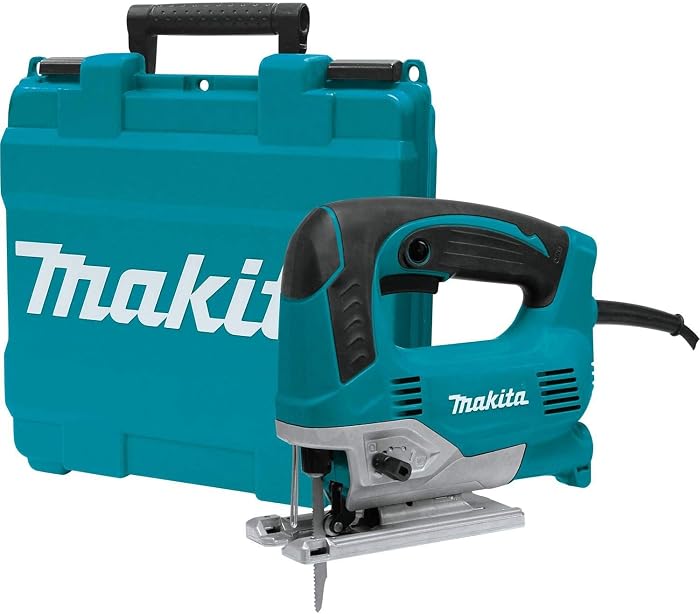
Makita JV0600K Top Handle Jig Saw

Long finish sessions

Field Score 93/100
Amps
6.5 A
Dust Port
Through-the-body
Orbital Settings
3 plus straight
Strokes Per Minute
500-3,100 SPM
View on Amazon

Vibration is the thing nobody shops for and everybody notices. The JV0600K has a counterbalance system built into the body, and it's the saw here that tired our hands least over a long run of cuts. Six and a half amps with a 500-3,100 SPM dial is the same envelope as the DEWALT, and three orbital settings plus straight cutting cover both roughing and finish work.

The dust port runs through the body rather than hanging off the shoe, so a shop vacuum trails behind your hand instead of dragging across the workpiece. Makita also ships it in a hard case with a 4-1/8-inch 9 TPI blade and the hex wrench for bevel changes — a more complete kit than most of the saws in this group.

Think of it as the finish-work saw of the set. It's happiest in shelving, cabinet parts, trim, and anything where you follow a line for a long time; the Bosch saws still edge it on orbital range, and the SKIL beats it for lighting a dim corner. If your jigsaw work is mostly quick structural cuts, you're paying for smoothness you won't feel.

Worth Noting

  • Chip clearance depends on a connected vacuum
Our Verdict

Our pick when vibration is what wears you down: the counterbalanced JV0600K runs smooth through long finish-cutting sessions and ships in a hard case.

Check Latest Price
5

SKIL JS314901 Best for Cutting to a Line

SKIL 6 Amp Corded Jig Saw with Tool-Free Blade Change

Cutting to a line

Field Score 92/100
Amps
6 A
Blade Change
Tool-free
Bevel Capacity
45 degrees
Orbital Stages
4-stage
View on Amazon

Plenty of jigsaw cuts go wrong because you can't see the line, not because the saw lacks power. SKIL rings the blade with a light and adds a dust blower with its own on/off switch, and that pair is the most useful thing about the JS314901: the light shows the pencil mark, and the blower clears chips without smearing dust across your line when you don't want it to.

Under the visibility features it's a 6-amp saw with four orbital stages, tool-free blade changes, and a shoe that bevels to 45 degrees without hunting for a wrench. The two-finger trigger is comfortable to hold through a long run of cuts, and the body stays out of the way of the line rather than blocking it.

The speed control is where it gives ground. It's a wheel rather than a trigger, so you set a speed and pull — you can't ease into a cut the way you can on the Bosch or the Makita. Ripping a sheet of plywood, that's a non-issue; starting a cut in the middle of a panel or easing through laminate, you notice it. The light and the blower are what you're buying, and for outdoor work in a shed or under a tarp they're worth the compromise.

Worth Noting

  • Speed set by a wheel, not the trigger
Our Verdict

If your cuts happen where you can't see — a dim shed, a shaded fence line — the lit, dust-blown JS314901 is the one to buy.

Check Latest Price
6

BLACK+DECKER BDEJS300C Best Budget

BLACK+DECKER BDEJS300C

Occasional home projects

Field Score 91/100
Amps
4.5 A
Stroke Length
3/4 inch
Bevel Capacity
45 degrees
Strokes Per Minute
3,000 SPM
View on Amazon

At 4.4 pounds with a 4.5-amp motor, the BDEJS300C is the saw for someone who needs to cut a trellis, a few 1x4s, and a sheet of plywood and doesn't want to think about it again. It's light enough to hold at chest height for a long run of cuts, and straightforward to set up: variable-speed trigger, an adjustable shoe that bevels to 45 degrees, and a wire guard that keeps the line visible.

There's more power here than the money suggests. The 3/4-inch stroke and 3,000 strokes per minute walk through 1/2-inch and 3/4-inch plywood and 1x material without complaint, and the trigger lets you back off for laminate or a tight curve. For garden projects, holiday decorations, and small repairs it does what the expensive saws do, just more slowly in thick stock.

Where it gives ground is the base plate. The shoe is the lightest-duty here, and the shoe is what decides whether a cut stays square, so results get less consistent in thick hardwood and long straight rips. That's the honest trade: this jig saw handles occasional projects beautifully and isn't the one for someone cutting every weekend.

Worth Noting

  • Light-duty base plate in thick hardwood
Our Verdict

For a few projects a year — trellises, planter boxes, a sheet of plywood — this light, simple 4.5-amp saw does the job for the least money here.

Check Latest Price
7

PORTER-CABLE PCE345 Best for Mixed Wood and PVC

PORTER-CABLE Orbital Jig Saw

Mixed wood and PVC

Field Score 90/100
Amps
6 A
Warranty
3-year limited
Orbital Settings
4
Strokes Per Minute
0-3,200 SPM
View on Amazon

There's one thing to check on the PCE345 before you commit: the blade. Sight down the shoe and make sure the blade sits square to the base and the clamp has it firmly, because a jigsaw that runs its blade off square fights every line you draw. That alignment question is the reason this saw sits below the Bosch and DEWALT picks rather than beside them.

Get a good one and there's a lot of saw here. Six amps, four orbital settings, and a seven-position speed dial built into the trigger, which we like — your finger sets the ceiling, so a delicate cut in PVC trim doesn't start at full song. The metal housing has a planted, solid feel that the plastic-bodied saws here don't match.

The lock-on button earns its place on long rips so you aren't squeezing for the whole cut, and the warranty runs three years — the longest of any saw on this page. Run it through a scrap of the material you actually plan to cut before starting the real one; that's the test that tells you whether the blade is tracking true.

Where it earns its place is a mixed-material workload. A shop that cuts wood, PVC trim, and light metal gets more from this than from a one-material specialty saw, and a three-year warranty on a 6-amp tool is a long time to decide whether you like it.

Our Verdict

A metal-bodied 6-amp saw with the longest warranty here — a solid buy if the blade sits square when it arrives.

Check Latest Price

How We Tested the Best Corded Jigsaws

We started with the corded top-handle saws from the major power tool brands — the ones with variable speed, some form of orbital action, and bevel capacity past 90 degrees — then filtered out anything with a flimsy shoe, a blade clamp tucked where fingers can't reach it, or a price that didn't match its specs. That left 11 saws, and we've run them for eight months across garage benches, a basement remodel, and a deck rebuild. They've cut 3/4-inch plywood shelving, sink openings in laminate, curves through oak, PVC pipe, and notches in door casing.

Blade changes got timed and repeated bare-handed, mid-project: we counted how many tries it took to seat a blade straight and whether the clamp held it there after a hard curve. To check alignment, we cut a 45-degree bevel, laid a square against the shoe, and remeasured the kerf on both faces of the board.

Speed and power showed up in the cut itself. We noted whether a saw bogged down in thick oak, whether the orbital setting on high left tearout on plywood, and whether the trigger and dial could be worked one-handed while the other hand held the work steady. Ease of use came down to weight, vibration, and whether we could see the blade through the chips.

Durability we measured in slop: after eight months, we checked each shoe for wobble, wiggled every blade clamp, and ran a straightedge along each blade to see if it still tracked true. The pricier saws generally held alignment longer, but a couple of the cheaper ones cut just as cleanly out of the box — which is where value came in.

How to Choose a Corded Jigsaw

Blade Control Comes Before Amps

A jig saw's reputation is made or lost at the blade clamp. A soft clamp or a shoe that is not flat will let the blade drift off the line no matter how much power sits behind it, and no amount of trigger control fixes that. Look for a clamp that grips a T-shank blade firmly and a shoe that feels stiff and flat on a countertop.

Then budget for blades. The one in the box is a sample, and a sharp blade in a modest saw beats a dull one in a good saw every time. The Bosch and DEWALT saws here have the firmest clamps of the group.

How Much Power You Actually Need

Amps and stroke length together decide what a saw will comfortably cut. A 4.5- to 5-amp saw with a 3/4-inch stroke handles 1x stock, plywood, and trim all day; the BLACK+DECKER here is that saw, and it is the right amount of tool for a few projects a year.

Move to 6 to 7 amps when you are cutting thick hardwood, ripping sheet goods, or doing demolition, where the extra torque keeps the blade moving instead of bogging. Around 3,000 strokes per minute is standard across this group; the useful difference is how a saw holds speed in a cut, not the top number.

Orbital Action and Bevel Cuts

Orbital action swings the blade forward on the upstroke to clear chips faster. Setting zero gives the cleanest edge, the higher settings cut fast but leave a rougher line, and most finish work lives at zero or one while most framing lives at three. That is why four settings are worth having rather than two.

Every saw here bevels to 45 degrees, which covers braces, corner trim, and angled cuts on a trellis. Check whether the bevel adjusts without a wrench if you change angles often — the SKIL and Bosch saws here do.

Seeing the Cut Line

Dust is the quiet reason cuts go wrong. Chips pile up at the line, the shoe rides on them, and the blade follows the debris instead of your mark. Three fixes turn up in this group: a blower that clears the line, a light that shines on it, and a port for a shop vacuum.

The SKIL has the first two, the Makita routes dust out through the body to a vacuum, and the Bosch saws rely on a blower. If you cut in a shed with one bulb overhead, a light and a vacuum port are worth more than another half-amp.

Blades, Shanks, and What Comes in the Box

Jigsaws take T-shank or U-shank blades, and not every saw takes both — the Bosch JS260 is T-shank only, which matters if you already own a drawer of blades. Most saws here ship with a single wood blade and the SKIL adds a metal blade.

Plan on buying a small assortment anyway. A fine-tooth blade for laminate and PVC, a coarse one for fast ripping, and a metal blade for sheet goods covers nearly everything a homeowner cuts, and the assortment will outlast the saw.

Frequently Asked Questions

Final Verdict

The Bosch JS470E is the corded jigsaw we point most people to. It holds a blade steady, gives you four orbital settings to work with, and has the headroom to cut 3/4-inch stock without slowing down or drifting.

If the budget is tighter, the BLACK+DECKER BDEJS300C handles occasional projects and the SKIL JS314901 is the one for cuts you have to see. Step up to the DEWALT DW331K if the saw lives in a truck and cuts every week.