The 8 Best Cordless Jigsaws of 2026

A jigsaw makes the cuts a circular saw can’t—the sink cutout, the deck-board curve, the outlet notch. Cordless models add convenience, but a weak motor bogs down in thick stock, a fussy shoe throws off a bevel, and a vague trigger makes tight curves feel like guesswork. I’ve used these saws for years; over the past six months, my team and I tested 12 cordless jigsaws on garage projects and small renovations.

The best earned it in the cut: enough power for 3/4-inch plywood, speed control that didn’t scorch thin PVC, and an on-off switch I could find with gloves on. We tracked cuts per charge, checked whether the base stayed square after bevel changes, and noted what came in the box—bare tool or kit—since value depends on batteries and blades.

Barrel-grip and D-handle saws feel different: barrel grips sit closer to the work for curves, while D-handles feel familiar from a drill. Brushless motors and orbital settings matter, but control beats spec-sheet bragging. The picks below cut cleanly and made blade changes without a fight.

Our Top Picks

The 8 Best Cordless Jigsaws of 2026

1

DeWalt 20V MAX XR Jigsaw (DCS334B) Best Overall

DeWalt 20V MAX XR Jigsaw (DCS334B)

One saw, everything

Field Score 97/100
Bevel
45 degrees
Weight
4.2 lb
Blade Speed
3,200 SPM
Orbital Action
4-position
View on Amazon

A jigsaw earns its keep on the cuts a circular saw cannot make: a sink cutout, a curve in a shelf, a plunge into the middle of a panel. Those are the cuts where the DCS334B behaved best in our testing. The body is compact, the saw weighs 4.2 pounds, and you can hold it in one hand while the other steers the work. Speed runs to 3,200 strokes per minute, and four orbital settings take it from a clean, slow cut in veneered plywood to an aggressive one in framing stock. That range, at that weight, is why it is the saw we recommend first.

The detail we kept coming back to is the blade change. It is an all-metal lever you flip with one hand, no key, and it takes standard T-shank blades, so one assortment pack covers everything from a fine scroll cut to a coarse framing blade. The LED sits above the shoe and lights the line when you are working under a cabinet or at the back of a garage. The shoe bevels to 45 degrees for trim and angled cuts.

What it does not come with is a battery or a charger, so the real cost is the saw plus the packs it will run on. DeWalt's 20V MAX line means those packs also drive a drill, a circular saw, and a nailer, which is the quiet argument for buying into a platform rather than chasing the cheapest bare tool. Pair it with a decent blade: the saw is quick enough that a dull one announces itself immediately as burned edges and a wandering line.

For our money this is the saw that covers the most ground — trim, plywood, cutouts, curves, and the occasional plunge into a countertop — without hunting for an outlet. It is not the cheapest way into cordless cutting and it is not the most powerful saw here. It is the one we reached for when we did not yet know what the next cut would be.

Worth Noting

  • Bare tool; battery and charger sold separately
Our Verdict

The cordless jigsaw we recommend to most people: light enough to hold overhead, quick enough for hardwood, and fitted with a blade lever you can work one-handed.

Check Latest Price
2

DeWalt DCS335B Barrel-Grip Jigsaw Best Barrel Grip

DeWalt DCS335B Barrel-Grip Jigsaw

Curves and detail

Field Score 96/100
Grip
Barrel
Bevel
45 degrees
Motor
Brushless
Weight
4.8 lb
View on Amazon

Where your hand sits is the whole argument for a barrel grip. On the DCS335B your palm wraps the motor housing, low and close to the work, instead of sitting back behind a handle. That is the position cabinetmakers have used for decades because it lets you look down the blade and turn a curve with your wrist rather than your shoulder. DeWalt builds it around the same brushless motor as our top pick, with an LED above the shoe and a lever-action T-shank blade change.

On coping cuts, sink cutouts, and tight radii, this is the saw we reached for. It is more maneuverable than the D-handle versions, and the low grip gives you real leverage through a curve. The cost is the controls: there is no trigger, so on and off live on a side switch, and the speed dial sits where you cannot reach it without moving your hand. Set your speed before the cut and the annoyance mostly disappears; adjust speed constantly and it will not.

It is the priciest of our picks and a bare tool, so the 20V MAX packs and charger are part of the total. With a pack clipped on, the weight sits forward of your wrist — the trade for all that control, noticeable on an overhead cut and invisible at a bench, where the saw's weight does the work of holding the shoe down on the panel.

Worth Noting

  • Side switch, no trigger, hard-to-reach speed dial
Our Verdict

Buy the barrel grip if you want your eye over the blade and your wrist doing the steering; the side switch is the price of that position.

Check Latest Price
3

Milwaukee M18 FUEL Jig Saw Best for Thick Stock

Milwaukee M18 FUEL D-HANDLE JIG SAW BARE TOOL

Thick stock

Field Score 95/100
Bevel
45 degrees
Motor
Brushless
Battery Platform
M18
View on Amazon

If our top pick is the saw for most people, this is the saw for a pile of 2-inch stock. The M18 FUEL cuts like a plug-in tool: it walked through thick hardwood in our testing without the stall you half expect from a battery saw, and the brushless motor holds its speed under load instead of bogging and recovering. Long rips are where the difference shows — you feed the saw rather than waiting for it.

The rest is built for that kind of work. A D-handle with a trigger, a stout shoe that bevels to 45 degrees, tool-free blade changes, and the M18 packs from the rest of your kit. Nothing about it is delicate, and the rubber overmold on the handle is the sort you can grip hard for a long cut without your hand cramping.

Our reservation is squareness. A blade sitting a degree or two off-square to the shoe turns a straight cut into a slow wander, and it is the first thing to check on any jigsaw before a visible cut. Square it up and the Milwaukee gives you power that does not sag in thick stock, which is the whole reason to buy it over a lighter saw.

It is a bare tool, so the packs and charger are on you unless you buy a kit. Worth knowing before you shop used: the saws that fail tend to fail after years of hard service rather than out of the box, so a well-used example is a real risk in a way a used drill is not.

Worth Noting

  • Blade can sit off-square; check before finish cuts
  • Bare tool; M18 battery and charger extra
Our Verdict

The saw for a stack of thick stock: it cuts like a plug-in tool and takes M18 packs you already own, as long as the blade sits square.

Check Latest Price
4

Makita 18V LXT Jig Saw (XVJ03Z) Best for Straight Cuts

Makita XVJ03Z 18V LXT® Lithium-Ion Cordless Jig Saw

Straight, square cuts

Field Score 94/100
Weight
6 lb
Blade Speed
0–2,600 SPM
Blade Change
Tool-less lever
Orbital Settings
3 plus straight
View on Amazon

Six pounds is a lot to hold at arm's length, and the XVJ03Z is the heaviest saw we recommend. Almost all of that mass is in the base — a heavy-gauge, precision-machined steel plate under the blade — and it is the reason this saw holds a line with less fighting than the lighter models here.

We liked the two-finger trigger and the tool-less blade lever, both of which let you keep one hand on the work. The 0–2,600 SPM range is a step behind the 3,200-SPM DeWalts on paper, and in hardwood you feel it: the saw wants a slower feed. What you get back is a cut that comes out square and clean with a good blade. Run the trigger through its full range when the saw arrives — speed that does not ramp cleanly is the one flaw that turns up.

It is a bare tool on Makita's 18V LXT platform, and it ships with a 4-1/8-inch blade and a cover plate that keeps the shoe from scarring finished work, a small thing that matters on a visible panel. If you already own LXT packs, the saw is the only purchase; if you do not, price batteries and a charger before comparing it to a kit.

Worth Noting

  • Bare tool; LXT battery and charger extra
Our Verdict

Choose this one for long straight cuts in plywood and panels: the machined base holds a line, and the six pounds pay for themselves at a bench.

Check Latest Price
5

Craftsman V20 Jig Saw (CMCS600B) Best Budget

Craftsman V20 Jig Saw (CMCS600B)

Tight budgets

Field Score 93/100
Bevel
45 degrees
Blade Speed
2,500 SPM
Blade Shanks
T and U
Orbital Settings
3
View on Amazon

The CMCS600B takes both T- and U-shank blades, which reads like a footnote until you are standing in a garage with a coffee can of old U-shank blades and no way to use them. That flexibility, plus a 45-degree bevel and three orbital settings, makes it our budget pick: 2,500 strokes per minute through a variable-speed trigger, on V20 batteries you may already own, for a fraction of what the premium saws cost.

Where it gives ground is speed. The 2,500-SPM ceiling trails the 3,200-SPM saws, and rough-cutting 2-inch stock takes a slower hand and a coarser blade. For trim, cutouts, and 3/4-inch plywood we did not miss the extra strokes. Blade changes are quick, the trigger sits where your finger expects it, and at 4.8 pounds it is light enough to run one-handed along a shelf.

It is a bare tool, so V20 packs and a charger are the rest of the bill unless you are already in the line. The shoe bevels both ways to 45 degrees and the base stays flat on a panel. Check the blade against a square before a visible cut; that habit is what separates a clean line from a wandering one on any jigsaw, and it costs nothing.

Worth Noting

  • Bare tool; V20 battery and charger extra
  • 2,500 SPM trails the premium saws
Our Verdict

The budget pick that still does the basics: 2,500 strokes per minute, three orbital settings, and both blade shanks for well under the premium saws.

Check Latest Price
6

Ryobi ONE+ HP Brushless Jig Saw (PBLJS01) Best for Ryobi One+ Owners

RYOBI ONE+ HP 18V Brushless Cordless Jig Saw (Tool Only) PBLJS01

Ryobi One+ owners

Field Score 92/100
Bevel
45 degrees each way
Motor
Brushless
Weight
4.3 lb
Orbital Settings
4
View on Amazon

The strongest argument for the PBLJS01 is not printed on the tool — it is the row of green batteries on your bench. Ryobi rates the brushless HP motor at up to 36 percent faster cutting and 78 percent longer runtime than the model it replaces, and the 4.3-pound body with four orbital settings is easy to steer one-handed.

The details are sensible: an easy-release blade lever, tool-free bevel adjustment that locks at 45 degrees each way, an LED over the cut line, and a T-shank wood blade in the box. Nothing about it feels like a corner was cut to hit a price, and the compact footprint is the reason it fits between a stud and a cabinet.

We reached for this one when the cut was in an awkward place — under a sink, inside a carcass — because the size and the light make it easy to aim. It is a bare tool, so it is only the bargain it looks like if you are already in One+, and that is where the value lands: the same packs run the rest of your One+ tools, so the saw is the only thing you buy.

Worth Noting

  • Bare tool; One+ battery and charger extra
Our Verdict

The easiest way into a good jigsaw if you already run One+ packs: brushless power, four orbital settings, and a size that fits awkward cuts.

Check Latest Price
7

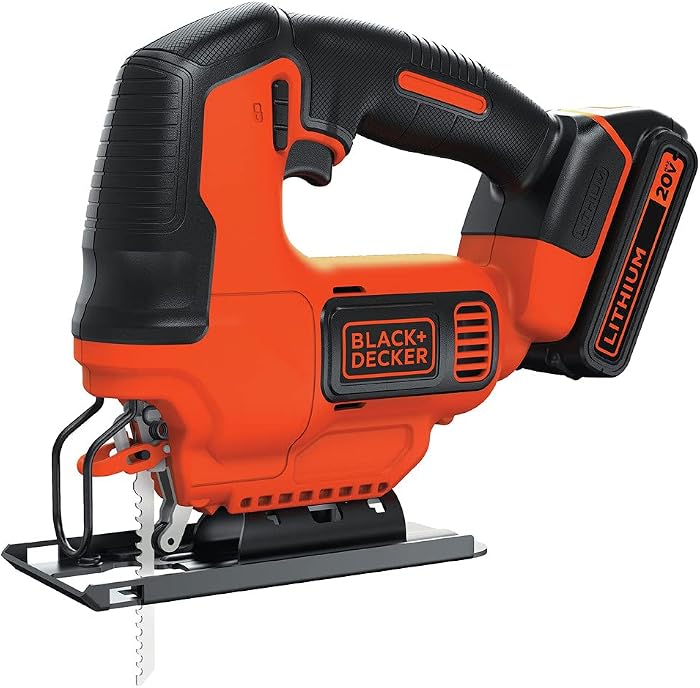
BLACK+DECKER 20V MAX Jig Saw (BDCJS20C) Best for Occasional Home Projects

BLACK+DECKER 20V MAX* POWERCONNECT Cordless Jig Saw (BDCJS20C)

Occasional home projects

Field Score 91/100
Bevel
45 degrees both directions
In The Box
Battery, charger, and blade
Blade Speed
2,500 rpm
Blade Shanks
U and T
View on Amazon

This is the only saw from a familiar brand here that arrives ready to cut: a 20V MAX battery, a charger, and a blade in the box. If you do not already own a battery platform, that is the difference between a saw you can use the day it lands and a saw plus a shopping trip.

The rest is sensible for the money. A variable-speed trigger runs it to 2,500 rpm, the tool-free chuck takes both U- and T-shank blades, the shoe bevels 45 degrees in either direction, and a wire guard keeps the cut line visible. At 5 pounds it is light enough to hold in one hand and it carries a two-year limited warranty.

Runtime is the weak point. Continuous cutting drains the included pack quickly, so this is a saw for a cutout, a shelf bracket, and a run of trim rather than an afternoon of decking; pair it with a larger pack if you have one. The shoe also does not hold a line as stubbornly as the premium saws, so clamp a straightedge for anything visible and let the tool follow it.

For what it is — a light, inexpensive cordless saw for around-the-house work — we think it earns its shelf space, and arriving complete is most of the appeal. Ask it to keep pace on a full sheet of plywood and you will be disappointed; ask it to open a wall or trim out a closet and it does the job. The two-year coverage is the part that tips it over a no-name kit.

Worth Noting

  • Short runtime on the included battery
  • Wanders on long straight cuts
Our Verdict

A fair buy for a first cordless saw: it arrives with a battery, a charger, and a blade, and it is honest about being a light-duty tool.

Check Latest Price
8

SEESII Cordless Jigsaw (JS01) Best for First-Time Buyers

SEESII Cordless Jigsaw (JS01)

First-time buyers

Field Score 89/100
Bevel
0–45 degrees
In The Box
Two batteries, charger, nine blades
Blade Speed
0–2,800 SPM
Orbital Settings
4
View on Amazon

Two 21-volt batteries, a charger, nine blades, a dust tube, a wrench, and a bag: the SEESII arrives as a kit in a way the big brands do not bother with. For a first jigsaw, or a second one that lives in a shed, the appeal is obvious — there is nothing else to buy.

The tool covers the basics and then some: a variable-speed trigger to 2,800 strokes per minute, four orbital settings, a base that bevels 45 degrees each way, a thumb-push blade release, an LED, and a safety lock. The blade release is the standout — one push, one pull, and the blade is locked, quicker than the lever changes on the big-brand saws.

The batteries are 2.0Ah, compact packs that suit trim and cutouts and drain fast in a long run of shelving; having two softens that, since the charger fills one while you cut with the other. Blade quality matters as much as the saw here: the included assortment covers wood, metal, and plastic, and a fine-tooth blade is what turns this from a rough cutter into a tidy one.

We think it earns a place for the buyer with no battery platform and no appetite for building one: a competent saw for occasional work, backed by a three-year warranty and lifetime service. The thumb-push release is the feature worth stealing from it, and the second battery is what keeps the saw cutting while the first recharges.

Worth Noting

  • Compact 2.0Ah packs, so plan on swapping
Our Verdict

Buy it as a complete first kit: two batteries, nine blades, and a bag for a buyer with no platform, so long as the work stays occasional.

Check Latest Price

How We Tested Cordless Jigsaws

We started with a shortlist of 20+ saws from our own research and owner feedback, then narrowed it by handle style, motor type, bevel range, orbital settings, blade-change system, price band, and whether each came as a bare tool or a kit. We eliminated duplicates and saws whose shoes or switches felt vague before cutting, then bought 12 units for testing. We ran them for six months in garage workshops and on small renovation projects, using each with its matching battery platform at the same amp-hour rating.

The main cut test was a curved line in 3/4-inch plywood and a straight bevel through a 2x4; we noted stalls, burn marks, and whether the blade wandered off the line. We also cut PVC pipe, notched studs for wiring, and made sink cutouts in countertop scrap. With gloves on, we adjusted speed from thin plastic to hardwood, operated the on-off switch, and changed blades between cuts, watching for any rotation in the clamp that would throw off the next cut.

Battery life was tracked by timing continuous cuts per charge and noting how much power dropped at the end of a pack. To check durability, we repeated bevel changes and looked for a shoe that no longer sat square, plus play in the blade guide after repeated use. We also logged what came in each box—batteries, charger, blades, bag—so a bare tool’s lower sticker didn’t get mistaken for better value. Ease of use came down to small things: blade changes without a tool, a switch I could hit without looking, and a grip that stayed comfortable through a long afternoon.

How to Choose a Cordless Jigsaw

Start With the Battery You Already Own

Every saw here but two is a bare tool, and that single fact decides more purchases than any specification on the box. If you already own DeWalt 20V MAX, Milwaukee M18, Makita LXT, or Ryobi One+ packs, buy into that line and put the money into the tool; the packs on your bench are the ones that will actually get used. If you own nothing, the arithmetic changes — the BLACK+DECKER and SEESII kits arrive with a battery and a charger, so they are the only saws here you can unbox and cut with.

Ignore the voltage badge as a measure of power. 18V and 20V MAX are nominal figures, and the capacity of the pack you clip on matters more than the number molded into the housing.

D-Handle or Barrel Grip

Almost every cordless jigsaw is a D-handle with a trigger, and that is the right shape for general work: your index finger runs the speed and the saw feels like the drill and circular saw beside it. A barrel grip puts your hand directly over the blade, which is why the DeWalt DCS335B is the one we reach for on tight curves and coping cuts — you can look down the blade and steer with your wrist.

The catch is the controls. Barrel-grip saws generally move on/off and speed to a body-mounted switch and dial, so nothing sits under your finger mid-cut. If you have never run one, that is the adjustment to expect.

Speed, Orbital Action, and the Cut You Want

Blade speed runs from about 2,500 strokes per minute on the budget saws to 3,200 on the DeWalts, and that gap matters less than orbital action. Orbital settings swing the blade slightly forward on the upstroke, which clears chips faster and cuts quicker at the cost of a rougher edge; setting zero gives the cleanest line in laminate, veneer, or any cut that will be seen.

Three settings cover most work, and the fourth step on the DeWalt and Ryobi saws is a finer choice between clean and fast rather than a new capability. More speed does not buy a cleaner cut: a sharp, fine-tooth blade at moderate speed beats a fast saw with a coarse blade every time.

Blades, Bevels, and a Square Shoe

Most of these saws take T-shank blades and change them with a lever. The Craftsman and the BLACK+DECKER also accept U-shank blades, which is worth knowing if you inherited a drawer of them. Every saw here bevels to 45 degrees, enough for trim and not much more.

The thing to check on any jigsaw is the shoe. The base has to sit square to the blade, or the saw will wander no matter how carefully you steer, and a blade knocked out of square will make a good saw cut badly. Run a combination square against the blade before your first finished cut, and again after the tool takes a fall.

Frequently Asked Questions

Final Verdict

The DeWalt DCS334B is the cordless jigsaw we recommend to most people. At 4.2 pounds with 3,200 strokes per minute, four orbital settings, and a blade lever you can work one-handed, it handles trim, plywood, curves, and the occasional countertop plunge without asking you to swap tools. Buy it if you are already on 20V MAX.

Cut curves all day and want your eye over the blade? Take the DCS335B and accept the side switch. Tight budget and light use? The Craftsman CMCS600B does the same jobs with less speed and leaves money for blades.