The 7 Best Cordless Reciprocating Saws of 2026

A cordless reciprocating saw is a study in tradeoffs: you give up some of the grunt of a corded tool to cut wherever the job happens to be. The gap between a good saw and an average one shows up fast — one slices through a nail-studded pallet board without slowing, another bogs down and leaves you sniffing for that hot electrical smell.

I've leaned on these saws for unglamorous work: breaking down pallets, trimming fence posts, cutting PVC in a tight corner. Over the past eight months we put 11 saws through those same routines, from compact one-handed models to full-size brushless saws, and the differences in power, weight, and blade changes were obvious within a couple of cuts. A variable-speed trigger earns its keep more than the spec sheet suggests — feathering the start is the difference between a clean cut in drywall and a torn one.

Most of these are bare tools, so the real cost is the battery platform you already own. The saws below earned their spot by cutting cleanly, staying comfortable in hand, and never making me worry about the motor.

Our Top Picks

The 7 Best Cordless Reciprocating Saws of 2026

1

DEWALT DCS367B Best Overall
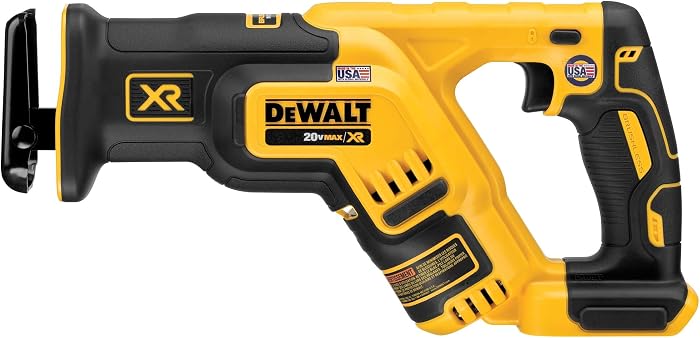
DEWALT 20V MAX XR Reciprocating Saw Cordless

All-around property work

Field Score 97/100
Speed
2,800 rpm
Length
14.5 in.
Weight
5.4 lb
Stroke Length
1-1/8 in.
View on Amazon

The DCS367 is the saw we hand to someone who wants one cordless recip saw to do the most: the 14.5-inch body fits between studs, and the 1-1/8-inch stroke and 2,800 rpm give it real full-size manners. The four-position blade clamp is the detail we appreciate most; turning the blade flat lets you flush-cut against a board or work into a corner where a fixed shoe cannot follow.

At 5.4 pounds bare, it is light enough to carry up a ladder but still has enough mass to resist hopping in green wood. The brushless motor and variable-speed trigger make it easy to start a cut slowly and then lean in. We also like the LED for dim barn corners and the keyless clamp for swapping between a pruning blade and a demolition blade.

Runtime is the variable: with a small pack the saw will remind you that recip saws are thirsty, while a larger pack keeps it working through a fence line. The rest of the ownership experience is straightforward: tool-free blade changes, a clear line of sight, and enough mass to keep the cut steady.

For most buyers, this is the one we reach for first. The only time we leave it in the truck is when a cut is so far overhead that a one-handed saw is the safer choice.

Worth Noting

  • Bare tool; batteries and charger sold separately
Our Verdict

We recommend the DCS367 as the default cordless recip saw for most buyers: it cuts like a full-size saw but fits between studs and in tight fence-line spaces.

Check Latest Price
2

Milwaukee M18 Fuel Sawzall Best for Heavy Demolition

Milwaukee M18 Fuel Sawzall Brushless Cordless Reciprocating Saw

Heavy demolition

Field Score 96/100
Motor
Brushless
Speed
3,000 SPM
Weight
6.8 lb
Voltage
18V
View on Amazon

The 3,000-spm motor and 18V M18 platform give this saw a deliberate, heavy-duty feel. It is built around two-handed work: long cuts in 4x4s, breaking down pallets, and cutting up storm limbs that are too big for a compact saw.

We recommend it for the jobs where a compact saw starts to bog. The extra mass and speed keep the blade engaged, and the lever-actuated blade clamp makes swaps quick. The trade-off is weight: at 6.8 pounds bare, it is a two-handed tool, and the motor can drink through a small pack.

The brushless motor and M18 Fuel electronics are the reason this saw feels stronger than its 18V rating suggests. We also like the metal-reinforced battery connection; it keeps the pack tight when the saw is bouncing through a cut.

For a homeowner with a few M18 batteries, it is a serious step up for storm cleanup. If most of your cutting is overhead or in tight framing, the Hackzall is the better fit.

Worth Noting

  • Bare tool; battery and charger not included
Our Verdict

Our pick for hard demolition and big limbs, the M18 Fuel Sawzall has the speed and torque to keep going when lighter saws bog down.

Check Latest Price
3

Milwaukee M18 Fuel Hackzall Best One-Handed

Milwaukee 2719-20 M18 FUEL Hackzall (Bare Tool)

One-handed cutting

Field Score 95/100
Motor
Brushless
Design
One-handed
Voltage
18V
Stroke Length
7/8 in.
View on Amazon

The 2719-20 Hackzall is built around a 7/8-inch stroke and a handle you can wrap one hand around. That shorter stroke removes less material per pass than a full-size saw, but it also makes the saw easier to control when you are reaching into a branch union or cutting pipe between joists.

We like it best as a second recip saw for anyone who already owns M18 batteries: it is the one we grab for overhead pruning, PVC, and quick cuts where a full-size body will not fit. The brushless motor and one-handed layout are the point; it will not keep pace with a full-size saw in thick hardwood.

The one-handed design is more than a shorter body. It lets you hold the branch or pipe with one hand and keep the saw steady with the other. That is the use case that earns it a place, not raw speed.

If your work is mostly bench-height demolition, the full-size saw is the stronger choice; the Hackzall is for the cuts that make you contort.

Worth Noting

  • Bare tool; battery and charger not included
Our Verdict

We reach for the M18 Fuel Hackzall when the cut is overhead or one-handed; it trades raw speed for control in tight spots.

Check Latest Price
4

Makita XRJ05Z Best for Thick Timber

Makita XRJ05Z 18V LXT Lithium-Ion Brushless Cordless Recipro Saw

Thick timber

Field Score 94/100
Speed
0-2,300 / 0-3,000 SPM
Weight
8.2 lb
Voltage
18V
Stroke Length
1-1/4 in.
View on Amazon

The 1-1/4-inch stroke is the first thing we notice about the XRJ05Z. It is longer than most of the saws here, and with the high-speed setting at 3,000 spm it makes quick work of thick limbs and fence posts.

We also appreciate the two-speed motor: low for starting a cut in green wood without bouncing, high for ripping through a pile of branches. The tool-less blade change is quick, and the speed selector gives you a useful low range when you need more control.

The cost is weight. At 8.2 pounds with a battery, this is the heaviest saw in this group, and we felt it most when reaching across a brush pile or holding the saw at chest height. The long stroke and power are worth it for ground-level work; for overhead cuts, a one-handed saw is kinder to your shoulders.

If you already own Makita 18V LXT batteries and cut a lot of firewood or fence-line brush, the XRJ05Z rewards the extra weight with faster, longer strokes. It is a specialist, not the saw we hand to a first-time buyer.

Worth Noting

  • Bare tool; battery and charger not included
Our Verdict

The XRJ05Z is the long-stroke choice for thick timber and stump work, provided you can handle its heft and already own Makita batteries.

Check Latest Price
5

DEWALT DCS369B Best Compact

DEWALT ATOMIC 20V MAX* Reciprocating Saw

Tight spaces

Field Score 93/100
Motor
Brushless
Design
One-handed
Length
12.5 in.
Voltage
20V MAX
View on Amazon

At 12.5 inches front to back, the DCS369 is the saw that fits where a full-size recip saw has no business going: between joists, under a sink, or one-handed in a tangle of branches.

The one-handed layout is not a gimmick. With a compact battery, the short body keeps the weight close to your hand, so you can hold a branch with one hand and cut with the other. The brushless motor and tool-free blade release keep it useful for quick pruning and PVC work, and it is listed as 37% lighter than the DCS367.

We reach for it when the cut matters more for access than speed. It will not replace a full-size saw in thick hardwood or a long demolition cut, and that is the trade you make for the short body. For a homeowner with DeWalt 20V batteries, it is the compact companion that gets used more than expected.

The included belt hook is a small but welcome detail on a ladder; clip it on and both hands are free to move the branch.

Worth Noting

  • Bare tool; battery and charger not included
Our Verdict

We like the DCS369 for overhead pruning and quick cuts in tight quarters, where its one-handed balance matters more than full-size power.

Check Latest Price
6

CRAFTSMAN CMCS300B Best Budget

​​CRAFTSMAN V20 Reciprocating Saw

Budget buyers

Field Score 92/100
Speed
0-3,000 RPM
Weight
4.4 lb
Voltage
20V
Stroke Length
1 in.
View on Amazon

If you already own Craftsman V20 batteries, the CMCS300B is one of the least expensive ways to add a recip saw to the truck box. The 4.4-pound body and 1-inch stroke make it a light-duty tool, not a demolition saw.

The 0-3,000-rpm variable-speed trigger and tool-free blade release are the right basics, and the compact 14.5-inch body fits in tight spots. We like the rubber grip and the balance for pruning and rough cuts; it is easy to carry around the property.

We recommend it for light trimming, pallet breakdown, and odd jobs where a full-size saw is overkill. Keep the cuts short and the blade sharp, and it does what a budget saw should.

We keep it in the category of tools that are handy because they are already there, not because they are the most capable.

Worth Noting

  • Motor is not built for sustained hard use
  • Bare tool; battery and charger not included
Our Verdict

If you already own Craftsman V20 batteries, the CMCS300B is our budget pick for light trimming and rough cuts around the property.

Check Latest Price
7

WORX WX550L

WORX Cordless Reciprocating Saw & Jigsaw

Light-duty versatility

Field Score 91/100
Modes
Reciprocating and jigsaw
Weight
4.2 lb with battery
Voltage
20V
Stroke Length
3/4 in.
View on Amazon

The WX550L earns its place with a pivoting head that switches between a reciprocating saw and a jigsaw. That sounds like a gimmick until you are trimming a shrub one minute and cutting a clean panel opening the next; the 4.2-pound body with battery makes it easy to carry around the yard.

The 20V PowerShare battery and charger are included, which makes it a true grab-and-go tool for a camper or small property. We like the four included blades and the compact footprint; it stores in a cabinet or under a truck seat without much fuss.

The jigsaw mode is the reason to consider it: it cuts cleaner curves in plywood and trim than a recip blade, and the pivoting head lets you get the shoe flat on the work. The four blades cover wood, metal, and PVC, so it is a useful camp and small-property saw.

We recommend it for light-duty versatility: a cabin-box saw for pruning, trim, and quick panel cuts. It covers more odd jobs than its size suggests, and the pivoting head is the part that keeps it in the truck.

Worth Noting

  • 3/4-inch stroke is slow in thick timber
  • Battery life is mixed in sustained cutting
Our Verdict

We recommend the WX550L as a light-duty 2-in-1 for campers and small property jobs, not as a replacement for a full-size recip saw.

Check Latest Price

How We Tested Cordless Reciprocating Saws

We started with every cordless reciprocating saw we could find that runs a brushless motor, uses a variable-speed trigger, and has a blade clamp you can work without a wrench, then narrowed by price, whether it's sold as a bare tool, and how often it turned up in owner reviews. That left 11 saws, which we ran for eight months in garages, basements, and backyards.

Most of the work was ordinary and repetitive, which is where a saw shows its weaknesses: breaking down pallets, trimming fence posts, cutting PVC and copper pipe, pruning overgrown shrubs, and notching a stud inside a finished wall. We used the compact one-handed saws overhead and in tight corners and the full-size saws on thicker material, so we could feel where the extra weight starts to cost you.

Every saw made the same cuts in 2x4s, pallet slats, and pipe. We counted how often a saw stalled and had to be restarted, weighed each one with a battery attached, and swapped blades barehanded to see whether the clamp fought back. After long cuts we felt the grip and motor housing for heat and checked for a hot plastic or burnt-brush smell, since that odor usually means the motor is straining. Battery packs were run flat on purpose to see whether power faded gradually or dropped off a cliff, and each saw went through repeated cutting sessions so we could listen for a change in motor pitch, which tends to show up before a motor quits.

We also treated them the way a shop does: bumped them off sawhorses, watched for slop developing in the blade clamp, and looked at what actually comes in the box, since most arrive without a battery or charger and the value only makes sense against the platform you already own.

How to Choose a Cordless Reciprocating Saw

Battery Platform Comes First

A cordless recip saw is a battery-and-charger purchase as much as a tool purchase. If you already run a 20V MAX, M18, or LXT system, a bare tool puts your existing packs to work and keeps you from maintaining another charger. If you are starting fresh, compare the kit price and the batteries included, not just the saw.

Voltage alone does not make packs interchangeable. Stay inside one maker's battery family, and check that the saw is the bare-tool or kit version you think it is. We prefer buying into the platform you will use for a drill, trimmer, or chainsaw too; a lone orphan battery is the most expensive kind.

Full-Size or One-Handed?

Full-size saws have longer strokes and more mass, which helps in thick posts, pallets, and demolition. One-handed models such as the DEWALT DCS369B and Milwaukee Hackzall trade some speed for a shorter body that reaches into branch unions, under sinks, and overhead.

If most of your cutting happens at bench height and you want the fastest cut, choose full-size. If you spend time on a ladder or holding a branch with one hand, the compact saw will earn its keep. A full-size Sawzall-style saw and a one-hander make a sensible pair, but most buyers should start with the size that matches the majority of their work.

Stroke Length, Speed, and Weight

Stroke length is the distance the blade travels; a longer stroke removes more material per pass. The 1-1/4-inch Makita XRJ05Z is the longest here and feels fast in thick timber, while 7/8- and 3/4-inch saws are easier to control in tight spots. Speed matters too, but a 3,000-spm saw with a short stroke is not automatically faster than a 2,800-spm saw with a longer one.

Weight is the other side of that coin. A 5- to 7-pound saw is manageable for most property work; an 8-pound saw lets you lean on it but tires you overhead. We pay more attention to balance with the battery installed than to the bare-tool number, because that is the weight your wrist actually carries.

Blades and Control

The blade does as much for the cut as the saw. Use a pruning blade for green limbs, a wood blade for clean carpentry cuts, and a bimetal or metal-cutting blade for pipe, sheet metal, and nails. A dull or wrong blade makes any saw feel weak and leaves a rougher cut.

Variable-speed triggers are worth having: start slowly to establish the kerf, then squeeze for speed. Let the blade cut at its own pace instead of forcing it. For clean work, keep a dedicated blade for each material and change it when the teeth round over.

Frequently Asked Questions

Final Verdict

The DEWALT DCS367B is the cordless reciprocating saw we recommend first. It has the stroke and speed to cut like a full-size saw, but its 14.5-inch body and four-position blade clamp let it work between studs and along fence lines.

If you already own Milwaukee M18 batteries and your work is mostly heavy demolition, the M18 Fuel Sawzall is the stronger specialist; for overhead cuts, the Hackzall is the one-handed alternative.