The 8 Best Double Sleeping Pads of 2026

An air pad packs down to the size of a loaf of bread and then slowly goes soft under you overnight; a foam mattress sleeps like your bed at home and eats half the trunk. Double pads live on that line, and which side you land on decides whether a trip feels like a treat or a test of endurance. What you're actually buying is a night where neither of you wakes up on the ground, or on top of each other.

I've slept on plenty of borrowed pads that were fine solo and a disaster for two, and the difference is rarely thickness — it's how the baffles and foam spread weight between two bodies of different sizes. Over the past seven months, we slept on 12 double pads in backyards, on a gravel car-camping site, and through one cold weekend in the low 30s.

The features that sell these pads deserve a second look. A built-in foot pump is a real convenience at dusk and a real headache if the valve is the first thing to fail, and six extra inches mean little if the pad bottoms out by 2 a.m. The picks below are the ones that held air, rolled up without a fight, and still felt worth the money a week in.

Our Top Picks

The 8 Best Double Sleeping Pads of 2026

1

FNARMW Double Sleeping Pad Best Overall

FNARMW Double Sleeping Pad – Double Sleeping Pad Camping

Couples, all-around camping

Field Score 89/100
Weight
4.4 lb
Thickness
6 in
Inflated Size
80" x 55"
Weight Capacity
800 lb
View on Amazon

Eighty inches long, 55 wide, six thick, and rated to 800 pounds: on the numbers alone this is the biggest double pad in the group, and the size is doing real work. Two adults get about 27 inches apiece, enough for a back sleeper and a side sleeper to stop negotiating. The 51-inch pads here don't offer that, and you feel the difference in the second hour, not the second night.

Size isn't why it takes the top spot, though. Air is. Of the inflatables here, this is the one that stayed inflated through every night we gave it — still firm at dawn, with a hip and a shoulder clear of the ground. That's the one variable nobody can fix after purchase: you can add a topper, but you can't add a valve that seals better.

The build behind that is less glamorous than the headline: 50D nylon with a TPU coating, a drawstring-style internal support that keeps the chambers from ballooning, and a built-in foot pump that fills the whole thing in a couple of minutes of steady stepping. No separate pump to forget, no lung power, and nothing loose to lose in the dark.

Two honest limits. At 4.4 pounds it's a car-camping pad, not one you carry into a backcountry site. And no R-value is published, so treat it as a three-season bed: when the ground starts freezing, put a closed-cell foam pad underneath and six inches of air stops acting like a radiator.

Worth Noting

  • 4.4 pounds rules out backpacking
  • No published R-value for cold nights
Our Verdict

We recommend it to most couples: it's the widest and thickest pad here, and the one that holds its air with the least fuss.

Check Latest Price
2

Lost Horizon Self-Inflating Mattress Best for Cold Weather

Lost Horizon Option3 Self-Inflating Foam Camping Mattress

Cold-weather car camping

Field Score 88/100
Weight
7.3 kg (16 lb)
R-value
13
Thickness
4.5 in
Inflated Size
80" x 52"
View on Amazon

Cold comes up through an air pad, and that is the entire case for the Lost Horizon. Under four and a half inches of air sits a solid foam core, and the combination is rated to an R-value of 13 — the highest insulation figure here by a wide margin, and more than five times the only all-air pad in this group that publishes one. For a truck bed in November or a tent in the snow, nothing else on this page is close.

The foam does a second job, and it's the one we appreciated most: it kills motion. On a pure air chamber, one person rolling over sends a wave across to the other. Here the foam absorbs it, so a light sleeper and a restless partner can share the same bed. The valve also lets you tune firmness — more air for a firmer surface, less for a softer one — which is how one pad covers both a back sleeper and a side sleeper.

The price is paid in portability. At 7.3 kg, about 16 pounds, this is a mattress you drive to rather than carry, and getting it back into the bag is the job nobody enjoys: foam wants to stay expanded, and the air has to be pushed out of it rather than poured out. Budget a few minutes and some body weight on the valve at the end of the trip.

What it is, is a bed. What it isn't is a backpacking pad or a warm-weather-only compromise, so think of it as the mattress that turns a vehicle-based trip into a comfortable one and leave it home when the plan involves miles.

Worth Noting

  • About 16 pounds, so vehicle camping only
  • Slow, awkward to deflate and repack
Our Verdict

Our pick for cold-weather car camping: the R13 foam build is the warmest, quietest sleep on this page by a distance.

Check Latest Price
3

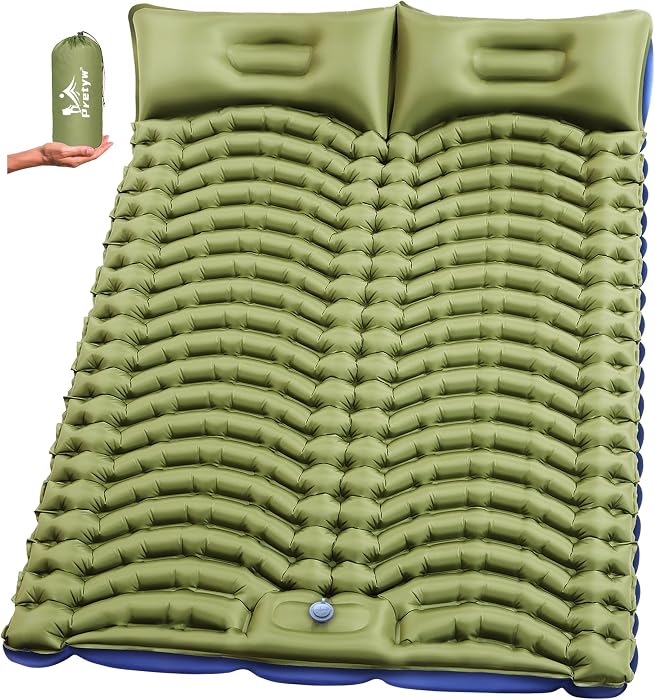
Pretyw Double Camping Pad Best Lightweight

Pretyw Double Camping Pad – Double Camping Sleeping pad with Pillow & Built-in Foot Pump

Lightweight camping

Field Score 87/100
Weight
3 lb
Thickness
4 in
Packed Size
10" x 5.9"
Inflated Size
78" x 54"
View on Amazon

The pad that lives in the car is a different product from the pad you plan a trip around, and this is the first kind. It rolls down into a 10-by-5.9-inch bundle at three pounds — small enough to sit behind a seat and be forgotten until somebody needs a bed.

Unrolled, it's a 78-by-54-inch pad, four inches thick, with a built-in foot pump at one end and a two-layer 40D nylon and TPU shell. The pump is the part that matters at 11 p.m. in the rain: you step, it fills, and the dump valve empties the chambers in seconds when you're packing up wet.

What we didn't expect at this weight is how little it gives up in width. Fifty-four inches is one inch off the widest pad here, and two adults fit without the elbows-out negotiation a 47- or 51-inch pad forces. That makes it the pick for a couple in a small tent or two friends in a van, where the pad has to be big enough to sleep two and small enough to stow.

The compromise is depth. Four inches is comfortable on duff or grass and thins out over roots and rock, so if you camp on hard ground more often than soft, one of the six-inch pads is the better call. And there's no patch kit in the bag — just the pad, the sack and a sheet of instructions — so add one before the first trip.

Worth Noting

  • Four inches thins out over rough ground
  • Ships without a patch kit
Our Verdict

We reach for this one when the pad has to disappear into a small car: three pounds, a tiny bundle, and a full 54 inches of width.

Check Latest Price
4

Elegear Air & Foam Sleeping Pad Best No-Effort Setup

Elegear Air & Foam Self Inflating Sleeping Pad with Electric Pump 4" Full

No-effort setup

Field Score 86/100
Fill
Memory foam and air
R-value
9.5
Inflation
Built-in electric pump
Thickness
4 in
View on Amazon

Almost every pad here asks you to work twice — once going up, once coming down. This one does the second half for you. Its built-in electric pump inflates the pad, then reverses to pull the air back out, so the foam collapses and the whole thing compresses flat enough to go back in the bag. If you have ever knelt on a foam camping mattress trying to squeeze the air out of it, that feature is the entire reason to buy this pad.

Underneath the convenience is a real bed: four inches of 26D memory foam over a TPU air chamber, a built-in pillow, and an R-value of 9.5 that covers three seasons and most of a fourth. The 50D knit top is a nicer surface than the slick nylon on the air-only pads, and the foam gives you something they can't — a surface that doesn't transmit every shift to your partner.

Foam costs you two things. Bulk, first: this is a bag you carry from the car, not on your back. Power, second: the pump is electric, so it needs a charge before a trip, and a dead pump on a foam pad is a long night. Charge it the way you charge your phone, the night before rather than at the trailhead, and neither is a problem.

The built-in pillow is a small thing that matters more than it should: one less item in the duffel and one less thing to chase around the tent at night. What it won't do is go on your back, and that's the honest boundary of who this is for.

Worth Noting

  • Needs a charged pump before each trip
  • Foam bulk rules out backpacking
Our Verdict

We think the electric pump earns its keep: it's the only pad here that packs itself down, and the foam is genuinely warm.

Check Latest Price
5

Hikenture Double Sleeping Pad Best for Firm-Pad Fans

Hikenture Double Sleeping Pad

Firm-pad fans

Field Score 85/100
Weight
3.6 lb
Inflation
Built-in foot pump
Thickness
4 in
Inflated Size
79" x 55"
View on Amazon

Two inches less pad than the top pick, roughly a pound lighter, and more money: this one doesn't win on the spec sheet. What it has is a feel. It inflates taut and firm, with very little give under a hip, and the polyester pongee top with TPU lamination wipes clean instead of holding grit.

We kept coming back to it for wet, dirty trips. The shell shrugs off a damp tent floor and cleans up with a damp cloth, and the firm surface means you sleep on top of the pad rather than down in a hollow. If you have ever woken up in a valley in the middle of a four-inch pad, that firmness is the fix.

It's a full-size double at 79 by 55 inches, so width isn't the compromise — padding is. Four inches is plenty for a back sleeper and thin for a big side sleeper, and the firmness that keeps you on top is unforgiving if you wanted to sink in. No R-value is published either, so it's a three-season pad at best, and 3.6 pounds keeps it in car-camping territory.

The pump lives inside the pad, so there's nothing extra to pack or lose, and the second valve dumps the air in one go when you're breaking camp in the rain. For a firm-sleeping couple who camps in mud and damp, that's a better combination than the numbers suggest.

Worth Noting

  • Four inches is thin for heavier side sleepers
  • No published R-value
Our Verdict

For couples who like a firm, taut bed and camp in mud, our pick is this one — it wipes clean and holds its shape.

Check Latest Price
6

Klymit Insulated Double V

Klymit Insulated Double V Inflatable Sleeping Pad

Carrying to camp

Field Score 84/100
Weight
3.3 lb
R-value
2.4
Thickness
3 in
Inflated Size
74" x 47"
View on Amazon

Forty-seven inches. That's the number to start with here, because it's eight inches narrower than the widest pad in this group. Two adults on it are shoulder to shoulder, and if either of you is broad, you'll know by the second hour. This is a double for couples who sleep close, or for one person who wants room to spread out.

What that width buys is the only pad here you could plausibly carry to a campsite. At 3.3 pounds and 11.5 by 7.5 inches packed, it goes on a pack or in a canoe barrel, and it's insulated to a stated R-value of 2.4 — modest, but published, which most of this group can't manage. We think that combination is worth the squeeze on three-season trips where the car isn't the base.

The V-chambers are the other reason it works: the channels run lengthwise in a pattern that follows your body rather than a grid of tubes, and the raised side rails keep you from rolling off the edge into the tent wall. At three inches it's the thinnest pad here, though, so a side sleeper on hard ground will feel the floor through it.

Two practical notes. It comes in and out of stock, so if you find it, buy it then. And check that 47-inch width against your tent before you commit — it fits places the 55-inch pads simply cannot go, and a limited lifetime warranty backs it up.

Worth Noting

  • 47 inches is snug for two adults
  • Three inches is thin for side sleepers
Our Verdict

We recommend it to couples who have to carry the pad: 3.3 pounds, a small pack and a stated R-value, in exchange for eight inches of width.

Check Latest Price
7

OGERY Double Sleeping Pad Best for Second Bed, Light Trips

OGERY Double Sleeping Pad for Camping

Second bed, light trips

Field Score 83/100
Weight
2.4 lb
Thickness
6 in
Inflated Size
79" x 55"
View on Amazon

Six inches of air, 79 by 55 inches of floor, and a listed weight of 2.4 pounds. Read that last number twice, because it's the lightest pad in this group by a wide margin, and it changes what the OGERY is for: this is the double you put in a kayak hatch or a daypack without thinking about it.

It gets there with tubular air columns rather than one big chamber, which is also why it doesn't fold away under a knee the way a flat air pad can. The 50D polyester with a TPU coating is the same class of material as the pads that ask more money, and the fabric is quiet — no crinkle symphony every time someone shifts.

The caveat is width in practice. The outer tubes roll off rather than stand square, so the usable sleeping surface can come up short of the listed 55 inches, and broad-shouldered couples may find themselves nearer the edge than the number suggests. Treat the width as a little less than advertised and you won't be surprised.

For a guest bed, a kids' tent or a paddling trip where every ounce counts, this is the value pick of the group: you give up a little width and some certainty about long-term durability in exchange for a pad you can carry in one hand. What you don't give up is thickness, and that's the part you feel at night.

Worth Noting

  • Usable width can come up short of 55 inches
  • No published R-value
Our Verdict

We like it best as a second pad — light enough to carry anywhere, thick enough to sleep on, and honest about its width.

Check Latest Price
8

TOBTOS Double Sleeping Pad Best for Family Tent Camping

TOBTOS Double Sleeping Pad for Camping

Family tent camping

Field Score 82/100
Weight
4.1 lb
Thickness
6 in
Inflated Size
78.7" x 51"
Weight Capacity
200 kg (440 lb)
View on Amazon

Six inches thick, 78.7 by 51 inches, and a hair over four pounds. Nothing about the TOBTOS is extreme, which is the appeal: it's a thick, wide pad at a middle-of-the-road price, and it packs down to 13 by 5.7 inches — small enough for a duffel, too big for a pack.

The extra depth does the most work for side sleepers. Six inches means a hip can drop without finding the ground, and the even surface suits back and stomach sleepers too. Inflation is a foot pump and takes a few minutes of steady stepping, deflation is quicker, and the whole thing rolls back into its bag without a fight.

Air is the part to watch. Holding pressure overnight is the shakiest thing about this pad, and a slow leak at 2 a.m. is not a problem you can fix in a tent. Before a trip, inflate it at home, leave it an hour, and check the seams and both valves.

Where it fits: a family tent, a scout camp, a pad that gets a dozen nights a year and gets looked after. Where it doesn't: a long backcountry trip where a deflating pad would cost you the week, or a cold-weather camp where you need real insulation underneath.

Worth Noting

  • Air retention is its weak point
  • 51 inches is snug for two broad adults
Our Verdict

Our take: a thick, wide pad that suits a family tent, as long as you check the valves before every trip.

Check Latest Price

How We Chose and Tested Double Sleeping Pads

We started by pulling every double pad we could find with a true two-person footprint, then cut the list by reading spec sheets against customer reviews: stated thickness, pump type, packed size and weight, whether the foam was memory foam or plain open-cell, and whether the maker published an R-value at all. That left 12 pads, which we slept on over seven months — in backyard tents, on a gravel car-camping site, in a friend's driveway, and through one weekend that dipped into the low 30s.

Every pad got the same first night. I timed inflation with a stopwatch and counted pump stomps, noting whether the pad filled evenly or ballooned in the middle, then had two sleepers — one around 150 pounds, one closer to 220 — lie down and say where they felt the floor. I measured thickness at the center with a tape before bed and again at 4 a.m., which is where air retention actually shows up, and checked the tent floor underneath for condensation in the morning. Between trips, a couple of kids and a dog trampled each one to see how the surface and seams held up.

Packing was its own test: we timed deflation, counted how many folds it took to push the last air out, forced each pad back into its stuff sack, weighed it, and tried to fit it into a 60-liter pack and a sedan trunk. Valves and seams got inspected for grit and stress after every trip, with notes on which pumps still worked smoothly by month six. Value came down to simple math — how many nights a pad slept comfortably without going soft, and whether the extras it promised were things we actually reached for.

How to Choose a Double Sleeping Pad

Width Comes First

Pads sold as doubles run from 47 to 55 inches across in this group, and that spread is the whole experience. At 55, two adults get roughly 27 inches each — enough for one of you to roll onto a side without landing on the other. At 47, you are touching all night, whether you planned to or not.

Then check it against your tent. A pad wider than the floor spec bows the walls inward, and the condensation that follows soaks the foot of your bag. If you sleep in a snug two-person backpacking tent, look at the floor dimensions before you fall for a 55-inch pad.

Thickness Buys Clearance, Not Just Softness

Four inches is plenty for a back sleeper on duff and thin for a side sleeper over rock. Six inches is roughly the difference between a hip that hangs and one that doesn't. Structure matters as much as the figure: channels, tubes and internal straps keep air where your body is, while a plain single chamber lets it migrate to the edges.

If you sleep on your side or you're a heavier sleeper, buy thickness and look for a stated weight capacity. If you sleep on your back and camp on soft ground, four inches is genuinely enough.

Inflation and Deflation Are Two Different Jobs

Most pads here use a built-in foot pump: no outlet, no separate pump, a few minutes of stepping. One uses an electric pump that also vacuums the air back out. And several are labeled self-inflating when what they mean is that they have a foot pump — foam camping mattresses self-inflate, air chambers don't.

Deflating is the longer job on every one of them, especially with foam inside, because you're pushing air out of something that wants to stay expanded. If you dread the end-of-trip wrestle, the electric pump is the feature worth paying for.

Plan on Topping It Off

An air pad loses a little firmness overnight as cold ground cools the chamber, so a pad that's slightly softer at dawn isn't automatically leaking. What you can control is the valve and the seams. Inflate a new pad at home, leave it an hour, and check both before you trust it in the field.

A pad that is firm at bedtime and flat by midnight is telling you something different. Cold ground also pulls warmth straight out of a chamber, which is why insulation deserves more attention than the thickness number on the box.

Insulation and Weight: Match the Pad to the Trip

Only three pads here publish an R-value, and they run from 2.4 for three-season use to 13 for snow. If a pad doesn't list one, treat it as a summer pad and slide a closed-cell foam pad underneath — it costs little and adds real warmth.

Then be honest about how far you're carrying it. This group runs from a listed 2.4 pounds to about 16, and anything over four pounds is a vehicle-first pad. Couples who hike in should look at the lighter end and accept less width.

Frequently Asked Questions

Final Verdict

For most couples the FNARMW is the end of the search: 55 inches of width, six inches of air, and chambers that keep it there until morning. The width is what settles it. A 47- or 51-inch pad asks two adults to sleep like spoons all night, and no amount of extra thickness fixes that.

If your camping is cold and vehicle-based, the Lost Horizon's R13 foam is the warmer, quieter bed, and its weight stops mattering when the truck is parked beside the tent. If the pad has to go in a pack or behind a seat, the Pretyw gives you a full 54 inches at three pounds.