The 7 Best Electric Fence Testers of 2026

An electric fence never announces that it's failed. It looks just like a working fence, which is why most people find out about a short when the livestock are already out. A tester tells you the fence is weak before that happens — and the better ones tell you which direction the fault lies, so you're not walking half a mile of tape twice.

I've carried one in the truck since a frosty morning spent hunting a short by hand. Over the past four months, my team and I walked fence line with 14 testers on poly tape, high-tensile wire, and goat netting. The keepers were the ones I could read in full sun, with gloves on, one-handed.

Here's what first-time buyers miss: volts only tell you the fence is weak, while current tells you where. Range matters too, since a tester whose scale starts at 2kV reads nothing at all on a fence limping along at 1.5kV — and that limping fence is the one you're out there checking. The picks below are the ones that held up.

Our Top Picks

The 7 Best Electric Fence Testers of 2026

1

Gallagher SmartFix G50905 Best Overall

Gallagher SmartFix Fence Volt & Current Meter

Long multi-pasture runs

Field Score 91/100
Display
Backlit LCD
Measures
Voltage and current
Warranty
1 year
Fault Direction
Directional arrows
View on Amazon

Most fence testers give you a number. The Gallagher SmartFix gives you a number and a direction. It reads voltage and current at the same time and puts an arrow on the screen pointing toward the fault, so instead of walking a run post by post you follow the current downhill to where it's leaking. High-tensile, braid, tape, polywire, netting: it doesn't care which, and it doesn't need a ground probe pushed into the dirt to take a reading.

That pairing is why it sits at the top of this group. A voltmeter tells you the fence is weak; current plus direction tells you where the weakness is, and on a rotational-grazing layout with a dozen paddocks that's the difference between a short walk and an afternoon of squinting at insulators. Everything else supports that job: volts and amps on one backlit screen you can read at dusk, a weather-resistant case, and a body small enough to leave in the truck door.

The no-probe design earns its keep on tall fences. On netting or a four-foot tape run, a tester with a lead and a ground rod has to reach soil from wherever you happen to be standing, and that's often the fiddliest part of the check. Here you hold the unit against the conductor and read.

One thing to be clear about before you buy: it's a diagnostic tool, not a monitor. It won't tell you a fence went down while you were in the house, because that's an indicator lamp's job and a different purchase. What it does is shorten the search once you already know something is wrong.

Worth Noting

  • Premium price
  • One-year warranty
Our Verdict

We point anyone maintaining more than a paddock or two at the SmartFix: it reads volts and amps and shows you which way the fault lies, with no ground probe to plant.

Check Latest Price
2

Speedrite ST100 Fault Finder Best for Comparing Fence Sections

Speedrite ST100 Fault Finder – Digital Fault Finder

Comparing fence sections

Field Score 89/100
Alert
Audible current indicator
Power
Replaceable 9V with low-battery warning
Measures
Voltage, current, direction
Previous Reading
Stored for comparison
View on Amazon

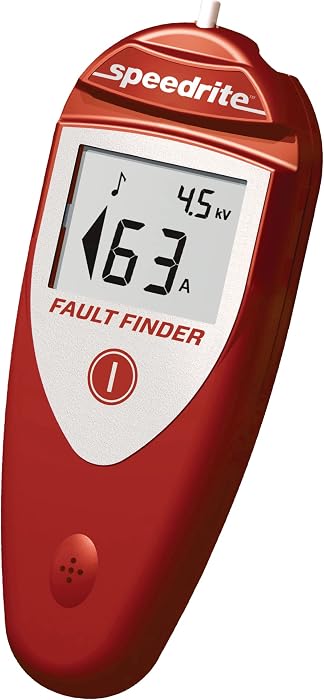
Set the Speedrite beside our top pick and the job is the same; the screen is what differs. Voltage, current, and current direction all sit on the display at once, and the unit holds the previous current reading so you can compare the post you just tested with the one in front of you. There's an audible current indicator as well, which means you can hear the load change without breaking stride to stare at a number.

The case is built for a truck bed: insulated, water-resistant, with a belt clip, running on a replaceable 9V that carries a low-battery warning. That warning matters more than it sounds. A meter with a fading cell gives you a quiet wrong answer, and quiet wrong answers are how a fence that was fine ends up rewired.

We give the SmartFix the edge on convenience and this one the edge on information. If you work a long run in sections, such as a vineyard row or a lane between paddocks, comparing each reading against the last is the feature you'll use every time.

Worth Noting

  • Costs as much as our top pick
Our Verdict

Between the premium pair, this is the one for reading current as well as seeing it: three values at once, an audible indicator, and stored readings to compare.

Check Latest Price
3

Gallagher G503014 Digital Tester Best Midrange Voltage Tester

Gallagher Digital Electric Fence Tester

Everyday voltage checks

Field Score 88/100
Range
0 to 12,000 volts
Housing
Water-resistant, auto turn-on
Included
Ground probe, fence stud, 9V battery
Resolution
100 V below 10 kV
View on Amazon

The G503014 reads voltage and nothing else, and for a great many fences that is the entire question: is the tape at the far gate still hot, or isn't it? Twelve thousand volts of range, a number on a screen, auto turn-on when it touches the fence, and a water-resistant housing. We hand this one to people who ask what they actually need rather than what the catalog says is best.

It comes with the parts that go missing: a ground rod probe, a fence stud for contact, and a 9V battery that Gallagher rates at six to twelve months. Resolution is 100 volts below 10 kV and 1,000-volt steps above it, fine enough to watch a fence sag post by post across a couple of paddocks.

What you give up is the amp reading, and that changes how you find a fault: read at the energizer, then at each post, and let the drop tell you where to look. Across two or three paddocks that's a short walk. Along a mile of high-tensile it's the afternoon the fault finders exist to save you, so match the tool to the fence rather than the other way around.

Worth Noting

  • Voltage only, no amps or direction
  • Coarse 1,000 V steps above 10 kV
Our Verdict

If your fence checks are about whether a strand is hot, this Gallagher does the job cleanly at a midrange price, probe and battery in the box.

Check Latest Price
4

allsun Digital Fence Tester Best Budget Digital

allsun Electric Fence Tester

Budget daylight readings

Field Score 87/100
Power
Pulse wake, 4-second shutoff
Range
300 V to 9.9 kV
Battery
Not included
Display
Digital LCD
View on Amazon

The display is the whole argument. Plenty of inexpensive testers get judged at dusk because that's the only time their lights show up; this one has an LCD that stays legible in full sun, which is exactly when you're standing in a field deciding whether the fence is doing its job. It wakes when it senses a pulse and shuts down four seconds later, so there's no power button to leave on and no flat battery next spring.

At the budget end of the digital group this is the one we reach for. Real numbers rather than a ladder of lamps, a screen you can read at arm's length, and a slim body that drops into a jacket pocket. We treat the figure as a comparison rather than a calibration: the same meter reading high at one post and lower at the next tells you everything you need, even if it runs a little off against a bench instrument.

The ceiling is 9.9 kV, which covers the battery and solar energizers most smallholdings run and won't cover a big mains unit. Below that it's straightforward: hook it on, read the pulse, move on. For a few strands of horse tape and a solar unit at the corner of the barn, that's the whole job.

Worth Noting

  • Battery not included
  • Tops out at 9.9 kV
Our Verdict

The budget digital we hand to smallholders: a big LCD you can read at noon, real numbers, and pulse-wake power that never gets left on.

Check Latest Price
5

FenceMate FT5501 Digital Volt Meter Best for High-Voltage Energizers

FenceMate Digital Volt Meter for Electric Fence

High-voltage energizers

Field Score 83/100
Range
Up to 15,000 volts
Display
Large LCD, auto on/off
Housing
Polymer with reverse-connection protection
Included
Grounding and 9V battery
View on Amazon

Fifteen thousand volts is the highest ceiling among the inexpensive digitals here, and that's the whole reason to pick it. If your energizer is a big mains unit pushing serious voltage down a long boundary, the cheap meters that stop at 9.9 kV can't tell you what you're actually running.

It shows up ready to work: grounding and a 9V battery in the box, a large LCD, automatic on and off so it isn't draining between checks, and reverse-connection protection for the day you hook it up wrong. The housing is molded polymer with a grip that doesn't slip in a wet hand.

We rate it the meter that lives in the truck: inexpensive enough to own two of, high enough in range to read anything on the place, and self-contained enough that you're not hunting for a ground lead. It reads volts only, so you're still walking the run to find the fault. That's the trade you make for the money.

Worth Noting

  • Voltage only, no amps or direction
Our Verdict

Buy it if your energizer runs hot: 15,000 volts of range, grounding and a battery in the box, for less than the fault finders.

Check Latest Price
6

M MINGYA 15kV Fault Finder Best for Mid-Price Fault Finding

M MINGYA 15kV Fault Finder – Electric Fence Tester and Fault Finder

Mid-price fault finding

Field Score 82/100
Range
200 V to 15 kV
Battery
9V included
Display
Backlit LCD
Measures
Volts, amps, current direction
View on Amazon

Volts, amps, and current direction on one backlit screen is normally a premium purchase. The M MINGYA does it at a midrange price and across a range from 200 volts to 15 kV, which covers everything from a pony strip to a mains energizer.

The rest of the package is sensible: a backlight for early and late checks, a belt clip so it's on you rather than in the truck, and a replaceable 9V in the box. Hold the metal top to the conductor, press the button, and the screen shows all three values at once.

Where it gives ground is in the hand. The housing is the least substantial of the fault finders here, and the readings are the part we trust least once the numbers start moving around. For occasional use that's a fair trade; for a tool that rides on the truck seat every day, it's the reason to spend more.

We keep it on the list because it's the least expensive way into direction finding, and direction is what turns a fence tester into a fault finder. Run a few horses on a mile of tape and want to know which way the current is leaking without paying premium money, and this is the one that gets you there.

Worth Noting

  • Housing feels light for the price
  • Readings less steady than the premium units
Our Verdict

The cheapest route to volts, amps, and direction on one screen. We like it for occasional fault hunting, not for a tool that lives in the truck.

Check Latest Price
7

L-FENCE 8-Light Tester

L-FENCE 8-Light Tester – Electric Fence Voltage Tester

Battery-free backup

Field Score 81/100
Power
No batteries required
Range
2 kV to 12 kV
Display
8 neon indicator lights
Included
Ground rod
View on Amazon

There's no battery in this tester because there's nothing in it that needs one. Eight neon lamps light in sequence as the fence pulse climbs from 2 kV to 12 kV, and the pulse itself is what lights them, so the failure that ends most testers' usefulness, a dead cell on the morning you need a reading, can't happen. For a tool that lives in a truck box through a winter, that's worth more than a decimal place.

Using it is two steps: hook the top over the wire or tape, push the copper probe into the soil, and count the lamps that fire. Walk the run and the count drops where the fault is. The shell is cold-resistant ABS with a matte finish that doesn't glare, and the body is comfortable to hold with cold hands.

The lamps are the limit. In direct sun they wash out and you'll be shading the unit with your hat to count them; in shade, at dawn, or once the sun drops they're clear. If your rounds happen at midday, buy a display. This is the dusk meter and the glovebox spare, the one that still works when everything else needs a battery.

Worth Noting

  • Lamps wash out in direct sunlight
  • Reads in light steps, not volts
Our Verdict

Keep one in the truck: no battery to die, eight lamps to show a voltage drop, and a price that makes a second tester an easy yes.

Check Latest Price

How We Tested Electric Fence Testers

I started with the listings rather than the hardware, reading what each tester claimed to measure, whether it read current as well as voltage, what battery it took, and how big the display was. From that pile I pulled 14: digital units with backlights and directional arrows, a couple of plain volt-only meters, and one battery-free neon model, because I wanted to know whether the extras were worth carrying. Every one of them went onto the same fences.

Those fences were real working ones — a six-acre horse pasture strung with poly tape, a cattle paddock on high-tensile wire, a goat pen of electro-net, and a garden bed running off a small energizer. Each tester rode in a truck door pocket for four months, got used with leather work gloves on, and got rained on.

To check accuracy, I took every reading on the same live wire and compared how far apart the 14 landed. To check fault-finding, I shorted the fence on purpose, first with a wet branch laid across the tape and then with a steel post leaned into the wire, and timed how long each unit took to flag it and whether its arrows pointed toward the short or away from it. Readability got checked at noon and again at dusk; the meters I could read in glare without crouching stayed in the rotation.

Durability came free with the job, since units got dropped off fence posts onto gravel and left in the truck bed through a cold snap. I also left the battery-powered models switched on to see whether auto-shutoff actually saved them, and noted which ones arrived with a battery in the box. What separated the top picks was rarely the spec sheet — it was whether the thing handed me a number I trusted in the ten seconds before the horses noticed the gate was open.

How to Choose an Electric Fence Tester

Voltage, Current, and Direction

Every tester here reads voltage. The ones that earn their price read current as well, and the best of them show which way that current is flowing. That's the difference between knowing a fence is weak and knowing which direction to walk to find out why.

On a couple of paddocks and a gate, voltage alone is plenty. On a long run, a rotational-grazing layout, or anything split into several zones, pay for amps and direction; the walking you save is the whole point. A unit that only lights up is a fault finder in name only.

Read It in Daylight

The most common complaint about fence testers is legibility, and it splits cleanly by display type. Neon and lamp units are cheap and battery-free, but their glow is faint against a bright sky, so they're dusk-and-dawn tools. An LCD gives you a number you can read at midday.

If your rounds happen before work or after supper, save the money and buy a lamp unit. If you check fences in the middle of the day with the sun on your back, buy the display.

Match the Range to Your Energizer

A tester that maxes out below your fence's output will simply pin at the top of its scale. Find the energizer's rated output, printed on the case or the box, and buy a tester that reads above it. Most battery and solar units on small farms sit comfortably inside the 9.9 to 15 kV digitals.

Higher range doesn't buy accuracy at low voltages; it buys headroom. A 15 kV meter reading a 4 kV fence is doing easy work.

Grounding and Leads

A tester works by completing a circuit from the fence to the soil, which is why most come with a ground rod or a probe on a lead. On tall netting or a four-foot tape fence, that lead has to reach the ground from where you're standing, and a short one turns a two-second check into a stretch and a reach.

Measure your tallest fence before you buy. Or choose a unit that reads current direction without a ground connection at all, which removes the problem rather than solving it.

Power and Upkeep

Most digitals run on a 9V, and some ship with one and some don't, so check the box before the season starts. A meter with a fading cell gives wrong readings rather than none, which is worse than a dead one. A low-battery warning is worth having for exactly that reason.

Pulse-wake circuits and auto shutoff stretch a battery across a season. If you know you'll forget to replace it, the battery-free neon units never leave you guessing, at the cost of precision.

Frequently Asked Questions

Final Verdict

Our default is the Gallagher SmartFix. It's premium money, and it earns it: volts, amps, and a direction to walk, all without a ground probe, which is what makes a long run quick to troubleshoot instead of a job you keep putting off.

If you only need a number you can read at noon, the allsun digital does that for a fraction of the cost. If you work a fence in sections and want to hear the current change as well as see it, the Speedrite's stored readings and audible indicator are worth the premium.