The 7 Best Solar Fence Chargers of 2026

A fence charger sends a short, sharp pulse down the wire every second or so, and whatever touches it does the rest. The choosing is the messy part. A unit billed for 20 miles can struggle at the far end of a quarter-mile run once the grass comes up — joules, not miles, are the real measure of punch. What you're buying is animals that stay put, predators that stay out, and no extension cord snaking to the back fence.

I've stood in wet grass at dusk with a voltage tester more than once, and I'm not the only one on my team who has. Over the past six months we've run 12 solar chargers on chicken coops, apiaries, garden beds, and a small goat pasture. What separated them was rarely the headline number — it was whether they still read strong voltage after a week of gray skies.

Here's what nobody tells a first-time buyer: a short-circuit alarm sounds like a gimmick until a branch drops across your wire at midnight. Setup that makes sense without the manual matters more than half the numbers on the box. The picks below are sorted by what each one is genuinely good at.

Our Top Picks

The 7 Best Solar Fence Chargers of 2026

1

Gallagher S12 Solar Energizer Best Overall

Gallagher S12 0.12J Solar Electric Fence Charger

Small pastures, gardens

Field Score 88/100
Mount
Grounding rod up to 0.5 in.
Battery
Lithium, 3-year warranty
Output Energy
0.12 joules
Fence Coverage
Up to 4 miles
View on Amazon

The S12 hangs on the ground rod instead of a wooden post, and that rod does double duty as its earth connection. You drive one rod, clamp the unit to it, and the fence is grounded: no second wire to run, no bracket to line up, no separate ground clamp to lose in the grass. Of the installs we did, this was the one that took a single trip to the truck.

The output is modest, at 0.12 joules over a rated 4 miles, which puts it in poultry-net, goat-paddock, and garden-perimeter territory rather than the back forty. What matters more to us is how it behaves when the weather turns. This is the charger in this group with the most convincing record of holding a usable charge through smoke, cloud, and short winter days, which is exactly when a cheap panel folds. Give it two or three days in direct sun before you connect it to anything.

Three years of coverage is the longest warranty here by a wide margin, and it is a large part of why we are comfortable calling a low-output unit the default. Buy a rod with it, up to half an inch in diameter and unpainted, and check the clamp that grips that rod once a year: it sits in weather and is the part most likely to let you down. The charger will outlast it.

Worth Noting

  • Ground rod sold separately
  • 0.12 joules suits only small fences
Our Verdict

We recommend the S12 for a small pasture, poultry run, or garden with no power nearby: one rod to drive, steady output in poor light, and the longest warranty in this group.

Check Latest Price
2

Parmak DF-SP-LI Best for Large Pastures

Parmak DF-SP-LI Electric Fencer

Large cattle pastures

Field Score 85/100
Battery
Sealed 6V rechargeable
Output Energy
1.6 joules
Backup Runtime
21 days without sun
Fence Coverage
Up to 25 miles
View on Amazon

Parmak's DF-SP-LI puts out 1.6 joules, more than ten times what our top pick delivers, and it is rated for 25 miles of fence. That gap is the whole story of this charger: it is built for the person running cattle or horses along a real fence line, where a small energizer disappears.

Joules are the honest number on a fence charger, but they are also the number that gets spent fastest. A long run of high-tensile wire, a wet season, weeds leaning on the bottom strand, electric netting: each of those eats into what reaches the far end, and a mile of fence can read a fraction of what the unit puts out at the terminal. This one has the headroom to absorb that in a way the 0.12 and 0.32 joule units here simply do not.

It is also the least forgiving of a rushed install. The sealed 6V battery is rated for 21 days in total darkness and the housing is weatherproof, but battery life and longevity are where it is least convincing, and when one of these goes it tends to be the main unit rather than the battery you could swap. At this end of the price range, plan for a solid post or wall and a ground rod you are happy to keep for years.

What stuck with us is where these turn up: bear fencing around beehives, where a short perimeter needs a hard pulse and a 25-mile rating is beside the point. That is a fair picture of what 1.6 joules buys, a short fence nobody argues with. If your fence is long and your animals are big, this is the one; for anything smaller, it is more charger than the job requires.

Worth Noting

  • Battery life and longevity are the weak spots
  • Bulky 17 x 8 x 13 in. housing
Our Verdict

We point cattle and horse owners at the Parmak when the run is long and the budget is not the constraint: 1.6 joules, three weeks of dark-weather runtime, and headroom for a real fence line.

Check Latest Price
3

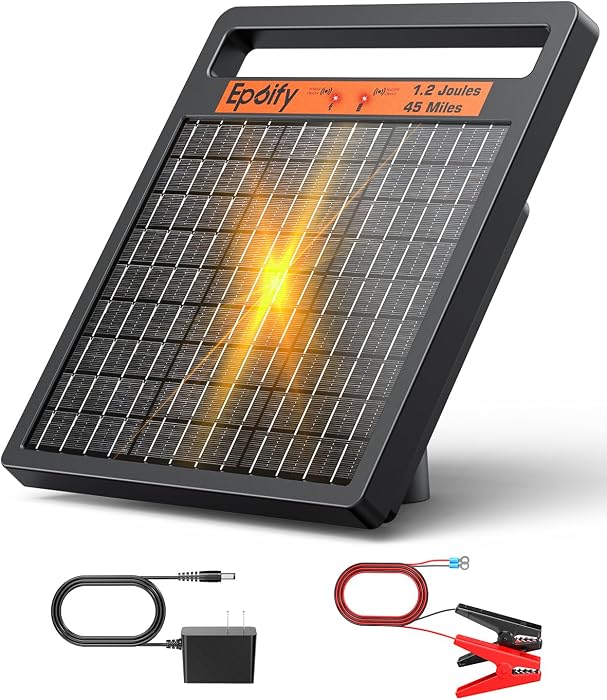
Epoify 1.2J 45-Mile Best for Big Coverage on a Budget

Epoify 1.2J 45-Mile – Solar Electric Fence Charger

Long fence runs

Field Score 84/100
Backup
AC adapter included
Solar Panel
8 watts
Output Energy
1.2 joules
Fence Coverage
Up to 45 miles
View on Amazon

Forty-five miles and 1.2 joules from a unit that costs less than our top pick: that is the pitch, and on paper it is the most coverage per dollar here. We read the mileage as a best case of clean wire, dry ground, good grounding, and a panel in full sun. Even discounted by half, it is a lot of energizer for the money.

What sold us on it for rough ground is the switch. A magnet held against the housing turns the unit on and off, so you are not unscrewing a lid in the rain or hunting for a rocker with gloves on. It also takes the included AC adapter for a full charge before it ever goes out to the fence, which beats waiting on the panel during a wet week.

The weak point is connection quality. A bad joint at the fence wire undoes a good charger faster than anything else, and this is the pick where the supplied alligator clips come up short; on a 12-gauge run, skip them and terminate with split bolts or proper connectors. Do that, and the LD02 is a serious amount of power for a rented field or a fence line across a ditch.

Worth Noting

  • Supplied clips make a poor connection
Our Verdict

For a long, rough fence line on a mid-range budget, we reach for the LD02: 1.2 joules, an eight-watt panel, and a magnetic switch you can work in gloves.

Check Latest Price
4

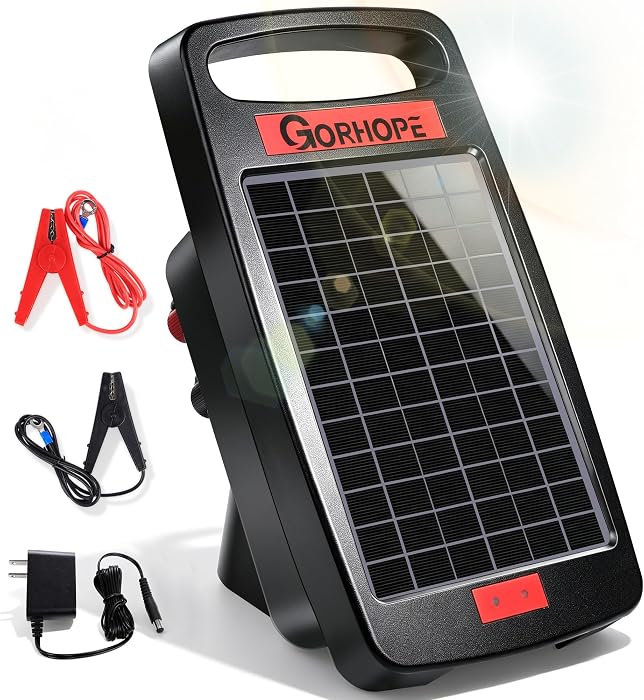
Gorhope 0.32J 20-Mile Best for Finding Faults

Gorhope 0.32J 20-Mile – 20 Miles Solar Electric Fence Charger with Short Circuit Alarm

Troubleshooting shorts

Field Score 83/100
Alarm
Short-circuit buzzer
Output Energy
0.32 joules
Backup Runtime
14 days without sun
Fence Coverage
Up to 20 miles
View on Amazon

Walking a fence line looking for the short is the worst job on an electric fence, and it is the one this charger takes off you. When vegetation, a broken wire, or a loose connection drags the fence down, a buzzer at the housing sounds off, so you know there is a fault before you go looking.

We rate that above the mile count. Twenty miles of fence that is grounded out reads zero no matter what the box says, and an alarm is the difference between finding a problem in ten minutes and finding it next week. The rest of the package is sensible: 0.32 joules, a tempered-glass panel, a lithium battery rated for 14 days without sun, and a housing that shrugs off weather.

Two things to plan for. Charging is the part to watch, because a run of gray days can leave this one short, so give the panel an unobstructed south-facing spot and keep the glass clean. And in sandy or dry ground, one rod may not be enough; drive a second before you blame the unit. Do both and you have a dependable small-pasture charger with a feature nothing else here has.

Worth Noting

  • Output sags after gray days
  • Needs a second rod in sandy soil
Our Verdict

We steer small-pasture and poultry owners to the Gorhope when hunting shorts has worn them out: the buzzer points at the fault, and 0.32 joules holds a real fence.

Check Latest Price
5

ANDMON MINI250 Best for Rotational Grazing

ANDMON MINI250 – MINI250 Solar Electric Fence Charger with Day or Night Mode

Rotational grazing

Field Score 82/100
Mount
360° T-post rotation
Weight
8.3 lb
Output Energy
0.25 joules
Fence Coverage
Up to 12 miles
View on Amazon

If your fence moves, whether that is strip grazing, a lane you close off, or a pen you drag to fresh grass, the MINI250 is built around that routine. It rotates on a T-post so you can face the panel into the sun without unbolting anything, and its night setting lengthens the pulse interval to stretch the battery through the dark hours.

At 8.3 pounds it is the heaviest unit we recommend here, and that is the trade for a sealed all-in-one body with the panel and battery in the same housing. Hanging it on a T-post makes the post carry the weight rather than your arm, but you still haul it out there, and moving fence twice a week makes that add up. The 0.25-joule, 12-mile rating is honest middle ground: enough for a paddock of goats or a pony, not for a section of cattle.

Unbox it and connect the battery before anything else, because the red lead ships disconnected, and a charger that seems dead is usually just that. Nothing about the housing feels fragile, and the 360-degree mount is the detail that makes it worth choosing over a cheaper fixed unit.

Worth Noting

  • 8.3 pounds, heaviest of these picks
Our Verdict

We hand the MINI250 to anyone moving fence every few days: it swings to face the sun on its T-post, slows its pulse at night, and holds a small paddock at 0.25 joules.

Check Latest Price
6

Epoify 20-Mile Energizer Best for Chicken Runs, Gardens

Epoify 20-Mile Energizer – Solar Fence Charger

Chicken runs, gardens

Field Score 81/100
Warranty
12 months
Dimensions
8.26 x 4.3 x 6.69 in.
Fence Coverage
Up to 20 miles
Output Voltage
5,700–10,200 V
View on Amazon

The listing for this one cannot agree with itself: the title says 0.32 joules, the description says 0.18. Whichever figure is right, treat it as a small-fence energizer for chicken runs, garden perimeters, and a pen for the dogs, and it makes sense.

Setup is the easy part: two cables, a ground rod, a post, and you are live. The 20-mile rating is the number that sells it, and it does run a real garden or poultry fence with a pulse that gets an animal's attention. The all-in-one body also moves between fences without tools, which is why it stays useful after the first installation.

Where it comes apart is charging. A small panel and a long gray spell can leave the fence reading low, and the failures that show up tend to be electrical rather than mechanical, so there is nothing to tighten. Buy it for a small enclosure, keep the panel facing the sun with nothing shading it, and do not ask a 20-mile rating to hold a mile of high-tensile wire. This is a charger for the near fence, not the far one.

Worth Noting

  • Output fades in long gray spells
Our Verdict

We point first-time fence builders at the LD01P for a chicken run or garden: quick to hang, modest money, and enough pulse for a small enclosure, as long as the panel sees sun.

Check Latest Price
7

EVIORTER 0.11J 10-Mile Best for Small Garden Fences

EVIORTER 0.11J 10-Mile – Solar Electric Fence Charger-0.11J-10 Miles

Small garden fences

Field Score 80/100
Solar Panel
5 watts
Output Energy
0.11 joules
Backup Runtime
30 days without sun
Fence Coverage
Up to 10 miles
View on Amazon

This is the cheapest charger we recommend, and at 0.11 joules it is also the least powerful, a combination that makes sense once you match it to the job. A garden fence, a hen house perimeter, a small pen for pigs or goats: none of those need more than a sharp pulse at nose height, and this delivers one in a package you can hang in minutes.

The 30-day backup claim is the longest of any unit here, which is more than it sounds on a 5-watt panel, because it means a long stretch of heavy cloud should not leave you with a dead fence. It wants about six sunny days to come up to full charge, so plan the install a week before the animals move in.

What we cannot offer is a long history. We are recommending a specification and a price here, not a service record, and a charger's real test is its third summer rather than its first week. For a low-stakes enclosure where a failure costs you an afternoon rather than a calf, that trade is worth making; if the fence is protecting something you cannot afford to lose, put the money into a unit with a track record.

Worth Noting

  • Little long-term history to judge
  • 0.11 joules won't hold large stock
Our Verdict

We recommend the EVIORTER where the stakes are low and the budget is real: a garden or hen house gets ten miles of coverage and the longest dark-weather reserve here.

Check Latest Price

How We Tested Solar Fence Chargers

We started by pulling every solar energizer we could find with a sealed housing and a stated joule rating, then narrowed by warranty length, weather rating, and the complaints that kept repeating in reviews — batteries that quit after one winter, terminals that corroded, setups that needed a manual and a second set of hands. That left 12 chargers, which we ran for six months, from early spring into fall.

Each one went onto a real fence: an overnight chicken coop, an apiary perimeter where bears had been tipping hives, two garden beds, and a small goat pasture we restrung weekly with polywire so we could see how each unit handled being moved. Around the hives, we kept the wire line clear of the entrances and watched whether the pulsing disturbed the colonies or kept the fence doing its job. We timed setup solo with a phone timer running, and noted whether the switches and labels made sense before we opened the instructions. Then we read voltage at the far end of every run with a fence tester — first on dry ground, then after rain — and logged what the panel recovered after three overcast days.

To check power and the short-circuit alarms, we dropped a branch across the wire and listened; the units that stayed silent told us something about how much attention they'd need at midnight. Durability got the least glamorous treatment: six months of full sun, then a close look at housings for cracks and terminals for corrosion. Ease of use showed up in small things, like whether we could flip a unit to a lower setting with cold hands. And we weighed what each delivered against what it cost, because a modest charger that holds voltage through November beats a bigger one that quits in October.

How to Choose a Solar Fence Charger

Match Joules to the Animal, Not the Mileage

Joules measure the energy in each pulse, and they are the honest number to compare across units. The mileage is a best-case figure that assumes clean wire, dry soil, and a good ground, which is why two chargers here can both carry a 20-mile rating with very different output behind it.

For poultry netting, a garden perimeter, or a paddock of goats, something in the 0.1 to 0.35 joule range is workable. For cattle or horses along a long high-tensile run, start at a joule and go up. The trap is buying miles: the wire does not care about the mileage, only about what reaches the far end.

Ground Is Half the Charger

The pulse leaves the energizer, runs the wire, and returns through the soil to the ground rod, so dry, sandy, or frozen ground is the most common reason a good charger reads badly. Drive the rod where the soil stays damp if you can, and in sandy ground add a second rod spaced well away from the first.

The Gallagher S12 mounts on its rod, which makes the earth connection impossible to forget; the rest need a rod and a lead. Check the clamp on that rod every season, because it corrodes before anything else on the fence does.

Plan for the Dark Stretch

A solar unit runs on a battery the panel tops up, and the backup figure, whether it is 14, 21, or 30 days without sun, is your buffer for heavy cloud, snow cover, and short winter days.

Before you trust one with animals, give it two or three days in direct sun with nothing connected, and connect the battery first if it ships disconnected. Then site the panel for midday sun with nothing casting shade, and wipe the glass every few weeks; a half-shaded panel charges at a fraction of its rating.

Mounting and Moving

If the fence stays put, a rod mount or wall bracket keeps the unit out of the way. If you strip-graze, look for a 360-degree T-post mount so you can swing the panel to follow the sun without dismantling anything.

Weight matters more than the word portable suggests. The units here run from 2.4 to 8.3 pounds, and a heavy all-in-one housing gets old on the third move of the week. Choose the weight you will actually carry out there.

Buy for the Third Summer

Almost every charger works in its first month. What separates them is what happens after a season of sun, frost, and voltage, which is why the warranty is worth reading: three years on the Gallagher, twelve months on the Epoify, and nothing stated on several others.

Keep the terminals clean, do not leave a fence shorted for weeks, and test the unit at the start of each season rather than discovering a dead charger during a storm.

Frequently Asked Questions

Final Verdict

Our default is the Gallagher S12. It will not light up 20 miles of wire, but it installs on a single ground rod, holds its output when the sky closes in, and comes with a warranty long enough to matter.

If your fence runs a quarter mile or more, or you are holding cattle rather than goats, the Parmak DF-SP-LI and its 1.6 joules are the reason to spend more. And if hunting shorts is what eats your weekends, the Gorhope's buzzer is the one feature nothing else here offers.