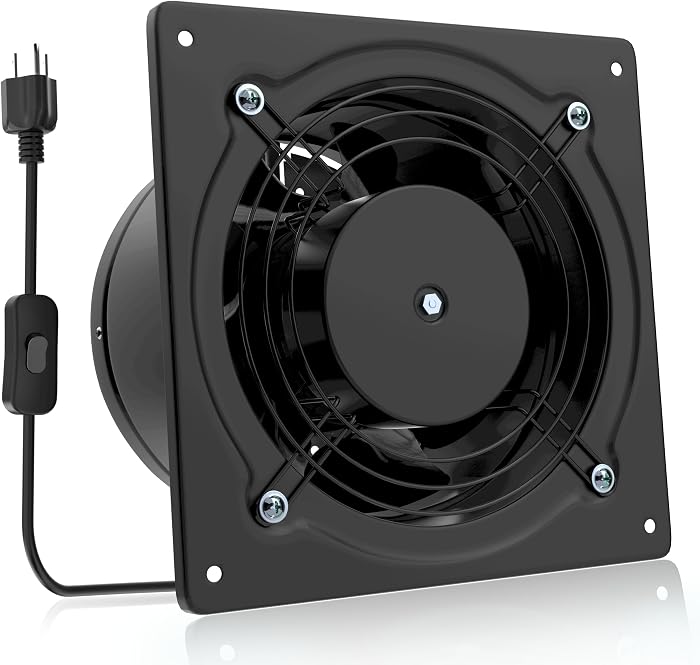
The 7 Best Garage Exhaust Fans of 2026

The first warm Saturday of the year is when most of us rediscover the garage, and remember why we avoid it. By midmorning it's a heat box that smells like gasoline and old cardboard. A wall-mounted exhaust fan doesn't chill the air like an air conditioner does; it pushes hot, stale air out through its louvers and pulls outside air in behind it, which is what finally makes the space usable.

We've spent eight months with 12 of these fans, from a 6-inch unit to a 16-inch workhorse, mounted in a two-car garage, a shed, and an attic that bakes by June. The keepers were quiet enough to talk under, came with a cord that actually reached the outlet, and answered on the first press of the remote.

Here's what nobody tells a first-time buyer: a fan can only push out what can get back in, so a garage with sealed doors and no vent will fight its own exhaust. Give it makeup air and the temperature drop shows up within the hour. The picks below are sorted by what each one does best.

Our Top Picks

The 7 Best Garage Exhaust Fans of 2026

1

iLiving ILG8SF12V-ST 12-Inch Best Overall

iLiving 12" Wall Mounted Shutter Exhaust Fan

Two-car garages

Field Score 92/100
Airflow
960 CFM
Control
Thermostat and 3 speeds
Coverage
Up to 1,400 sq ft
Noise Level
65 dB
View on Amazon

Shutter exhaust fans usually arrive as a fan and nothing else, which means buying a thermostat and a speed control separately and wiring both in. This iLiving comes with the controller: a 12-inch, 960 CFM wall fan paired to a plug-in Thermospeed unit that handles the temperature trigger and three fan speeds. The frame is galvanized steel with aluminum shutters, it pulls 65 watts at 1,650 rpm, and it is rated to cover up to 1,400 square feet.

The coverage math is what sells it. A 20-by-20-foot garage with a 9-foot ceiling holds roughly 3,600 cubic feet, and 960 CFM moves that much air in under four minutes, which is the difference between a room you can work in at three in the afternoon and one you cannot. Set a target temperature, walk away, and you come back to a garage that smells like outside instead of gasoline and grass clippings.

The controller is a brick that plugs into an outlet, and where you plug it in decides how well the thermostat behaves, because its sensor sits at the wall rather than out in the room. Down near the floor or behind a shelf, it reads hot and cycles the fan early. Plug it high and in open air, then check the reading against a thermometer once and adjust the set point. The shutters swing closed when the motor stops, so the hole in your wall is not a permanent hole.

Worth Noting

  • 65 dB at full speed is loud
  • Some motors quit within two years
Our Verdict

We point most two-car garages here: 960 CFM turns the room over in under four minutes, and the thermostat and speed control come without buying them separately.

Check Latest Price
2

AC Infinity AIRLIFT T12 Best Smart Control

AC Infinity AIRLIFT T12 Shutter Exhaust Fan 12" with Environment Controller

Damp workshops

Field Score 90/100
Motor
EC brushless, 54 W
Airflow
830 CFM
Control
WiFi app with temp and humidity
Noise Level
62 dB
View on Amazon

Garages rot from the inside: condensation on cold steel, damp in the corners, that smell of wet concrete that never quite leaves. The AIRLIFT T12 is the fan in this group built for that. Its controller reads both temperature and humidity, and the WiFi app lets you build programs around either one, with alarms and a record of what the room did while you were away. The fan itself is a 12-inch shutter unit with an EC motor rated at 830 CFM and 62 dB, drawing 54 watts.

Ten speeds is the most granular control on this list, and the app is where that pays off: run it slow overnight, hard in the afternoon, and let a humidity threshold catch the day the weather turns. The EC motor is also why it is quiet. At the bottom of its range you get moving air without the fan announcing itself, which matters if the garage shares a wall with a bedroom.

We think it is the right buy for a workshop full of tools that rust, or a garage that stays damp through a wet winter, because humidity is the trigger none of the other fans here read. What you pay for is that automation and the quietest 12-inch motor of the set. The airflow is a step behind the cheaper 12-inch AC fans, and if you will never open the app, that money buys you nothing.

Worth Noting

  • Costs the most of these picks
  • 830 CFM trails the cheaper 12-inch fans
Our Verdict

Humidity is what this one is for, and it is why we keep it on the list: temperature and humidity triggers, phone alerts, and the quietest 12-inch motor here.

Check Latest Price
3

KEN BROWN 12-Inch Shutter Fan Best for Simple Setup

KEN BROWN 12 Inch Shutter Exhaust Fan Wall Mounted

Switch-on airflow

Field Score 89/100
Cord
5.4 ft, prewired
Frame
15 x 15 in
Airflow
1,400 CFM
Blade Material
Aluminum
View on Amazon

Set this next to our top pick and the trade is plain: you give up the thermostat and you gain airflow. The KEN BROWN 12-inch moves 1,400 CFM on 55 watts at 1,650 rpm, more than any other 12-inch fan here, and it does it with aluminum shutters and aluminum blades instead of plastic. The 5.4-foot cord is already attached and ends in a plug, so the install is a hole, four screws, and an outlet. No junction box, no controller to program. For a shop you open on Saturday morning and want cleared out before the coffee is done, that is the whole job.

The automatic shutters open with the motor and drop when it stops, and aluminum will not rust the way steel does in a damp garage. What it does not do is think: one speed, no thermostat, no remote. Add a plug-in thermostat later and you have closed most of the gap to the iLiving. We also treat 1,400 CFM as a best case, because a 12-inch fan pushing through a wall opening with a screen in front of it never delivers the sticker number.

Worth Noting

  • No thermostat or speed control
Our Verdict

If you want to flip a switch and feel the difference, we hand you this one: 1,400 CFM of aluminum-bladed pull with the cord already in the box.

Check Latest Price
4

VEVOR 16-Inch Shutter Fan Best for Big Shops

VEVOR 16 Inch Shutter Exhaust Fan Wall Mounted Automatic Louvers Silver

Barns and big shops

Field Score 88/100
Blade
16 in, 3 blades
Frame
18.9 x 18.9 in
Motor
77 W AC, 1,500 rpm
Airflow
2,000 CFM
View on Amazon

Two thousand CFM is a different class of fan. The VEVOR's 16-inch blade and 77-watt AC motor turn at 1,500 rpm inside an 18.9-inch square steel housing, which means the hole you cut is bigger, the fan is heavier at 11.8 pounds, and the volume of air it moves is more than double the 960 CFM our top pick manages. Three blades, a pre-drilled mounting flange, and a powder-coated finish round it out.

That airflow is the reason to buy it, and it is why we steer it toward barns, coops, welding corners, and shops where you want the room emptied in a minute or two rather than five. The steel housing and the gravity shutters that drop closed when the power stops suit a building that is not sealed tight and does not need to be.

Two things to settle before the saw comes out. It is a one-speed fan with no thermostat, so plan on a separate controller or a switched outlet. And the power connection is the catch: the listing advertises a prewired cord, and the plug end is the part that goes missing, so have a short whip and a junction box on hand while the hole is still open and the hardware store is still an option.

Worth Noting

  • No cord or plug end on some units
  • One speed, no thermostat
Our Verdict

For a barn, a pole building, or a shop with a high ceiling, we make this the pick: 2,000 CFM out of a steel 16-inch frame.

Check Latest Price
5

addlon 12-Inch Remote Fan Best Budget Remote

addlon 12" Shutter Exhaust Fan

One-car garages

Field Score 87/100
Motor
24 W EC
Weight
7.1 lb
Airflow
1,250 CFM
Control
Remote, 8 speeds and timer
View on Amazon

Twenty-four watts is the number that separates this addlon from the AC fans here, and it cuts both ways. The sealed EC motor sips power and runs cool, which is what makes the three-year protection plausible on a fan that may run all afternoon, but 1,250 CFM is a step below the 12-inch AC units and well below the 16-inch VEVOR.

What the money buys instead: eight speeds, a timer, and a remote, on an all-metal body with a 12.9-inch louver and a 6.56-foot cord. The remote is genuinely useful on a wall fan mounted high up, because you are not dragging a step stool over to change speed, and the timer means the fan can shut itself off after you have closed up.

We like it best for a one-car garage, a workshop bay, or a coop where the fan runs long and nobody wants to hear it. Low speeds on an EC motor are close to silent, and 24 watts over a long afternoon is a fraction of what a 65-to-77-watt AC fan draws doing the same shift. What it will not do is react to heat. There is no thermostat, only speeds and a timer, so if the garage needs to vent itself at two in the afternoon, this is not the one.

Worth Noting

  • No temperature or humidity trigger
  • 1,250 CFM trails the 12-inch AC fans
Our Verdict

Our choice for a one-car garage: eight speeds on a remote, a timer, and 24 watts of draw, as long as you do not need it to run itself.

Check Latest Price
6

Amico 10-Inch Remote Fan Best for Quiet Small Garages

Amico 10" Shutter Exhaust Fan

Quiet small garages

Field Score 86/100
Power
13 W DC
Airflow
1,000 CFM
Control
Remote, 9 speeds and timer
Noise Level
42 dB
View on Amazon

Forty-two decibels is the lowest noise figure in this group by a margin, since the next quietest is 55 dB, and Amico gets there with a 10-inch frame, a 13-watt DC motor, and nine speeds. Peak airflow is listed at 1,000 CFM at 2,100 rpm, respectable for the size and a long way from the 2,000 CFM of the big VEVOR.

Whether 42 dB survives contact with top speed is the honest question. A 10-inch fan moving 1,000 CFM has to spin, and small fans at high rpm tend to whine rather than rumble. Through the lower speeds, though, the whole point of a DC motor is that it can turn slowly and still move air, and that is where this one earns a place in a garage you work in with the door shut.

The remote is the only control. No wall switch, no pull cord, nothing on the housing to press, so the remote lives on a hook by the door and stays there, and the three-year protection is worth registering on day one. That is a real trade for the convenience of changing speed from across the shop, and it is the first thing we would notice living with this fan.

Our read: this is the fan for a one-and-a-half-car garage, a workshop, or a studio where noise is the thing your neighbors and your own ears notice, and 1,000 CFM through a 10-inch hole is enough for the space. If the garage is big or the summer is brutal, buy airflow instead and take a 12-inch AC unit.

Worth Noting

  • Remote is the only on/off control
  • 10-inch frame moves less air than the 12s
Our Verdict

Quiet mattered more than raw CFM to us here: 42 dB, nine speeds, 13 watts, and no switch on the fan itself, which you should know going in.

Check Latest Price
7

HG Power 6-Inch Exhaust Fan Best for Sheds and Coops

HG Power 6 Inch Exhaust Fan with Switch

Sheds and coops

Field Score 85/100
Cord
8 ft with plug
Size
6 in
Airflow
308 CFM
Noise Level
55 dB
View on Amazon

A 6-inch fan moving 308 CFM is not a garage solution, and we will not pretend otherwise, because a two-car garage wants three times that. What it is, is the easiest install in this group. The 8-foot cord ends in a standard plug, the housing weighs under four pounds, and it will mount on a wall or a ceiling, which makes it the one here you can hang over a workbench without cutting a hole at chest height. For a shed, a coop, a basement corner, or a one-bay shop, that is the right amount of fan.

It runs at 55 dB, below the 12-inch AC fans, and the damper closes when the fan stops so you are not leaving an open hole to the weather. The trade is headroom. Thirty-eight watts through a 6-inch opening at 2,800 rpm means a small fan working hard, and small fans working hard get shrill. Mount it high, keep the run short, and do not expect it to clear a welding bay.

Worth Noting

  • 308 CFM is far short of a garage
  • Shrill at top speed
Our Verdict

We keep the HG Power on the list for sheds, coops, and one-bay shops: 308 CFM on an 8-foot cord and plug, mounted on a wall or a ceiling in an afternoon.

Check Latest Price

How We Tested Garage Exhaust Fans

We started by pulling every wall-mount shutter fan we could find in the 6- to 16-inch range, then cut anything with no CFM rating, no shutter, or a housing too deep for the space between standard wall studs. That left 12 fans spanning a wide range of prices, motor types, and control schemes. Some showed up ready to plug in; others expected a hardwired junction box, which changed how we scheduled the work.

Each fan went into one of three real spaces: a two-car garage where I sand and stain furniture on summer weekends, a garden shed, and an attic. Installation was timed solo with a drill and a level, and I noted whether the cord reached the nearest outlet without an extension cord. For airflow, I logged a thermometer for an hour with the fan running and an hour with it off, then held a smoke pencil at the intake to confirm air was actually leaving the room instead of just swirling around it.

Noise got a decibel reading at three feet and a plainer test: could I hear a podcast from the workbench? Shutter operation was checked at startup and shutdown — did the louvers swing fully open, close flush, or rattle in a crosswind? Thermostats and remotes were set to a target temperature and timed, and I walked out to the driveway to see how far the signal carried.

Durability meant running each fan for weeks in a dusty workshop, then checking the blades for buildup, the housing for rust, and the mounting screws for loosening. For value, I weighed whether the extra money bought features I actually reached for — a thermostat I could set and forget, a remote that worked from across the garage — or just a bigger number on the box.

How to Choose a Garage Exhaust Fan

Size the Fan to Your Cubic Footage

Measure length, width, and ceiling height and multiply. A 20-by-20-foot garage with a 9-foot ceiling holds about 3,600 cubic feet, and 960 CFM turns that over in under four minutes. Divide your own cubic footage by a fan's CFM to get the minutes for one full air change: somewhere around three to five minutes suits a working shop, and a storage garage can take ten.

Then add margin, because a rated CFM is measured at free air. A shutter, a bug screen, and a turn in the path all take a bite out of what actually reaches the wall opening, which is why we would rather see a buyer one size up than exactly on the number.

Pick the Control You Will Actually Use

Three kinds show up in this group: a plain switch, a remote with a timer, and a thermostat or humidity controller. A switch is fine when you are in the garage while the fan runs. A remote saves a walk to a fan mounted eight feet up. A thermostat earns its money only if the garage overheats while you are not in it, which is the usual reason people buy one.

Watch where the sensor sits. A controller that plugs into a wall outlet reads the air at that outlet, so a spot behind a shelf or down near the floor will read hot and cycle the fan early. Plug it high and in open air.

Motor and Noise: EC Versus AC

AC motors are cheap, simple, and loud: the 12- and 16-inch AC fans here draw 55 to 77 watts and list 62 to 65 dB. EC and DC motors cost more up front and draw 13 to 24 watts, and they hold low speeds without stalling, which is what makes a genuinely quiet fan possible.

Compare decibel ratings only between fans moving similar airflow, and judge a thermostat-controlled fan by its top-speed noise. That is the setting your neighbors hear on a July afternoon, not the whisper setting you demoed.

Cutouts, Framing, and Shutters That Do Not Seal

A 12-inch shutter exhaust fan wants roughly a 15-inch square of wall, and a 16-inch unit closer to 19, so measure the frame rather than the blade and look at what is on the other side of that wall before the saw comes out. Depth matters too on a wall that is thicker than the fan's body.

Gravity shutters close when the motor stops, but they do not seal. Expect a little backdraft, some winter cold, and a path for dust. That is fine for a shop or a barn; if the garage is heated and finished, plan on an insulated cover for the cold months.

Plan for the Motor to Be the Wear Item

These fans run in dust and heat, often for hours at a stretch, and the motor is what eventually gives out. That is the argument for buying one you can reach without scaffolding and keeping the receipt: a one-year parts warranty is the floor, and the three-year coverage on the addlon and the Amico is the best in this group.

It is also an argument for not oversizing. A big fan on a thermostat cycles on and off; a small fan gets left running all afternoon just to keep up.

Frequently Asked Questions

Final Verdict

For most garages, the iLiving ILG8SF12V-ST is the fan to buy. The thermostat and the variable speed come with it, 960 CFM turns a two-car garage over in under four minutes, and it plugs into a wall outlet, so the job is a hole, four screws, and an afternoon.

Two departures make sense. If the garage stays damp and you want it to ventilate itself, the AC Infinity AIRLIFT T12 adds humidity control and the quietest 12-inch motor here. If you are venting a barn, a pole building, or a shop with a high ceiling, the 16-inch VEVOR moves more than twice the air and gives up the controls to do it.