The Best Garage Shelving of 2026

Garage shelving is one of those purchases you make after the floor disappears—again. I've tried the flimsy plastic unit that bowed under paint cans and the metal rack that wobbled every time I pulled off a toolbox. A good unit gets boxes, bins, and bikes off the floor and makes the space usable again.

Over the past six months, my team and I set up and loaded 12 shelving units in garages, basements, pantries, laundry rooms, and closets. We focused on what matters after the novelty wears off: whether the frame felt sturdy under real weight, how long assembly took, whether shelves adjusted to fit tall bins, and whether casters or leveling feet kept things steady on uneven concrete.

One thing I've learned: capacity numbers are only half the story. A shelf can be rated for hundreds of pounds and still feel sketchy if the feet don't sit flat or the posts flex. The picks below are the ones that stayed solid, fit the spaces we had, looked tidy enough to leave visible, and were worth the money.

Our Top Picks

The Best Garage Shelving of 2026

1

Sterilite 5 Shelf Unit Best Overall

Sterilite 5 Shelf Unit

General garage storage

Field Score 97/100
Shelves
5
Assembly
Tool-free snap-together
Overall Size
36"W x 18"D x 75.13"H
Load Per Shelf
150 lb
View on Amazon

Eighteen inches of depth is the quiet reason this unit works in a garage. The five tiers measure 36 inches wide and 18 deep, so a 40-quart tote sits fully on the shelf instead of hanging over the front edge, and there is room to push a box back against the wall. It stands 75 inches tall, which puts the top tier above eye level for most of us.

That combination of roomy shelves and a midrange price is why this is the shelving we recommend first. Assembly is snap-together — no bolts, no tools — and it takes minutes rather than an afternoon. Bring a rubber mallet for the top tier, because the posts want a tap to seat fully. The perforated plastic shelves are the other reason we like it here: air moves through, so damp winter air does not sit trapped under whatever you have stored.

The ceiling is the 150-pound-per-shelf rating. That covers bins of holiday decorations, tools, paint, camping gear, and most of what accumulates against a garage wall. It does not cover a wall of liquid in glass, an engine block, or a stack of feed sacks. If dense weight is your problem, the steel racks below earn their extra cost and this one politely steps aside.

At 75 inches tall it is a unit to anchor rather than lean on, and the top tier rewards a step stool. Maintenance is a rag: wipe it down and it looks new, which is more than we can say for a wire rack sitting in a dusty garage for a year.

Worth Noting

  • 150 pounds per shelf rules out dense loads
  • 75 inches tall, so measure ceiling and reach
Our Verdict

For most garages this is the shelf we point to: roomy 18-inch-deep tiers, tool-free assembly, and enough capacity for bins and tools at a midrange price.

Check Latest Price
2

REIBII 3200LBS 5-Tier Shelving Best Heavy-Duty

REIBII 3200LBS Storage Shelves 55.5" W Garage Shelving Heavy Duty 5 Tier

Heavy loads

Field Score 96/100
Frame
25mm steel rods with V-braces
Shelves
5
Overall Size
55.5"W x 18"D x 71"H
Total Capacity
3,200 lb
View on Amazon

Three thousand two hundred pounds is the sort of figure that usually belongs to a warehouse pallet rack, not a shelf you put up yourself on a Saturday. On the REIBII it works out to 640 pounds a tier across five shelves, carried on 25mm steel rods with V-shaped braces reinforcing each level. That is the rack we reach for when the load is the entire point: engines, cases of oil, feed sacks, and the ammo cans that have been squatting on the floor for two years.

The size is the catch, and it is a big one. At 55.5 inches wide it wants a clear wall run, and the listing itself asks for roughly 56 inches of door width to get it into the building. At 71 inches tall the top tier sits high enough that you will want a step stool. Assembly is bolt-free and quick — line up the posts, snap the sleeves, tap the shelves down — and then the leveling feet do the real work, screwing out until the frame stops rocking on a slab that slopes toward the door. Anti-tip hardware comes in the box, and on something this tall you should use it.

It costs more than anything else on this list, and load is the only honest justification. If your garage holds coolers, bins, and a lawnmower, the Sterilite or the Amazon Basics rack does that job for less and is far easier to move around. If it holds a transmission and a stack of oil cases, nothing else here comes close.

Worth Noting

  • 55.5-inch width needs a long clear wall
  • Premium price
Our Verdict

If your garage holds engines, feed, or cases of oil, this is the rack that will not flinch — 640 pounds a tier and leveling feet for a sloped slab.

Check Latest Price
3

Amazon Basics 5-Shelf Wire Rack Best Wire Rack on Casters

Amazon Basics 5-Shelf Heavy Duty Garage Shelving Storage Rack with 4" Wheel

Rolling wire storage

Field Score 95/100
Wheels
4-inch casters included
Shelves
5
Overall Size
30"W x 14"D x 64.75"H
Load Per Shelf
300 lb on leveling feet
View on Amazon

The box lists three capacities, and the gap between them is the most useful thing about this rack: 300 pounds per shelf on the leveling feet, 132 pounds on the four-inch casters when it is parked, and 88 pounds while it is rolling. That is not fine print. It is a description of the two products you are actually choosing between — a fixed 300-pound wire shelf, or a cart you can push around the garage at roughly a third of the load.

At 30 inches wide and 14 deep, it is a shallow unit. Cans, jars, tools, wire baskets, and paint tins sit happily. Deep totes overhang the front edge, and anything that needs a 16-inch shelf will hang off it. The tiers adjust in one-inch increments and it goes together without tools, which makes it the easiest wire shelving unit here to reconfigure when your storage habits change.

Wire shelving on casters flexes, and that is the honest trade. The capacity numbers already tell you what to do about it: load it heavy and leave the wheels off, or keep the dense tiers near the floor if it is going to roll. We keep coming back to this one for a garage that is a workshop half the time, because a rack you can move out of the way is worth more than capacity you never use.

Worth Noting

  • 88 pounds per shelf while rolling
  • 14-inch depth will not take deep totes
Our Verdict

The most flexible wire rack here: park it on its feet for 300 pounds a shelf or roll it out of the way, as long as you do not need deep shelves.

Check Latest Price
4

FLEXIMOUNTS 2x4 ft Wall Shelves Best Wall-Mounted

FLEXIMOUNTS 2-Pack 2x4ft 24-inch-by-48-inch Wall Shelf Garage Storage Rack Wall

Overhead wall storage

Field Score 94/100
Pack
Two 2x4 ft units
Mount
Wall mount
Capacity
300 lb per unit
Overall Size
48"W x 24"D per unit
View on Amazon

Each tier is a 2x4-foot shelf built from two 1x4-foot panels that meet in the middle, and that joint is where these wall shelves live or die. The halves overlap where they join, so depending on where your studs fall, the seam does not always land as neatly as the product photos suggest.

We like these for the problem they solve rather than the way they look. A garage with two cars and one usable wall gives you no floor space at all, and this kit puts 600 pounds of bins, coolers, and seasonal gear in the air above the hood. The brackets bolt to framing, all the hardware comes in the box, and the kit includes an installation template and a bubble level, so one person can hang a shelf without a helper holding a pencil.

Three things to check before ordering. The wall needs solid framing, because this is not a drywall-anchor product and no hardware fixes a hollow wall. A shelf two feet deep needs clearance above whatever parks under it, including the garage door track. And the joint between the panels will not sit perfectly flush on every wall — if a visible seam would bother you every time you pull in, a single-piece shelf or a freestanding rack avoids the issue entirely.

Worth Noting

  • Seam between halves can sit uneven
  • Needs solid framing, not drywall anchors
Our Verdict

For a garage where the floor is the scarce resource, these put 600 pounds of bins overhead and leave the slab clear — provided you have solid studs to bolt into.

Check Latest Price
5

Sakugi 5-Tier Shelving Unit Best Slim Shelving

Sakugi 5-Tier Shelving Unit – Storage Shelves

Narrow wall runs

Field Score 93/100
Shelves
5
Overall Size
33"W x 12.6"D x 72"H
Post Diameter
0.9 inches
Total Capacity
1,000 lb
View on Amazon

At 12.6 inches deep and 33 inches wide, this rack slides into the strip of garage wall you would otherwise waste: the narrow run beside the car door, the gap past the water heater. Five tiers on a 72-inch frame give you a lot of vertical storage for the footprint, and the whole thing weighs under 18 pounds, so one person can walk it into place. It is also one of the least expensive five-tier racks here, which makes it the obvious first step for a garage with more clutter than floor.

The 1,000-pound total is a figure to hold loosely. Five tiers at 200 pounds each assumes weight spread evenly across a shelf, and that distinction matters most on a light frame: keep cans and boxes distributed rather than piled in one corner. Use it for seasonal clothes, boots, sporting goods, and pantry overflow, and leave the dense stuff to a steel rack. Set aside about 45 minutes for assembly, and keep the parts in their labeled bags until you need them — that tip comes up again and again, and it is the difference between a smooth build and a floor covered in look-alike sleeves.

Worth Noting

  • 200-pound rating assumes evenly spread loads
  • Narrow shelves will not take wide bins
Our Verdict

Five tiers on a 12.6-inch footprint — the rack for a narrow strip of garage wall, as long as the loads stay light and evenly spread.

Check Latest Price
6

Sakugi 3-Tier Metal Shelf Best for Tight Gaps

Sakugi 3-Tier Metal Shelf – 3-Tier Metal Storage Shelves Adjustable Feet

Tight gaps

Field Score 92/100
Feet
Adjustable leveling feet
Shelves
3
Overall Size
18"W x 12"D x 30"H
Load Per Shelf
100 lb
View on Amazon

Every garage has a gap that is not worth a full-size rack: the space beside the washer, the strip between the car door and the wall, the corner behind the recycling bin. This Sakugi is 18 inches wide, 12 inches deep, and 30 inches tall, and it fits all three. Three tiers, 100 pounds each, with leveling feet so it does not rock on a slab.

What it holds is the point — pint cans, spray bottles, boots, small bins, hose fittings, a stack of sandpaper. What it does not hold is a cooler, a case of oil, or anything much wider than 11 inches. The pictures flatter it, too: 18 inches of width disappears fast once a few items are on it, so measure the gap and then picture that gap at 18 inches rather than the roomy shelf in the photo.

We treat these as gap fillers rather than primary shelving. Buy one for a specific measured space and it earns its keep; buy it expecting a garage rack and you will be disappointed. Worth knowing before you order two: these are not designed to stack with each other, so a pair sits side by side rather than one on top of the other.

Worth Noting

  • Three tiers only
  • Not designed to stack with a second unit
Our Verdict

Measure the gap first: at 18 inches wide and 30 tall, this is the unit that turns dead space into three tiers for cans, boots, and small bins.

Check Latest Price
7

HOMEDANT 47.7 in. 5-Tier Shelving Best for Dry Pantry Storage

HOMEDANT 47.7 in. 5-Tier Shelving – Black 47.7" W 5 Tier Storage Shelves Garage Shelving Unit Metal

Dry pantry storage

Field Score 91/100
Shelves
5
Assembly
Boltless snap-together
Overall Size
47.7"W x 18.2"D x 71.3"H
Shelf Material
Steel frame with MDF boards
View on Amazon

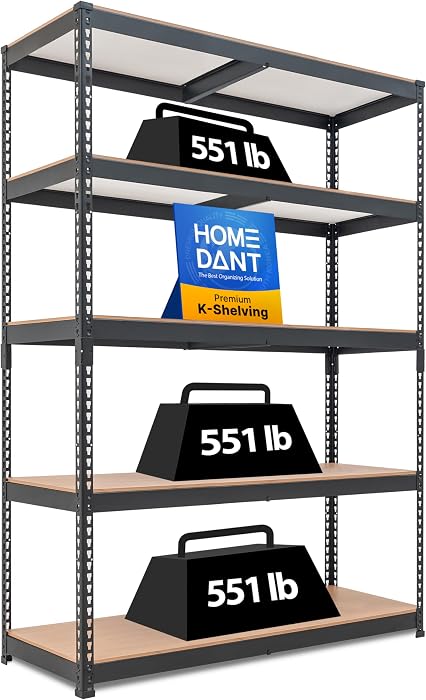
Most of this list is wire. The HOMEDANT is a steel frame carrying five MDF boards, and that single difference changes what the shelf is good for: small parts do not tip through gaps, boxes do not take a wire imprint, and there is no dust line to wipe off every can.

At 47.7 inches wide and 18.2 deep, each tier takes long boxes, totes, and appliances — a printer and a cutting machine share a level without hanging over. It is also the heaviest unit here at 67 pounds, most of it board, so plan on two people to stand it up or carry it downstairs.

Assembly is boltless: the posts and beams interlock, you tap them home, and the frame squares up as it tightens. The instructions are detailed and the five tiers adjust, so a tall item can have a level almost to itself.

What gives us pause is the price against the materials. This is premium money for MDF boards on a steel frame, and the finish is good without being furniture grade. For a pantry, a utility room, or a garage corner that stays dry, it is a tidy, solid choice and genuinely nicer to load than wire. For a damp garage or heavy loads, the steel and plastic racks here are the better spend.

Worth Noting

  • Heaviest unit here at 67 pounds
  • MDF boards are wrong for a damp garage
Our Verdict

Solid boards instead of wire make this the tidier shelf for a dry pantry or utility room, and the boltless frame goes up fast — just do not hand it engine parts.

Check Latest Price
8

DEANIC 4-Tier Foldable Shelf Best for Rolling, Folding Use

DEANIC 4 Tier Foldable Storage Shelves with Wheels

Rolling, folding use

Field Score 90/100
Setup
Arrives assembled, folds down
Wheels
4 casters, 2 with brakes
Capacity
600 lb without wheels
Overall Size
28"W x 13.4"D x 50"H
View on Amazon

It arrives assembled. That is the whole pitch, and after a morning spent tapping shelves onto posts, it is a pitch we understand: unfold the frame, lock the casters, done. When the job is over it folds back down out of the way, which is not something any other rack here will do.

Open, it measures 28 inches wide, 13.4 deep, and 50 tall — four tiers on four rubber casters, two of them braked. The capacity split matters here: 600 pounds on the leveling feet, 240 pounds on the wheels. Since the wheels are the reason to buy it, plan around 60 pounds a shelf in practice.

The folding hinge is the trade. A rack that folds is a rack with joints, and joints move. Locked open and loaded evenly it is steady enough for bins, tools, and boxes, but it does not have the dead-rigid feel of a bolted steel frame, and the narrow 13.4-inch depth keeps it out of the deep-tote business.

Where it earns its premium is movement. If the rack lives in one corner of the garage and never travels, a fixed rack gives you more capacity for less money. If it goes to shows, out to the driveway, or into the truck for a season of gear, nothing else here sets up in seconds and disappears just as fast.

Worth Noting

  • 240 pounds on casters, not 600
  • Premium price for a folding frame
Our Verdict

The rack that is already built: unfold it, roll it where the work is, fold it away after — you are paying for that convenience, not for capacity.

Check Latest Price

How We Tested Garage Shelving

We started by researching the category and narrowing a long list by footprint, shelf count, claimed capacity, material, and assembly style, then brought in 12 units that covered the main formats: freestanding metal racks, plastic shelving, wall-mounted shelves, and foldable no-assembly options. Testing ran for six months in garages, basements, pantries, laundry rooms, and closets—the places where these shelves actually live. I set up each unit solo and timed it, noting whether the instructions made sense, how many tools were needed, and whether the frame went together square.

Then we loaded them the way people actually load shelving: paint cans and toolboxes in garages, detergent bottles and bulk paper goods in laundry rooms, canned goods and small appliances in pantries, and storage bins in basements. We checked for wobble by giving each unit a gentle nudge after loading, watched whether posts or plastic shelves bowed under weight, and noted if adjustable shelves moved easily or fought us. For units with casters or leveling feet, we rolled them over garage-floor seams and adjusted the feet on sloped concrete to see if the frame sat flat.

We also measured footprints and checked fit in tight spots—whether a unit cleared a door swing, sat below a wall cabinet, or left enough room to pull bins in and out. Appearance got a simple test: after a few weeks, did the finish scratch, did the plastic look chalky, did the shelf look like something we'd leave visible in a pantry? Durability came from repeated loading and unloading over six months, plus checking welds, plastic seams, and hardware for loosening. The units that made the list were the ones that stayed steady, fit their space, and still felt worth their cost after real use.

How to Choose Garage Shelving

What a Load Rating Really Tells You

Per-shelf ratings assume weight spread across the tier rather than piled in one corner, and the total on the box is that per-shelf number multiplied out. Where it gets interesting is wheels. The same Amazon Basics rack carries 300 pounds a shelf on its leveling feet, 132 pounds on casters that are not moving, and 88 pounds while rolling; the DEANIC splits 600 against 240 the same way.

Decide before you buy whether the rack is furniture or a cart, because it cannot be both at full capacity. If it will roll, size the load to the wheeled figure and keep the dense tiers low.

Wire, Solid Board, or Plastic

Wire lets air through and dust fall clear, which is why it dominates garage storage, but small items tip through the gaps and boxes take the imprint of the wires. Solid boards — the HOMEDANT's MDF, or a quarter-inch sheet of plywood laid over a wire tier — hold cans, jars, and parts properly, at the cost of airflow. Plastic, as on the Sterilite, never rusts and wipes clean, and it tops out around 150 pounds a shelf.

Match the surface to what you store. A damp garage argues for wire or plastic; a pantry holding small, light, spillable things argues for board.

Measure the Wall, the Height, and the Way In

The racks here run from 12 to 24 inches deep and 64 to 75 inches tall, and the difference between fitting and not fitting is usually depth. Tape the footprint on the floor, then stand back and check it against a car door, a walkway, and the garage door track. Height matters twice: a 75-inch unit puts its top tier above eye level, and a wide unit still has to travel from the driveway to its spot.

Freestanding or Wall-Mounted

Floor space and wall space are separate budgets. A freestanding rack carries the most weight and rearranges easily, but it eats the parking bay. Wall shelves like the FLEXIMOUNTS clear the floor entirely and put bins over the hood, as long as there is solid framing behind the drywall.

Whichever you pick, anchor a tall unit to the wall and screw the leveling feet down until it stops rocking on the slab. A loaded rack that tips is the one failure mode worth designing out before anything goes on the shelves.

Frequently Asked Questions

Final Verdict

For most garages, the Sterilite is the shelving to buy: 18-inch-deep tiers that hold real totes, snap-together assembly that takes minutes, and a frame that will not rust, all at a midrange price. Move up to the REIBII 3200 if the load is genuinely heavy — engines, feed, cases of oil — because nothing else here carries that kind of weight.

If floor space is what you are short of rather than capacity, hang the FLEXIMOUNTS shelves instead and leave the slab clear for the car.