The 8 Best Hole Saws for Metal of 2026

A hole saw looks simple until you lean into a sheet of stainless. The teeth skate, the saw chatters, and a few seconds of too much pressure turns a sharp cutter into a smooth, useless ring. The right one bites on contact and leaves a round hole without burning up the bit or your patience.

I've cut my share of oversize holes for conduit and sink decks, and the gap between a good saw and a cheap one shows up in the first inch. Over the past six months, my team and I ran 14 hole saws and kits through mild steel, stainless, PVC, and drywall. Bi-metal is the versatile default, carbide holds an edge far longer in stainless, and either way the arbor is half the equation — a saw that won't thread onto the mandrel you already own becomes drawer clutter.

Below are the ones that stayed sharp, cut round, and earned a spot in the toolbox, with notes on which sizes and kits are worth the money and which I'd buy again.

Our Top Picks

The 8 Best Hole Saws for Metal of 2026

1

Lenox Speed Slot 2-Inch Hole Saw Best Overall

Lenox Speed Slot 2-Inch Hole Saw

general metal cutting

Field Score 94/100
Arbor
Included
Diameter
2 in
Material
Bi-metal
Cutting Depth
1-9/16 in
View on Amazon

Five teeth per inch is the spec that turns a hole saw into a metal saw: coarse teeth give chips somewhere to go instead of packing the kerf and stalling the cut. Lenox puts that tooth count on a 2-inch bi-metal cup with a 1-9/16-inch cutting depth, and it ships arbored with the pilot bit already threaded in, so it goes from the box to your drill with no parts run. It handles exhaust tube, angle iron, and trailer panel without complaint. For most people cutting metal at home, that combination is the whole decision.

In aluminum sheet and light steel the cut comes fast and clean, and the teeth came out of a long run of holes still biting — sharpness is where this saw separates itself from the cheap cups. The Speed Slot earns its name too: the plug works loose with a wiggle instead of a screwdriver fight, which matters when you're overhead or reaching into a bay.

Two limits are worth knowing before you order. It's one diameter, so a project with three hole sizes means three saws, and the 1-9/16-inch depth means thicker stock gets cut from both sides and lined up by eye. Sheet metal and pipe are its home; heavy plate and stainless belong to carbide.

Buy a spare pilot bit with it. The teeth on a bi-metal saw outlast the pilot, and a bent pilot is what ends most of these saws' working lives — a small add-on that keeps a good cup in service instead of retiring it early.

Worth Noting

  • Sold in one diameter only
  • Not for thick plate or stainless
Our Verdict

For clean 2-inch holes in sheet metal, pipe, or a trailer panel, this arbored bi-metal saw is the one we tell people to buy first.

Check Latest Price
2

Diablo DHS14SGP Bi-Metal Set Best Set

Diablo Bi-Metal Hole Saw Set

high-volume metalwork

Field Score 93/100
Sizes
7/8 to 2-9/16 in
Pieces
10 cups, 1 mandrel, 1 pilot bit, 2 adaptor nuts
Cutting Depth
2-3/8 in
Mandrel System
Snap-Lock Plus
View on Amazon

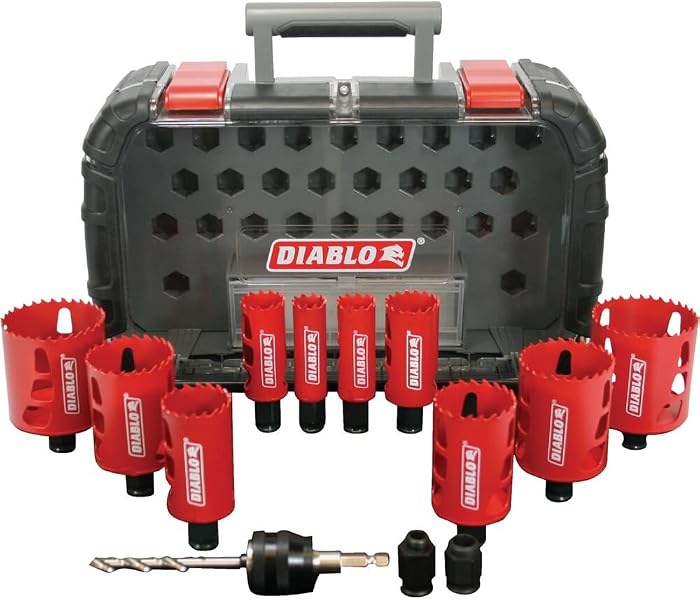
This Diablo set is the biggest spend in this guide, and it's the one we point to when someone is done buying saws one at a time. Ten cups run from 7/8 inch to 2-9/16 inch, a single Snap-Lock Plus mandrel drives all of them, and the case carries the pilot bit and two adaptor nuts. That's a working range in a box you can carry to a job.

Depth is what earns it the space. At 2-3/8 inches the cups cut through a 2-by in one pass — siding, a stud, a doubled header — where a standard cup makes you flip the work and hope both holes line up. We also rate the changeover: release the collar, swap the cup, keep drilling, with no hex key lost in the sawdust.

The variable-pitch teeth run smoother than a constant-tooth cup, with less chatter on entry, and that's a difference you feel in your wrists after the twentieth hole. Plugs eject without a tool, so a run of holes keeps moving instead of stopping for a screwdriver.

Buy one spare pilot bit when you buy the kit. It wears before the cups do, and a missing pilot parks the whole case until a replacement arrives — the one part that can take a very good set out of service.

Worth Noting

  • Cups only fit the Snap-Lock Plus mandrel
  • Case slots aren't marked by size
Our Verdict

Buy this set if you change hole sizes all day; the deep cups and tool-free changeovers pay you back in time you don't spend swapping arbors.

Check Latest Price
3

EZARC 7/8-Inch Carbide Hole Saw Best for Stainless

EZARC Carbide Hole Saw Heavy Duty

stainless steel sinks

Field Score 92/100
Diameter
7/8 in (22 mm)
Material
Tungsten carbide
Pilot Bit
Spring-loaded
Max Material Thickness
3/16 in
View on Amazon

Stainless is where bi-metal saws go to die: the teeth work-harden the surface, the edge dulls, and you finish the hole with a file. The EZARC cutter is built for that job — tungsten carbide teeth, a 7/8-inch cutting diameter, and a spring-loaded pilot that ejects the plug on the way out. A wrench and a second pilot bit come in the bag, so there's no arbor to source.

This is the one we hand someone cutting a stainless sink or a truck panel. Carbide holds an edge where high-speed steel gives up, and the cut comes out round and burr-free enough to skip the cleanup pass. Oil and a slow drill turn it into a two-minute hole. Run it fast and dry and you'll round the teeth off before you're through the first one.

Carbide is hard and brittle in the same breath: keep the cup square to the work, run the drill slow, and let the teeth cut. Tip it to hurry a hole and you'll chip a tooth, and a chipped tooth doesn't cut stainless anymore. Oil helps more than pressure does.

Worth Noting

  • Capped at 3/16-inch material
  • One 7/8-inch diameter per purchase
Our Verdict

We reach for this cutter when the material is stainless and the hole has to look machined rather than rescued with a file.

Check Latest Price
4

HYCHIKA 17-Piece Bi-Metal Kit Best Budget Kit

HYCHIKA 17-Piece Bi-Metal Kit – Bi-Metal Hole Saw Kit

starter shop kit

Field Score 91/100
Sizes
3/4 to 2-1/2 in
Storage
Case included
Saw Blades
11
Cutting Depth
40 mm
View on Amazon

If your drill lives in a shed and your hole sizes are whatever the job turns out to be, this is the kit to start with. We like it as a first kit rather than a last one: eleven bi-metal cups from 3/4 inch to 2-1/2 inch, two mandrels, three pilot bits, a hex key, and a case that keeps the sizes findable. Having every size on hand ends the drive-to-the-store cycle that makes small projects drag.

The teeth are hard and the cuts come out clean in plywood, PVC, and thin sheet. Two mandrels and three pilot bits is the detail that matters more than the saw count — a bent pilot doesn't park the whole set, and swapping cups doesn't mean re-chucking from scratch every time.

The largest cups want a half-inch chuck, so a 3/8-inch drill means adapting or skipping your bigger sizes. In metal, slow the drill down and clear the chips often; that's how these cups last long enough to be worth the shelf space.

Worth Noting

  • 40 mm cutting depth limits thick stock
  • Teeth dull faster in steel than wood
Our Verdict

Our pick for a first metal-capable kit: eleven sizes, two mandrels, and a case, for less than a couple of single saws.

Check Latest Price
5

Klein Tools 31872 Carbide Cutter Kit Best for Conduit

Klein Tools 31872 Heavy-Duty Hole Cutter Kit

conduit and panels

Field Score 90/100
Sizes
7/8, 1-1/8, 1-3/8 in
Material
Carbide
Pilot Bits
Spare included
Max Material Thickness
3/16 in
View on Amazon

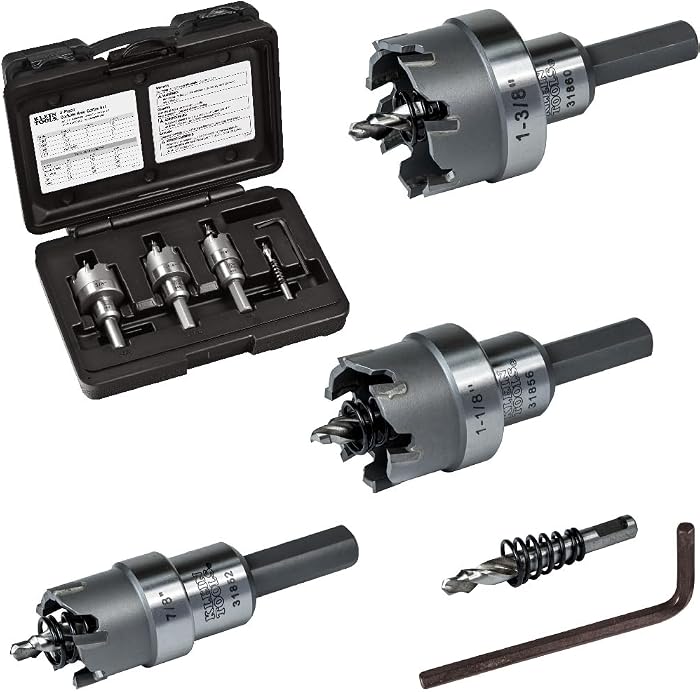
Three sixteenths of an inch is the ceiling here, and it's the number to check before you order: these carbide cutters are built for sheet — stainless, mild steel, iron, copper, brass — up to that thickness and no more. Within it they cut like a punch, in the three sizes that cover most conduit and panel work: 7/8, 1-1/8, and 1-3/8 inch, with a spare pilot bit and a rust-proof case.

The split-point pilot is the detail we appreciate most. It bites instead of skating, so you can start a hole on a curved panel or a rounded box without a center punch, and the saw doesn't walk across your layout line. The integrated flange stops the cutter from diving once it breaks the surface, which is what saves the back side of a panel from tearing out.

For a shop being wired or a barn being fitted with conduit, this is the case that stays in the truck. It's not a woodworking set and it won't replace a bi-metal kit for general work — it's what you open when the material is stainless and the hole has to be right the first time. Carbide doesn't bend, so keep the cutter square and let it cool between holes; do that and the tips last.

Worth Noting

  • Three diameters only
Our Verdict

We recommend this set when the holes are conduit knockouts in stainless and you want them clean on the first attempt.

Check Latest Price
6

Milwaukee 28-Piece Hole Saw Kit Best for All-In-One Kits

Milwaukee 49-22-4185 All Purpose Professional Ice Hardened Hole Saw Kit 28 Piece

all-in-one kits

Field Score 89/100
Pieces
28
Material
Matrix II bi-metal
Tooth Hardening
Ice hardened
View on Amazon

Twenty-eight pieces is the answer this kit gives to the Diablo case, and the trade runs the other way: more sizes, less depth. Milwaukee's ice-hardened bi-metal covers small pilots up through the big cups, with the arbors and adaptors to drive them, all in one box. If your work moves between trades — a little electrical, a little plumbing, a gate to hang — having the odd size on hand is worth more than a deeper cup.

The teeth are Matrix II bi-metal, ice hardened for longer life, and the saw bodies are deep enough to bury a 2-by in one pass. Wood with nails, sheet metal, laminate: the cuts come out clean, and the tooth count is aggressive enough to move quickly without grabbing.

Count the arbors and pilot bits against the contents list while the return window is open. A set this size lives or dies on every adaptor being in the box, and a missing nut strands the cups it drives until a replacement shows up.

Our read: this is a volume kit for someone who wants one case and will keep it sorted. The teeth are the reason to buy; the storage is the reason to add a drawer divider or a canvas bag and treat the case as a shelf box at home.

Worth Noting

  • Case lets the cups shift out of their slots
  • Some sets arrive missing an arbor or pilot bit
Our Verdict

Choose this if you want one box with every size in it and don't mind keeping it sorted yourself.

Check Latest Price
7

VIKITON 6-Inch Bi-Metal Hole Saw Best for Six-Inch Holes

VIKITON 6-Inch Bi-Metal Hole Saw – 6 inch Hole Saw for Wood

six-inch holes

Field Score 88/100
Cuts
Wood, plastic, drywall, cornhole boards, thin metals; not stainless
Arbor
Included
Diameter
6 in (152 mm)
Material
Bi-metal
View on Amazon

Six inches is not a bigger version of a 2-inch saw; it's a different tool with different rules. The VIKITON cuts 6-inch holes in plywood, drywall, plastic, and thin metal — cornhole boards, recessed light cans, speaker cutouts, the tube opening on a feeder — and it comes with the arbor, a spare pilot bit, and a hex key. At 152 mm across it removes a lot of material every revolution, so it wants a drill with torque and a hand that lets the teeth work.

Deep gullets between the teeth are the right call at this size: chips need somewhere to go or the cup binds and the arbor takes the strain. Our advice is to run it slow. A 6-inch cup spinning fast in thin steel burns teeth and snatches the drill; at low speed with light pressure it goes through a board and leaves a clean edge.

The stainless exclusion is the one thing to plan around — this saw is for thin mild steel and wood, not a sink or a truck panel. Everything else about it reads as a specialist: it's the least expensive saw here, the arbor is in the box, and it earns its place the first time you need a hole nothing else in your shop can make.

Worth Noting

  • Not for stainless or thick steel
  • Needs a half-inch chuck and a slow drill
Our Verdict

We reach for this one when the hole has to be six inches, and nothing else in this group can make that cut.

Check Latest Price
8

ASNOMY 12-Piece TCT Kit

ASNOMY 12-Piece TCT Kit – 12PCS Tungsten Carbide Hole Saw Kit for Hard Metal and Steel

budget carbide kit

Field Score 87/100
Sizes
5/8 to 2-1/8 in
Cutters
10 carbide cutters
Pilot Bits
Titanium-plated
Cutting Depth
25 mm (1 in)
View on Amazon

For someone who wants carbide teeth without paying per-cutter prices, this is the kit: ten TCT cutters from 5/8 inch to 2-1/8 inch, a titanium-plated pilot bit for each, and a case that keeps the sizes separated. It covers the diameters a general shop actually meets, from grommet holes up to a 2-inch pipe pass-through.

The three-blade tooth pattern is why these cut as fast as they do — an outer and an inner edge scribe the circle while the middle tooth clears, so the cutter doesn't skate on entry. In mild steel and aluminum they do what carbide is supposed to do: a round, clean hole without the blueing and file work a dull bi-metal saw leaves behind.

Stainless is a maybe rather than a promise. These tips will get through a thin panel with oil and a slow drill, and they'll shed teeth if you push them. Keep the speed down, flood the cut with oil, and let the cup finish the hole before you lift it.

What you're buying is coverage, not longevity. The cutters are consumables — when one loses its tips you replace that size instead of the set, and the range means you're not buying a whole kit to get a 1-3/4-inch hole again. For a shop cutting occasional holes in mild steel that math works; for daily stainless, the Klein cutters are the better spend.

Worth Noting

  • One-inch cutting depth suits sheet only
Our Verdict

Worth it if you want a drawer full of carbide sizes and accept that the tips are a wear item.

Check Latest Price

How We Tested Hole Saws for Metal

We started with the listings themselves, separating bi-metal saws from carbide cutters, checking claimed diameter ranges against the fittings, conduit, and pipe we actually drill for, and noting which arbor or mandrel each saw runs on. From that pile we narrowed to 14 saws and kits — singles for one-off jobs, sets for people who want sizes on hand — and tested them over six months.

Most of that time was spent in the shop, chucking each one into a handheld drill and a drill press to cut 7/8-inch holes in 16-gauge mild steel for conduit knockouts, 2-inch holes in stainless sheet, and the occasional pass through PVC and drywall to see how the teeth handled soft material. We counted clean holes per saw before it started needing real pressure and timed the cuts. We also watched the chips: whether they cleared, or packed the gullets and cooked the teeth.

Sharpness got measured rather than eyeballed — calipers against the labeled diameter, a check for whether the pilot bit wandered on start, and a count of holes until the cut slowed. We kept cutting past dull to see what failed first: stripped teeth, cracked carbide tips, or a bent arbor. Every saw went on its own arbor and then on a mandrel from another kit, with notes on thread pitch, adaptor nuts, and whether it fit a standard chuck.

For the kits, we tallied how many included sizes matched real-world fittings, whether the price made sense for the sizes we'd genuinely use, whether the case survived a truck bed and kept everything findable, and which saws we'd spend our own money on again.

How to Choose a Hole Saw for Metal

Match the teeth to the metal

Bi-metal saws — high-speed steel teeth welded to a flexible body — are the default for mild steel sheet, pipe, and bracket work, and they forgive a handheld drill that wanders off speed. Tungsten carbide cutters stay sharp in stainless and abrasive sheet, but the tips are brittle, the cut is shallower, and each cutter costs more than a whole bi-metal cup.

If stainless appears anywhere in your project, plan on carbide for those holes specifically, and keep a bi-metal cup for everything else. Sellers use the terms loosely, so a listing that calls the tool a hole cutter and names stainless in the same breath is usually the one built for it.

Check the cutting depth against your material

Cutting depth is the inside height of the cup, and it's the number most buyers skip. A one-inch cup handles sheet and thin tube; 1-9/16 inches clears most angle iron and trailer panel; 2-3/8 inches cuts a 2-by in a single pass. Deeper cups also flex more, so buy the depth the job needs rather than the deepest one on the shelf.

If your material is thicker than the cup, you cut from both sides and line the holes up by eye. That works on a fence rail and it fails on a visible panel. Measure the thickest thing you'll cut, add a little, and choose from there.

Arbors, chucks, and the drill behind the saw

Plenty of saws are sold bare, and the arbor can cost as much as the cup, so read the box contents before you compare two prices. Chuck capacity sets your ceiling: cups beyond about 2 inches want a half-inch chuck, and a 6-inch cup on a 3/8-inch drill is the wrong pairing no matter how carefully you feed it.

Big saws also need low RPM. If your drill's slowest speed is fast and there's no clutch, that — not the tooth count — is what limits the diameter you can run safely.

Singles, sets, and which sizes earn a place

Buy the single size you need when the job is one hole. A set earns its money when you cut repeatedly and refuse to stop for parts, and the sizes that matter in metal are 7/8 inch and 1-1/8 inch for conduit and knockouts, 2 inches for pipe and grommets, and one large cup if you cut panels.

We care more about a case that keeps sizes findable than about three extra cups nobody touches. Replacement pilot bits and one spare arbor extend a kit's life far more than another diameter does.

Frequently Asked Questions

Final Verdict

Start with the Lenox. A 2-inch arbored bi-metal saw covers sheet, pipe, and panel work, and its coarse teeth clear chips instead of packing them, which is most of what separates a saw that finishes the hole from one that stalls halfway through.

If stainless is anywhere on your list, add a carbide cutter in that size before you buy anything bigger — the EZARC 7/8-inch handles sinks and panels without the file work. And if you change hole sizes several times a day, the Diablo set's depth and tool-free changeovers are the ones that pay you back.