The 8 Best Infrared Thermometers of 2026

An infrared thermometer reads the heat a surface gives off, which means you can check a pizza stone, a griddle, or a drafty window frame without touching anything. The catch is emissivity — how efficiently a given surface radiates heat — and plenty of budget guns lock it at one value that's right for food and cast iron but wrong for shiny metal or glass.

I bought my first one to stop guessing at griddle temperature and now keep one in the kitchen, one in the garage, and one wherever the grill ended up. Our team tested 12 of them over six months, cooking, checking air registers, and pointing them at hot engines, and the differences came down to honest accuracy, real range, and whether the buttons made sense without the manual.

A word of warning: these are surface thermometers, not forehead thermometers, so don't buy one to check a fever. They are, however, genuinely fun to own — once one lives in your kitchen, you start pointing it at everything. The picks below split cleanly between kitchen duty, HVAC and engine work, and the all-arounders that do both.

Our Top Picks

The 8 Best Infrared Thermometers of 2026

1

Etekcity Lasergrip 1080 Best Overall
Etekcity Infrared Thermometer Laser Temperature Gun

All-around home use

Field Score 96/100
Emissivity
Adjustable, 0.1 to 1.0
Response Time
0.5 seconds
Temperature Range
-58° to 1,130°F
Distance-to-spot Ratio
12:1
View on Amazon

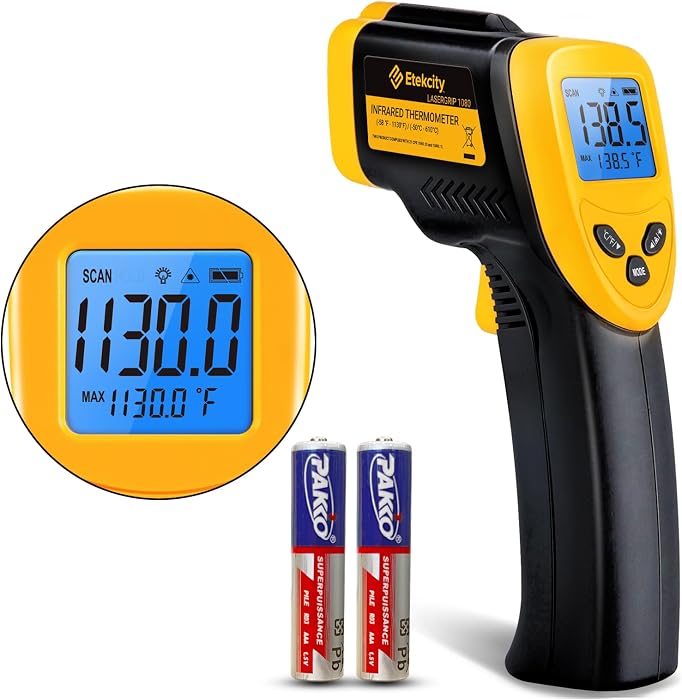
A dial for emissivity and a ceiling of 1,130°F are what lift the Lasergrip 1080 above the cheaper guns here. Squeeze the trigger and a backlit number lands in half a second; the °F/°C button, the MAX hold, and the laser switch sit where your thumb expects them. The body is molded ABS in a pale yellow that's easy to spot in a cluttered drawer.

Emissivity is the setting that earns its keep. It adjusts from 0.1 to 1.0, which is what lets one gun read a matte cast-iron skillet, a painted duct, and a bare aluminum engine bracket without any of them coming back strange. The 12:1 ratio puts the spot at roughly an inch across from a foot away — tight enough that you're reading the pan and not the burner flame behind it.

This is the one we hand to most people. It covers the span of jobs a house actually produces, from a griddle to an AC register to an exhaust manifold, and it does it on two AAA batteries with a two-year warranty behind it. Of the inexpensive guns in this guide, it's the one we trust with a number that matters.

Two small irritations: no case or pouch in the box, and the battery compartment inside the grip is tight enough to need a thumbnail. Neither is a reason to look elsewhere. The 774 is cheaper and stops at 842°F; the Fluke costs several times more and stops at 932°F.

Worth Noting

  • No case or pouch in the box
  • Tight battery compartment in the grip
Our Verdict

Our default pick for most homes: adjustable emissivity, a 1,130°F ceiling, and half-second reads at a midrange price. Step up to the Fluke only if the number goes in a report.

Check Latest Price
2

Fluke 62 Max Best for Professional Use

Fluke 62 Max Industrial Infrared Thermometer

Pro and shop work

Field Score 95/100
Warranty
3 years
Temperature Range
-22° to 932°F
Environmental Rating
IP54
Distance-to-spot Ratio
10:1
View on Amazon

The 62 Max costs several times what the budget picks here do, and it is the only thermometer in this guide we treat as an instrument rather than a gadget. Fluke rates the body IP54, backs it for three years, and states accuracy at ±1.5°C or ±1.5% of reading.

Range runs from -22°F to 932°F with a 500 ms response, and the screen reports minimum, maximum, average, and the difference between min and max. That last figure is the reason to own it: walk a heat exchanger, a radiator, or a row of breakers and you get the spread across the surface instead of one point in the middle.

The trade is optical. At 10:1 this is the narrowest ratio on the page, so from any given distance it averages over a wider patch than the 12:1 and 16:1 guns. On a duct or a pan that's irrelevant. On a bearing race or a single small register, step closer until the spot fits the target.

We reach for the Fluke when someone will act on the number — a service call, a bearing running warm, a class demo — and it's the one here that feels built to stay in a bag for years. The manual is a fold-out of pictures with no words, and we learned the modes by pressing buttons rather than reading.

Worth Noting

  • 932°F ceiling trails cheaper guns
Our Verdict

For work where a wrong number costs money, this is the thermometer we trust: sealed to IP54, backed for three years, and the steadiest reader here. Home cooks can stop at the Etekcity.

Check Latest Price
3

TempPro TempScan PLUS TP450 Best for Pizza Ovens and Grills

TempPro TempScan Infrared Thermometer Gun with 2 Laser for Pizza Oven Grill

Pizza ovens, griddles

Field Score 94/100
Targeting
Dual laser
Emissivity
Adjustable, 0.1 to 1.0
Temperature Range
-58° to 1,022°F
Distance-to-spot Ratio
16:1
View on Amazon

Two laser dots that close into a ring at the right distance are why the TP450 is our pick for cooking at arm's length. Its 16:1 ratio is the widest here, so you can stand back from a pizza oven and the dots bracket the circle being measured — the stone, not the firebrick behind it. In a category where most guns give you a single dot and no sense of the spot, that's a real advantage.

The rest of the spec sheet is solid rather than special: -58°F to 1,022°F, emissivity adjustable from 0.1 to 1.0, response in half a second, and a screen that cycles MAX, MIN, and AVG. The average is the sleeper — sweep across a griddle and you get one number for the whole surface rather than a dozen readings to average in your head.

What we don't like is the packaging around that performance. The body is light enough to feel insubstantial, there's no case in the box, and the mode buttons take a session to learn. Near the top of its range we treat the reading as directional rather than exact. None of that undercuts the aiming advantage, which is the reason this one goes to the pizza oven while the others stay in the drawer.

Worth Noting

  • No case in the box
  • Mode buttons take time to learn
Our Verdict

The easiest gun here to aim: dual lasers bracket the spot and the 16:1 ratio keeps you back from the heat. We reach for it at the pizza oven and the griddle.

Check Latest Price
4

TempPro TempScan CORE TP30 Best Value

TempPro TempScan Infrared Thermometer Gun for Pizza Oven Griddle HVAC

Value-minded cooks

Field Score 93/100
Emissivity
Adjustable, 0.1 to 1.0
Display Modes
MAX/MIN/AVG
Temperature Range
-58° to 1,022°F
Distance-to-spot Ratio
12:1
View on Amazon

The button the top pick doesn't have is the one that sells the TP30: a MIN/AVG toggle beside MAX. Sweep it over a griddle and the average tells you what the whole surface is doing while the minimum finds the corner where the pancakes will pale. For less money than the Etekcity 1080 and a fraction of the Fluke, that's a lot of thermometer.

We like it best as the value pick for someone learning their equipment. Emissivity adjusts from 0.1 to 1.0, the range reaches 1,022°F, readings land in under half a second, and the whole gun weighs about as much as a deck of cards — easy to hold one-handed while the other hand turns a burner.

What you give up is consistency at the edges: readings near the 1,022°F ceiling are the least reliable part of its range, so treat the hottest numbers as approximate. It's also lighter and more plasticky than the pricier picks, which is fine on a counter and less fine on a job site. For griddle work, oil temperatures, and vent checks, neither limitation shows up.

Worth Noting

  • Lighter, more plasticky build than pricier picks
Our Verdict

The value pick — averaging modes the top pick lacks, adjustable emissivity, and a 1,022°F ceiling for less money. We think it's the smart first gun for a home cook.

Check Latest Price
5

KNINE OUTDOORS TG-2024-OG Best Budget

KNINE OUTDOORS Infrared Thermometer Gun

Tight budgets

Field Score 92/100
Targeting
Single laser
Emissivity
Adjustable, 0.1 to 1.0
Temperature Range
-58° to 1,112°F
Distance-to-spot Ratio
12:1
View on Amazon

Pick up the KNINE and the first thing you notice is how little there is to it: a light, hollow-feeling body in orange plastic that's closer to a toy than a tool. Then you point it at a griddle and it does the job, and the plastic stops mattering.

The specifications are why it's here. A -58°F to 1,112°F range beats the Etekcity 774's ceiling by a wide margin, emissivity adjusts from 0.1 to 1.0, the distance-to-spot ratio is 12:1, and the LCD stays legible in a dim garage. Nothing on that list is exotic, but all of it together at a budget price is unusual.

We keep it as the budget pick because it covers the two jobs most people actually have — surface temperatures on a grill and temperature splits around the house — and the range takes it from a cold pool deck to a hot grill without a second tool. Treat it as a bargain rather than a workhorse; the build is the part we trust least, and putting it away wet or dropping it on concrete is how these end.

Worth Noting

  • Three-second long press to change units
Our Verdict

A budget gun that still reads to 1,112°F with adjustable emissivity — we keep it for grills and household checks, not for a job site.

Check Latest Price
6

Klein Tools IR1 Best for the Toolbox

Klein Tools IR1 Infrared Thermometer with Targeting Laser

Truck and toolbox

Field Score 91/100
Included
Pouch and 9V battery
Emissivity
Fixed at 0.95
Temperature Range
-4° to 752°F
Distance-to-spot Ratio
10:1
View on Amazon

Klein builds this one for the truck box, and the design says so: a target laser, a backlit screen, a fitted pouch, and a body with enough heft to sit next to a multimeter without feeling out of place. With a -4°F to 752°F range and emissivity fixed at 0.95, it isn't the most flexible gun on this page. It's the one that lives in a toolbox and gets pointed at tires, hubs, vents, and whatever else is running warm.

The two limits are the optics and the floor. At 10:1 you need to get closer to a small target than with the 12:1 and 16:1 guns, and -4°F is the warmest bottom end here, so a walk-in freezer or a January driveway check is outside what it does well. The 9V that ships inside can also arrive flat, so check it before you trust the gun and keep a spare in the pouch.

Worth Noting

  • -4°F floor rules out freezer checks
Our Verdict

The toolbox gun: pouch, target laser, and a body with some heft. We keep it for tires, hubs, and HVAC, not for anything below freezing.

Check Latest Price
7

Temirup IR02C-OR Best for High-Heat Shop Work

Temirup IR02C-OR – Infrared Thermometer Gun

High-heat shop work

Field Score 90/100
Emissivity
Adjustable, 0.1 to 1.0
Second Sensor
K-type contact probe
Temperature Range
-58° to 1,472°F
Distance-to-spot Ratio
12:1
View on Amazon

A ceiling of 1,472°F is the headline, and it's the highest on this page — enough for a forge, a kiln, or an oven on self-clean day. The second sensor is the more interesting one: a K-type contact probe in the same body, so you can read the surface of a pan and the middle of the steak in it without swapping tools.

The display is the best here. It's a color VA screen with a backlight, MAX and HOLD, and two alarms: a differential alarm that sounds when the temperature moves past a set amount, and a spoilage alarm aimed at damp walls, wood, and food. We haven't seen another gun in this set that will beep at you for either.

The body is where the money didn't go. It's plastic, light at 5.6 ounces, and it reads as a house-brand tool rather than a premium one. Readings near the top of that 1,472°F ceiling are approximations rather than precision — with a range that wide, treat the extremes as directional.

Where it wins is the one-tool kitchen and shop: surface and internal temperature from the same handle, alarms for both, and a screen you can read in a dark garage. If you already own a good instant-read probe, that advantage shrinks to the ceiling alone, and the Etekcity gets you past 1,100°F for a good deal less.

Worth Noting

  • Plastic body feels ordinary
  • Extreme high readings are approximate
Our Verdict

Surface and internal temperature from one handle, plus the highest ceiling here at 1,472°F. Our pick when a single tool has to do both jobs.

Check Latest Price
8

Etekcity Lasergrip 774 Best for Simple Household Checks

Etekcity Infrared Thermometer Laser Temperature Gun 774

Simple household checks

Field Score 89/100
Battery
2 AAA, included
Response Time
0.5 seconds
Temperature Range
-58° to 842°F
Distance-to-spot Ratio
12:1
View on Amazon

If you've shopped for one of these at all, you've met the 774 — it's the pale-yellow gun that turns up in every list and the shape most people picture when they hear the phrase. It's simple on purpose: -58°F to 842°F, a 12:1 ratio, half-second reads, a backlit screen, and two AAA batteries in the box.

For household checks it earns the ubiquity. Freezer and fridge temperatures, a coffee maker, a wall that feels cold, oil before the fish goes in — it reads all of them quickly, and the display shows a running average of what you've swept, which smooths out an unsteady hand. We reach for it when the question is whether something is roughly right rather than exactly what it is.

Its limits are real. The feature set stops at a MAX hold, with no MIN or AVG mode for sweeping a surface, and the plastic is the part that gives trouble — the battery door and the seam around the screen are the spots to watch. There's also no attachment point for a strap, which matters more than it sounds when you're up a ladder.

Worth Noting

  • 842°F ceiling is the lowest here
  • No attachment point for a strap
Our Verdict

The one most people picture, and it holds up: half-second reads, a backlit screen, and a running average for unsteady hands, below our top pick's price.

Check Latest Price

How We Tested the Best Infrared Thermometers

We started by pulling every infrared thermometer we could find that published a temperature range, a distance-to-spot ratio, and a manual that actually explained emissivity, then cut the field to 12 units spanning budget hardware-store guns up to industrial models.

Testing ran six months and happened where these tools actually live: the patio on pizza night, a cast-iron griddle on Saturday mornings, air registers during a July heat wave, a fridge and chest freezer, and an engine bay right after a twenty-minute drive. For accuracy, we checked readings against a probe thermometer in ice water and boiling water and against a thermocouple on a sheet pan, then took three readings of the same surface at one foot, three feet, and across the room to see whether the measurement spot stayed on target or drifted onto the background.

Ease of use got scored in a dark garage: we switched from Fahrenheit to Celsius, turned the laser and backlight on and off, and adjusted emissivity without opening the manual, then noted how long those steps took once we did. We recorded what each manual covered and skipped, especially the emissivity table. Durability meant drops from counter height onto concrete, a week in a hot car, and a light spray for anything claiming water resistance, and we logged every battery change plus how fast the auto-off kicked in.

What separated the front-runners wasn't the biggest number on the box. It was whether the reading held steady, whether the controls still made sense three months in, and whether the price matched the jobs you'd realistically hand it.

How to Choose an Infrared Thermometer

Emissivity Is the Setting Everyone Skips

Every material radiates infrared differently, and emissivity is how you tell the gun which one you're aiming at. Most of what people measure — food, matte paint, cast iron, plastic, wood — sits around 0.95, which is why so many temp guns ship locked to that number. Polished metal is the exception: chrome, bare aluminum, and stainless radiate far less and read low on a fixed setting.

If engine parts, ductwork, or anything shiny are on your list, buy a gun with adjustable emissivity and dial it to the material. If not, a piece of matte tape on the shiny part gets you a usable reading at 0.95.

What Distance-to-Spot Ratio Really Means

The ratio tells you how wide the measurement circle grows as you back away. At 12:1 the circle is roughly an inch across from a foot out; at 16:1 it stays smaller at the same distance. Everything inside that circle gets averaged into one number, so aiming a 10:1 gun at a small register from across the room reads the wall behind it as much as the vent. Dual-laser models bracket the circle with two dots, which is the fastest way to learn the habit. For griddle work 12:1 is plenty; for reaching into an oven, more is better.

Match the Range at Both Ends

Ceilings get the attention, and for cooking they matter: 752°F to 842°F covers skillets, griddles, and most grills, while pizza ovens and engine work push past 1,000°F and kilns go higher still. Don't ignore the floor. A gun that stops at -4°F is a poor choice for a chest freezer or a January driveway, while the -58°F models here read cold surfaces comfortably. Pick the ceiling your hardest job needs, then check the floor against the coldest thing you plan to measure.

Batteries, Bodies, and What Survives the Drawer

AAA guns are the easier long-term buy: cheap cells, and a set lasts a season of weekend use. A 9V costs more and is the part most likely to arrive flat, so check the included battery before you rely on the gun and keep a spare in the pouch. Beyond power, look at auto-off, the backlight, and whether a case comes in the box — the guns here that skip a pouch are the ones that end up scratched in a drawer.

Know When You Need a Probe Instead

Infrared reads surfaces: not the middle of a roast, not the air inside a smoker. If doneness is the question, a contact probe answers it and the infrared only tells you how hot the pan is. That's the case for a 2-in-1 like the Temirup, which carries a K-type probe alongside the infrared sensor. Otherwise, a separate instant-read probe and a basic gun cover both jobs, and each does its half better.

Frequently Asked Questions

Final Verdict

The Etekcity Lasergrip 1080 is the one we point people to first: adjustable emissivity for metal, a 1,130°F ceiling that covers a pizza oven and an engine bay, and half-second readings on a backlit screen. If the number goes into a service report or a repair decision, pay for the Fluke 62 Max instead — IP54, a three-year warranty, and the steadiest accuracy in this group.

If budget is the deciding factor, the KNINE reaches 1,112°F with adjustable emissivity for less; just don't expect it to survive a job-site life. And if you cook more than you diagnose, the TP450's dual lasers make it the easiest of these to aim at a hot surface.