The 8 Best Inverter Generators of 2026

A generator that won't start when the lights are out is just a heavy box with a handle. I learned that during a three-day outage when a borrowed unit refused to catch, and I've been picky about starting ever since. The right inverter generator fixes the whole scene: steady power for the fridge, router, or RV, without making you shout over the engine.

Over the past eight months, we've tested six inverter generators, from compact camping models to home-backup sizes, on gas and propane. I cared about cold starts after a unit sat, whether the starter battery held up, how much load each carried before it surged, and how loud it got from 25 feet away. We also noted the practical stuff: RV outlets, parallel ports, eco modes, CO shutoffs, and whether the panel made sense in the rain. Price mattered, but value came down to what each could run and how reliably it did it. The picks below are the ones that earned garage space.

Our Top Picks

The 8 Best Inverter Generators of 2026

1

Westinghouse iGen4500DF Best Overall
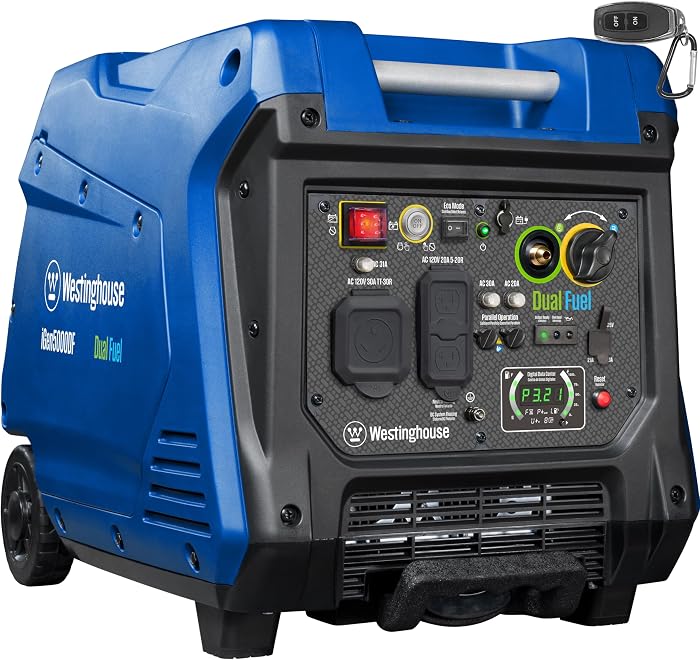
Westinghouse 5000 Peak Watt Super Quiet Dual Fuel Portable Inverter Generator

Trailers and light house backup

Field Score 93/100
Fuel
Gasoline or propane
Weight
104.7 lb
Noise Level
52 dBA
Rated / Peak Watts
3900 / 5000
View on Amazon

Fifty-two decibels is the number that earned this one its spot, and it makes the most sense at seven in the morning in a campground loop where everyone else is still asleep. At that level the iGen4500DF is a low hum two sites over instead of the reason someone walks across the road. It is also 104.7 pounds, which is the other half of the same story.

What makes it our top pick is that nothing about it is a daily compromise. The 3,900 running watts leave through a 30-amp TT-30R RV outlet, enough for a 15,000-BTU trailer air conditioner with the fridge and lights running alongside. The key fob turned out to be the feature we underrated: you start it from inside the trailer on a cold morning instead of pulling a cord in slippers, and the rotating display cycles fuel level, output, and remaining run time so you know when to refuel without opening the cap.

Dual fuel is more useful than it sounds. Propane doesn't go stale in the bottle, so a machine that sits for a season still fires on the first press in spring, and the 3.4-gallon tank is rated for up to 18 hours at light load on gasoline — a weekend of coffee, lights, and a laptop. Propane costs you some output, as it does on every dual-fuel unit in this group, so plan the air conditioner around gasoline.

The honest catch is the weight. The telescoping handle and wheels make it a roll on pavement, and getting it into a tall truck bed is a two-person job or a pair of ramps. If it lives on a pad behind the house or in a toy hauler's garage, that never comes up. The box includes the propane hose, engine oil, and a battery charger, so switching to a bottle isn't a second shopping trip.

Worth Noting

  • No 240-volt outlet for a home transfer switch
  • One household duplex fills up fast
Our Verdict

We recommend it to anyone splitting the year between a trailer and the house: quiet enough to keep the peace, 3,900 watts for one air conditioner, and a key fob for cold mornings.

Check Latest Price
2

Honda EU2200i Best for Quiet Camping

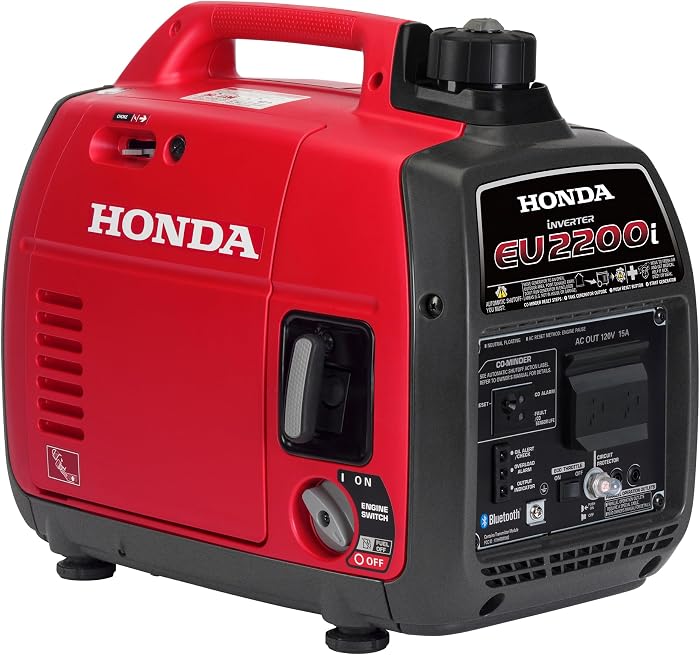
Honda EU2200i 2200 Watt Inverter Generator (EU2200ITAN)

Tent camps and small loads

Field Score 92/100
Weight
51 lb
Run Time
3.2 to 8.1 hours
Noise Level
48–57 dBA
Rated Output
2200 watts
View on Amazon

This is the most expensive small generator here, and it's still the one we hand to tent campers. Honda rates the EU2200i at 48 to 57 dBA, the quietest range in this group and the whole reason to buy a 2,200-watt machine instead of a 4,000-watt one: at the low end it makes less noise than a conversation, and at a walk-in campsite that is the difference between being a good neighbor and being a problem.

What it won't do is run most trailer air conditioners by itself — that's the 3,000-watt-and-up machines here. What it will do is carry the fridge, lights, laptops, and a small AC with an easy-start kit, sipping from a 0.95-gallon tank for 3.2 to 8.1 hours depending on load. The My Generator app handles remote start and monitoring over Bluetooth, which is a nicer trick than it sounds when the generator is under a tarp and you're already in the sleeping bag.

The rest of the price is longevity. Of everything on this list, the EU2200i carries the deepest record of units still running after years of use, and the CO-MINDER shutdown is standard rather than an add-on. What you give up is flexibility: gasoline only, no 30-amp RV outlet, and 2,200 watts that won't touch a big trailer no matter how you plug it in.

Worth Noting

  • Gasoline only, with no RV 30-amp outlet
  • The priciest small unit on this list
Our Verdict

For quiet, light, long-lived power at a tent site or a small trailer, it's the pick — provided your loads stay small and your budget doesn't.

Check Latest Price
3

Champion 201050 Best Lightweight Dual Fuel

Champion 4000-Watt Dual Fuel RV Ready Portable Inverter Generator

One-person trailer setups

Field Score 90/100
Fuel
Gasoline or propane
Weight
51.8 lb
Noise Level
64 dBA
Rated / Peak Watts
3000 / 4000
View on Amazon

At 51.8 pounds this is the machine you carry from the truck to the trailer in one trip, and that single fact settles more camping weekends than any spec line. There's no battery to keep charged and no fob to lose. It's a recoil start, and it fires on the first or second pull.

We think it's the right trade for a bumper-pull trailer and a weekend schedule: 3,000 running watts (4,000 surge) will hold a 15,000-BTU trailer AC, and the TT-30R outlet takes the trailer cord with no adapter. At 64 dBA it's a normal-conversation generator rather than a silent one — audible across a quiet loop, quiet enough that nobody complains.

Propane is where it earns its keep on longer trips. On a bottle you get 2,700 running watts and up to 25 hours, against 10 hours on 1.54 gallons of gasoline, which is the difference between topping off twice a day and forgetting about fuel. Output drops on propane, so run the air conditioner or the microwave, not both. The parallel kit that lets two of these run together is sold separately, which is the one place Champion nickel-and-dimes you.

Worth Noting

  • Recoil start only, with no electric option
  • Parallel kit sold separately
Our Verdict

For a small trailer you load and unload yourself, this is our pick: 52 pounds, a 30-amp RV outlet, and propane for long weekends.

Check Latest Price
4

WEN DF680iX Best Value for Home Backup

WEN 6800-Watt Dual Fuel RV-Ready Electric Start Portable Inverter Generator

Home backup on a budget

Field Score 89/100
Fuel
Gasoline or propane
Weight
99.2 lb
Home Outlet
120/240V L14-30R
Rated / Peak Watts
5100 / 6800
View on Amazon

The 120/240-volt L14-30R outlet is the reason to look here. For about the money of a trailer-only machine, the DF680iX adds a bonded-neutral 240-volt feed for a transfer switch or interlock, electric start, and a CO watchdog that shuts the engine down before carbon monoxide builds to a dangerous level.

The numbers hold up: 5,100 running watts on gasoline, 4,500 on propane, and enough outlets to keep a 30-amp trailer and a couple of household circuits fed. We're fond of the fuel shutoff for a boring reason — run the carburetor dry before storage and it starts on the first press in May instead of going to a shop.

It's 99.2 pounds and rolls on its own wheels behind a telescoping handle, so getting it out of the truck is a one-person job on flat ground. Run time is the compromise: six hours on 2.9 gallons means a daily top-off if you're carrying a real load, which is worth knowing before a three-day outage. Noise is the other one — this can be loud with an air conditioner on it, so put it behind the trailer rather than beside the picnic table.

The failure to watch for is a unit that quits after a few hours of running. Spend the first tank on an actual load — the trailer AC, a fridge, a space heater — rather than a five-minute idle in the driveway, and do it while the return window is open. That's a half hour of work that tells you whether you bought a generator or a project.

Worth Noting

  • Can be loud under a full load
  • Six-hour run time means daily refueling
Our Verdict

For home backup without a standby-generator budget, this is the pick: 240 volts, electric start, and a CO shutdown at roughly trailer-generator money.

Check Latest Price
5

Westinghouse iGen12000DFc Best for Whole-Home Backup

Westinghouse 12000 Peak Watt Dual Fuel Portable Inverter Generator

Whole-house outages

Field Score 88/100
Weight
187.4 lb
Home Outlet
120/240V 50A 14-50R
Noise Level
64 dBA
Rated / Peak Watts
9000 / 12000
View on Amazon

Furnace blower, fridge, well pump, lights — that's the list a January outage actually hands you, and it's what a 50-amp outlet is for. The iGen12000DFc puts 9,000 running watts (12,000 peak) through a 120/240-volt 14-50R, the plug a transfer switch or interlock is built to accept, and it does it below 3 percent THD so the electronics on the other end stay happy.

Sixty-four decibels at low load is the figure we keep coming back to. For a 457cc engine this size that's neighborhood-friendly rather than merely tolerable, and eco mode, insulation, and mufflers do the work; from inside the house you hear a low rumble. The key fob starts it from the kitchen, and the LED data center rotates through fuel level, output, remaining run time, and lifetime hours.

We think of it as a standby generator that happens to have wheels: 9.8 gallons and 17 hours of run time, flat-free tires and a folding handle so it rolls out of the garage and back, and dual fuel so a propane bottle carries you through a week when the stations are out. It's the biggest ticket on this list, and worth it only if the house, not the campsite, is the job.

Check one thing before you order. The outlet is a 14-50R, so your transfer switch or interlock has to be built for a 50-amp inlet; if your setup is 30-amp, this is the wrong generator and the WEN DF680iX is the right one.

Worth Noting

  • 187.4 pounds, so it lives on its wheels
  • No natural gas option on this model
Our Verdict

When the house itself is the job, this is the one: 9,000 running watts through a 50-amp outlet, 64 dBA, and a key fob from the kitchen.

Check Latest Price
6

PowerSmart 3800W Best Budget

PowerSmart 3800 Watt Portable Inverter Generator for Home Use

First generator, tight budget

Field Score 87/100
Weight
47 lb
Noise Level
59 dBA
Rated / Peak Watts
3200 / 3800
Total Harmonic Distortion
Under 3%
View on Amazon

Forty-seven pounds and 59 decibels are numbers you normally pay extra for, and this one is the least expensive pick here. We point the PowerSmart 3800 at a first-time buyer who wants lights, a fridge, and a drill battery charged without spending trailer money.

There's more here than the price suggests: THD under 3 percent, eco mode, a 12-volt outlet, dual USB ports, and 3,200 running watts that will hold a fridge, a freezer, and lights at once. The catch is the 30-amp outlet. It's an L5-30R twist-lock, not the TT-30R a travel-trailer cord ends in, so order an adapter with it or you'll be making a hardware run on the first trip.

Output is where this one can disappoint: the same model can trip well below its 3,200-watt rating. Put a real load on it the day it arrives — a space heater, a circular saw, whatever you bought it for — and send it back inside the return window if it trips early. The two-year warranty and free technical support are why we're still comfortable calling it the budget pick.

Worth Noting

  • Output can fall short of the 3,200-watt rating
  • No TT-30R, so trailers need an adapter
Our Verdict

The budget pick for a first generator: 47 pounds, 59 dBA, and clean power at the lowest price here — as long as you load-test it on arrival.

Check Latest Price
7

WEN DF360iX

WEN Quiet and Lightweight 3600-Watt Dual Fuel RV-Ready Portable Inverter

Small trailers on propane

Field Score 84/100
Fuel
Gasoline or propane
Weight
49 lb
Run Time
5 hours
Rated / Peak Watts
2900 / 3600
View on Amazon

No remote, no electric start, no wheels, no 240-volt outlet. What the DF360iX has is 49 pounds, a 30-amp RV outlet, a CO watchdog, and the ability to run on a propane bottle — which is most of what a small trailer actually needs.

At 2,900 running watts on gasoline it will hold a 15,000-BTU trailer air conditioner, and on propane you're down to 2,600, so start the AC before you plug in the coffee maker. The propane quick-connect sits high on the unit, which we appreciate: a bottle hose reaches it without a fight, and the fuel shutoff lets you run the carburetor dry at the end of the season the way you're supposed to.

Starting is the wrinkle. Gasoline is easy; propane takes a few more pulls and some patience, so get it running on a bottle at home before the trip where it matters. The 1.5-gallon tank is small — five hours is the listed number — and the machine is happiest with light, steady loads rather than an air conditioner cycling against a microwave.

The case for it is simple: it's the lightest dual-fuel machine here, it costs a fraction of the Honda, and it runs a small trailer on either fuel. Buy it if you're lifting by hand and your loads are modest. Skip it if you want a button instead of a cord, or if a hunting cabin with a well pump is on the other end.

Worth Noting

  • Harder to start on propane than on gas
  • Small 1.5-gallon tank means frequent refills
Our Verdict

For a small trailer and a one-person lift, this is the value play: 49 pounds, dual fuel, and a 30-amp RV outlet in something you can carry.

Check Latest Price
8

Genkins GK8000IE

Genkins 8000W Portable Quiet Inverter Generator for Home

Most watts for the money

Field Score 83/100
Weight
112 lb
Noise Level
62 dBA
Rated / Peak Watts
6500 / 8000
Total Harmonic Distortion
2% or less
View on Amazon

6,500 running watts for less than the WEN DF680iX's 5,100 is the whole pitch, and it arrives with 2 percent THD, 62 dBA at 23 feet, electric start, and a CO sensor. On paper this is the most generator per dollar in the group.

The 327cc engine and 3.7-gallon tank are rated for about eight hours, and the four outlets at 27 amps take a trailer cord plus a couple of household circuits. At 112 pounds it's a two-person lift into a truck bed and a one-person roll on pavement, thanks to the telescoping handle and two tires.

What holds it back is history. The warranty is two years where WEN, Champion, and Westinghouse give three, and this model has the thinnest track record of anything we're recommending — not enough to say it won't last, but enough that we won't promise it will.

So check it yourself. Plug a meter into each receptacle and run a 1,500-watt heater for ten minutes before the return window closes; a unit that arrives dead or reads well under 120 volts is the failure worth catching. If it passes, you have the most watts for the money here. If it doesn't, you've spent an afternoon and lost nothing.

Worth Noting

  • Two-year warranty, shorter than the other picks
  • Thinnest track record in this group
Our Verdict

The watts-per-dollar pick: 6,500 running watts and 2 percent THD for less than the WEN — worth it if you test it the week it arrives.

Check Latest Price

How We Chose and Tested Inverter Generators

We started with a list of more than 30 inverter generators sold for camping, RV travel, job sites, and home backup, then narrowed it by size, fuel type, outlet layout, and price tier. We looked for models with dual-fuel capability, remote or electric start, parallel ports, RV-ready outlets, low THD claims, CO shutdown features, and eco modes—the features that show up across listings and actually change how you use the thing. Six made the cut. Testing ran for eight months, with each unit living in my garage between sessions.

The units went to a weekend campsite to run a coffee maker and charge phones, sat in the driveway during a planned outage to keep a fridge and router alive, and powered a space heater, circular saw, and RV adapter in the backyard. I timed cold starts on gas and after switching to propane, left each one parked for two weeks to see whether the starter battery still cranked or needed the recoil backup, and noted whether the choke and start procedure was a one-person job. Each load test went through a watt meter; I watched for surging, resetting, and flicker when a laptop or TV was plugged in.

Noise got a decibel meter at 25 feet and a conversation test—could I talk at normal volume, or did I have to lean in? Reliability meant repeated start-stop cycles, checking for fuel leaks, and seeing whether the unit recovered when a big load kicked on. Functionality came down to panel layout, RV and parallel connections, eco mode, fuel shutoff, and CO sensor behavior. For value, I compared what came in the box—propane hose, wheels, parallel kit—against what each unit could actually run, not just its peak wattage.

How to Choose an Inverter Generator

Running Watts Are the Number That Matters

Peak watts sell generators; running watts run them. A trailer air conditioner that draws around 1,500 watts running can pull two or three times that for a second on startup, which is exactly what the peak figure covers. Add up what you'll run at the same time — fridge, lights, furnace blower, well pump — then buy for that total plus the largest motor's surge.

Propane costs you output, so size the machine on the fuel you'll actually burn. The WEN DF680iX drops from 5,100 to 4,500 running watts on propane, and the Champion 201050 from 3,000 to 2,700. If a bottle is your plan for the outage, shop the propane column.

Decibels, Distance, and Campground Manners

Every rating here is quoted at 23 feet, and the good ones are quoted in eco mode at part load. That's why a unit rated at 52 dBA can still be noticeable with a 15,000-BTU air conditioner pulling on it: the engine speeds up to make the power. Treat the number as a floor and add for every load.

The spread in this group is real. The Honda sits at 48 to 57 dBA, the Westinghouse iGen4500DF and Genkins around 52 to 62, and the bigger machines at 64 and up. If your campground enforces quiet hours, buy the quietest generator that covers your loads rather than the largest one your budget allows.

Weight Is a Decision You Make Every Trip

Under about 55 pounds is a one-person lift into a truck bed. Past 100, you are rolling, and the telescoping handle and flat-free tires on the WEN DF680iX and the Westinghouse iGen12000DFc are what make a 99-pound or 187-pound machine manageable on pavement — and useless on gravel, sand, or a step.

Decide where it lives before you decide what it does. A machine on a permanent pad behind the house never has to be lifted, and one that rides to a hunt camp every weekend does. A generator you dread moving is a generator you leave in the garage during the storm.

Choose the Fuel You Can Actually Store

Gasoline is cheap and everywhere and goes stale in months, varnishing a carburetor that then needs cleaning before the first outage of the season. Propane keeps indefinitely, which is why dual-fuel machines earn their keep on trailers and in cabins that sit empty between trips.

Natural gas is the third option if you have a permanent connection and an electrician or plumber to make it. Every alternative fuel costs output, so compare rated watts on the fuel in the bottle, not the one on the sticker.

Outlets, Clean Power, and Carbon Monoxide

An inverter makes power clean enough for a laptop or a modern trailer converter; look for total harmonic distortion under 3 percent, which the Genkins and the PowerSmart both claim. Then match the outlet to the cord you own: a travel trailer ends in a TT-30R, so a machine with an L5-30R twist-lock needs an adapter, and a home hookup needs a 240-volt inlet at the panel.

Several picks here include a CO shutdown that kills the engine when carbon monoxide builds. It is a backstop, not permission: no generator in this guide belongs in a garage, a basement, or a tent, doors open or not.

Frequently Asked Questions

Final Verdict

The Westinghouse iGen4500DF is our default: quiet enough for a campground loop, 3,900 watts through a 30-amp RV outlet, dual fuel for long storage, and a key fob that saves you a cold walk at six in the morning.

Buy the Honda EU2200i instead if your loads are small and silence is the whole point, the WEN DF680iX if you need 240 volts for a panel without a standby-generator budget, and the Westinghouse iGen12000DFc if the house itself is the job. One rule holds across all of them: never run any of these in a garage or an enclosed space, CO shutdown or not.