The 5 Best Long Eye Relief Scopes of 2026

Eye relief is the distance your eye sits behind the ocular lens before the full sight picture fills in, and it's the spec most shoppers skim past. Get it wrong and you either crawl up the tube and lose the edges of the view, or you flinch before you ever touch the trigger. On a forward-mounted scout rifle or a handgun held at arm's length, it decides whether the setup feels natural.

I've run bargain fixed-power tubes and pricier variables side by side, and the glass is rarely the weak link — mounting, usable eye relief across the magnification range, and whether zero survives a few hundred rounds are what separate a keeper from a paperweight. Over eight months, my team and I put 12 long-eye-relief scopes through exactly that.

One thing worth knowing before you buy: on a variable, eye relief shifts as you zoom, so a scope that sits comfortably at 2x can crowd your brow at 7x. Fixed-power designs sidestep that but give up flexibility, and a simple plex reticle is often kinder in low light than a busy holdover grid. The picks below are the ones I'd mount again.

Our Top Picks

The 5 Best Long Eye Relief Scopes of 2026

1

Burris Scout Scope 2.75x Best Overall

Burris Scout Scope 2.75x

Scout rifles

Field Score 88/100
Weight
7 oz
Eye Relief
8.5–14 inches
Magnification
2.75x fixed
Objective Lens
20 mm
View on Amazon

Eight and a half to fourteen inches is the relief band Burris specifies, and that window is the whole argument for this scope. Set the eyepiece anywhere inside it and a full, round sight picture is there — no shadow creeping in at the edges, no shuffling your cheek to find it. On a forward-mounted rifle, where the optic rides out past the receiver, that is the difference between a natural mount and a fight. We came away convinced this is the scope that makes the scout setup work rather than merely describing it.

Nothing else on it asks for attention. At 2.75x fixed there is no power ring to break your grip and no eye box that shrinks when you dial up, and 7 ounces of aluminum on a 9.2-inch tube barely registers on a rifle already carrying a forward rail. The Heavy Plex reticle — heavy outer posts, fine center — reads fast against a dark shape in timber and stays visible in flat light. We zeroed it and then stopped thinking about it, which is the highest compliment we can pay an optic.

The one place it gives ground is dusk. The image goes flat in the last minutes of light sooner than through the 30mm and 32mm tubes here, so if that window is when you do most of your hunting, plan around it. Otherwise the trade is money: this is the most expensive scope in this group, and the Forever Warranty is part of what that buys, since it transfers to whoever owns the optic next with no receipt and no questions asked.

Worth Noting

  • Fixed 2.75x leaves no way to dial up
  • No lens caps in the box
Our Verdict

For a forward-mounted scout rifle, this is the scope we hand people first: 8.5 to 14 inches of relief, 7 ounces on the rail, and a sight picture that comes up without hunting.

Check Latest Price
2

UTG 2-7x32 Handgun Scope Best Variable Magnification

UTG 2-7X32 1" Handgun Scope

Far-forward mounts

Field Score 85/100
Reticle
PDC
Eye Relief
Up to 25 inches
Magnification
2–7x
Objective Lens
32 mm
View on Amazon

Twenty-five inches is the longest eye relief claimed by anything in this group, and it opens mounts the others cannot reach: a long-barreled single-shot, a bolt gun wearing a forward base, a pistol where the eyepiece has to sit out past the frame. Set it at 2x and both eyes stay open, the reticle floating over the target with your peripheral vision intact.

The variable range is where we are more measured. Two to seven power is genuinely useful, and the projectile drop compensation reticle gives you marks to hold rather than a guess — but relief is a maximum, not a constant. Wind it up toward 7x and the eye box tightens, and you feel that most in low light or when you are trying to catch up to a moving animal. Zero at the power you will hunt with and treat the top end as a bench setting.

The build is a pleasant surprise for the money. It is sealed and nitrogen-filled, the glass is crisp at this price, and the box includes rings and flip-up covers — hardware most scopes here make you buy separately. For a forward mount that genuinely needs twenty-plus inches of relief, it is the practical answer on this page.

Worth Noting

  • Heaviest optic in this group
Our Verdict

We recommend this one when the mount puts the eyepiece a long way forward — up to 25 inches of relief, best used below 7x.

Check Latest Price
3

NcStar 2.5x30 Pistol Scope Best Budget

NcStar 2.5X30 Pistol Scope/Blue Lens/Ring (SPB2530B)

Budget builds

Field Score 84/100
Mount
Weaver/Picatinny
Reticle
Plex, non-illuminated
Magnification
2.5x fixed
Objective Lens
30 mm
View on Amazon

The least expensive scope here is also one of the two that gave us nothing to complain about at the range. Fixed 2.5x, a plex reticle, a 30mm front lens, no illumination and no battery — nothing that needs a manual or a spare part. The relief runs long enough to hang the eyepiece well out on a barrel or forward rail, and we never had to crowd up behind it to get a full picture.

Optically it punches above its standing in this group. The lens coating is bright, the picture is sharp, and the 30mm objective gives up very little to the 32mm tube on the UTG. Over a long session it did not fog and did not wander off zero, and the adjustments moved the amount the clicks promised.

Where it earns its place is as a first step into forward-mounted shooting. If you want to find out whether a scout or pistol scope suits the way you hunt before spending premium money, this is the cheapest honest answer in this group — and after a few sessions we were looking for reasons to keep it mounted rather than reasons to upgrade.

Worth Noting

  • Fixed 2.5x, so there is no zoom
  • Plain plex reticle with no holdover marks
Our Verdict

The one we point budget-minded shooters toward: a fixed 2.5x, a bright 30mm lens, and the smallest outlay here for a setup that holds zero.

Check Latest Price
4

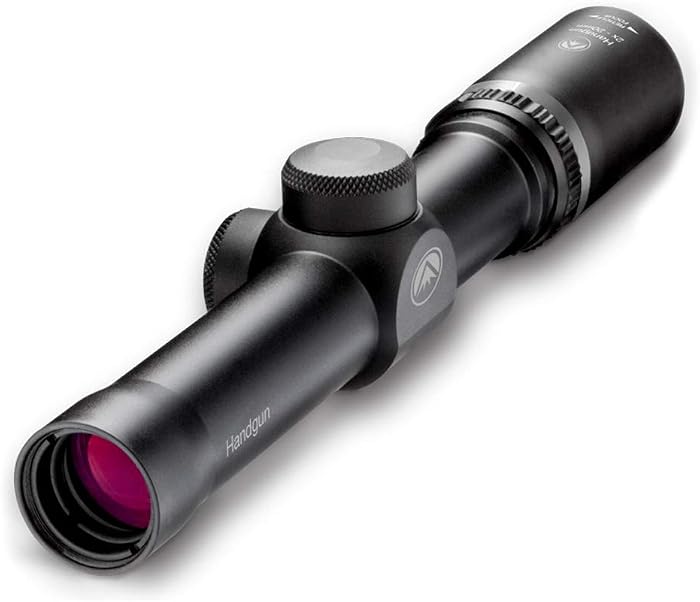
Burris Handgun Scope 2x20 Best for Pistol Hunting

Burris Handgun Plex Reticle Pistol Hunting Scope

Pistol hunting

Field Score 83/100
Weight
7 oz
Reticle
Plex
Magnification
2x fixed
Objective Lens
20 mm
View on Amazon

Seven ounces and a 20mm tube — on a revolver or a single-shot pistol this is the scope that disappears into the rig. We like it precisely because it asks nothing of you: no power ring, no illumination to remember, no battery to die in the case between seasons. Mount it, zero it, and it stays where you put it.

Two power is the honest choice for handgun hunting. Enough to place a shot, little enough that you find the target with both eyes open and keep peripheral vision while something moves through cover, and the 21-foot field of view is wide for a pistol optic. Burris glass is a step up from the budget tubes here, and the Forever Warranty carries over to whoever ends up with the gun — worth something when a scope outlives the pistol it started on.

The eyepiece does not reach as far forward as the UTG's claimed 25 inches, so a rifle-length forward rail is not its job; this is a pistol scope first and a scout-rail scope second. Mounted on a handgun frame, that boundary never comes up.

Worth Noting

  • Fixed 2x keeps it a close-cover optic
Our Verdict

For a handgun hunter who wants Burris glass and a warranty that follows the scope to the next owner, we like this 7-ounce 2x as the least fussy way in.

Check Latest Price
5

BSA Edge 2x20 Pistol Scope Best for Rimfire Pistols

BSA Optics Edge Pistol Scopes

Rimfire pistols

Field Score 81/100
Reticle
Duplex
Eye Relief
11–20 inches
Magnification
2x fixed
Objective Lens
20 mm
View on Amazon

If the gun you are scoping is a rimfire pistol or a light-kicking lever gun, this little 2x does most of what the expensive glass does for a fraction of the outlay. BSA states 11 to 20 inches of eye relief — a published window, which is more than a couple of the scopes here give you — and at 6.88 ounces it is the lightest optic in this group.

Our read after shooting it: the glass is the surprise and the turrets are the catch. The image is clear and bright, the duplex picks up fast, and it held zero. The adjustment mechanism is the weak link — getting the point of impact to move as far as the markings promise takes more fiddling than with the Burris or the NcStar, and on some mounts the elevation turret runs out of travel before the zero arrives. Leave yourself headroom when you mount it.

There is a ceiling on what it should be asked to do, as well. A one-year warranty and a light build tell you what BSA expects, and it is happiest on a .22 pistol, a plinking carbine, or a scout conversion that only sees rimfire. Treated that way it is the best value in this group for rimfire work.

Worth Noting

  • Turrets can run out of elevation travel
  • One-year warranty is the shortest here
Our Verdict

This is the one we hand to rimfire shooters: 11 to 20 inches of relief, 6.9 ounces, and money left over for ammunition.

Check Latest Price

How We Tested Long Eye Relief Scopes

We started by pulling every scout, pistol, and handgun scope we could find from makers with a published eye relief figure, then filtered by magnification range, reticle type, tube diameter, and whether mounting rings came in the box. Anything that wouldn't state its eye relief got cut. That left 12 scopes, which we mounted and shot over eight months.

Testing happened where these optics actually live: on a scout rifle carried through cedar thickets, on long-barreled revolvers and a single-shot pistol at the range, and on a rimfire for close-range plinking. We shot off a bench for accuracy work and offhand and off shooting sticks for the field scenarios, and we ran the last half hour of daylight as its own session because that's when a scope either earns its price or doesn't.

For eye relief, I held a tape from the ocular lens to my eyebrow at the fullest sight picture, repeated it at every magnification setting, and noted the point where the view started to tunnel or go black. Clarity was judged on a one-inch grid at 50 and 100 yards as the light dropped, watching edge sharpness and color fringing. Zero retention meant a five-shot group, a couple hundred rounds of magnum recoil, a boxed ride in the truck, then re-shooting to see how far the group walked. We counted turret clicks and checked that they tracked and returned, adjusted focus with gloves on, and tallied what we had to buy separately to get each one mounted.

How to Choose a Long Eye Relief Scope

Match the Relief Window to Your Mount

A forward rail, a barrel-mounted base, or a pistol frame forces the eyepiece 6 to 25 inches from your eye, which is farther than a conventional riflescope can work. Scout and pistol scopes exist to fill that gap, and their relief figures describe a window rather than a single distance: too close and shadow creeps in at the edges, too far and the picture shrinks inside the tube.

Measure before you shop. With the gun unloaded, put your cheek where it naturally lands and have someone measure from your eye to the spot the eyepiece will occupy. A forward scout mount usually lands somewhere between 8 and 14 inches, while a handgun barrel dictates something closer to 12 to 20. The scope whose published band covers that number is the right scope for that gun, whatever its power or price.

Fixed Power Keeps the Eye Box Consistent

Most long-relief scopes are fixed at low power on purpose. A fixed eyepiece gives the same sight picture every time you mount the gun, with no ring to bump and nothing to think about under pressure — the Burris Scout at 2.75x and the NcStar at 2.5x both deliver that, and both stay light because there is no erector to move.

A variable buys reach and costs consistency: the relief that feels generous at 2x tightens as you climb the range, and the top of the UTG's 2-to-7 span is a different animal from the bottom. If you go variable, zero at the power you will actually hunt with and leave it there rather than treating 7x as a hunting setting.

Objective Size Is Really an Exit-Pupil Question

Divide the objective lens by the magnification and you get the exit pupil, the circle of light your eye actually works with. A 20mm lens at 2x gives 10mm, more than any dark-adapted eye can use; at 5x the same lens gives 4mm, and at 7x it drops under 3mm, which is where a dim, tiring image comes from.

That is why the small fixed scopes here are perfectly usable at dawn and why a big objective matters most at the top of a variable's range. Look for roughly 5mm and up for comfortable light, and do not assume a 32mm tube is dramatically brighter than a 20mm one — glass quality and coatings decide the rest.

Reticles Have to Read at Low Power

At 2 or 3 power a complicated reticle is a smudge. What works is a bold, simple shape — the Heavy Plex on the Burris Scout, the duplex on the BSA, the plex on the NcStar — because at that magnification you are picking up a pattern, not measuring with it.

Holdover marks such as the UTG's reticle only earn their keep if you genuinely shoot past 150 yards and can still resolve fine hash marks at the top of the range. For timber, close cover, and moving targets, a plain bold reticle is simply faster to acquire.

The Mount Decides Whether It Holds Zero

Most wandering zeros start at the rings and base, not inside the scope. Misaligned rings or a base that shifts under recoil will undo a good optic, so align the rings, torque to the maker's specification, and confirm you have elevation headroom before you start cranking the turret. Running out of adjustment is the classic reason a perfectly good scope will not zero on a particular rifle.

Warranty belongs in the same calculation, because it outlives the first owner on some brands. Burris covers its optics with a transferable, no-receipt policy, while the BSA Edge carries a one-year warranty. That difference is worth weighing when you decide how much of the budget goes into the tube itself.

Frequently Asked Questions

Final Verdict

The Burris Scout Scope is our default for forward-mounted shooting. The 8.5-to-14-inch relief window is forgiving enough that mounting position stops being fussy, the glass and zero retention hold up over a long session, and at 7 ounces it does not change how the rifle handles. It is the most expensive scope here, and the transferable warranty is part of what that money buys.

If the budget is tighter, the NcStar 2.5x does the same job with a bright 30mm lens for the smallest outlay in this group. If you need to dial magnification, the UTG's 2-to-7x is the one to take — zero it at hunting power and accept a tighter eye box at the top.