The 6 Best Men's Riding Boots of 2026

A riding boot has to do two jobs that fight each other: protect your feet and ankles in a crash, and stay comfortable enough to walk in when you get off the bike. Over the past six months, my team and I have ridden in 12 pairs, from casual ankle boots to full dirt bike boots, and the difference between the good ones and the rest comes down to how they handle that tension.

Fit and stiffness matter more than most shoppers expect. A boot that feels snug in the shop can leave your feet numb after an hour, and a sole stiff enough for the pegs can make a short walk miserable. We also worked every side zipper and buckle with gloves on, since a closure that catches or packs with grit will ruin an otherwise solid pair. Durability, quality, and appearance came down to whether the boot still looked and felt right after a season of real use.

The picks below cover commuters, cruiser riders, and dirt riders. They were chosen for protection first, comfort second, value third.

Our Top Picks

The 6 Best Men's Riding Boots of 2026

1

IRON JIA'S MT016 Best Overall
IRON JIA'S Motorcycle Shoes for Men & Women

Street and commuting

Field Score 94/100
Closure
Side zipper and laces
CE Rating
EN 13634:2017, 1-2-2-1
Shaft Height
Ankle-high
Upper Material
Cordura and microfiber
View on Amazon

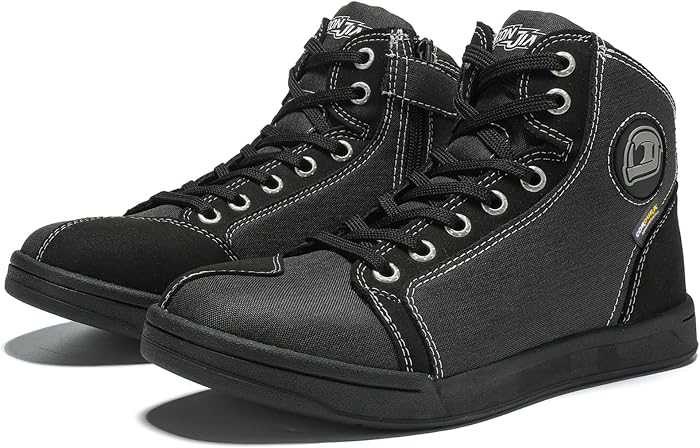
The rating code is where we start. IRON JIA'S publishes a full EN 13634:2017 rating for this boot, 1-2-2-1, which is more than any other pair on this page tells you about what it is built to survive. Behind the code sit a thickened heel, an ankle protection device, and shift pads exactly where the lever rubs.

It earns the top spot because it covers the riding most men actually do: a commute, a weekend loop, an errand. The side zipper opens the boot wide enough to step into without touching the laces, the Cordura and microfiber upper stays comfortable in warm weather, and the toe box leaves room for wide feet. We spent a morning in them walking between stops and never felt the urge to swap into shoes.

Two limits are worth knowing. The upper is water-repellent rather than waterproof, so damp roads and a passing shower bead off but sustained rain soaks through, and the sole and insole are where these wear out, with separation possible inside a year of hard use. Neither matters much to a street rider; both matter if you commute through winter or spend weekends in mud.

Worth Noting

  • Not waterproof in steady rain
  • Sole and insole can separate within a year
Our Verdict

We recommend the MT016 as the one boot most men should start with: certified ankle and shift protection, an easy side zip, and a shape that stays comfortable on and off the bike.

Check Latest Price
2

Harley-Davidson Hagerman Best Leather Cruiser Boot

Harley-Davidson FOOTWEAR Mens Hagerman Motorcycle Casual Boots Ankle

Cruisers and touring

Field Score 93/100
Weight
4 lb
Closure
Side zipper and laces
Shaft Height
Ankle-high
Upper Material
Leather
View on Amazon

Most leather riding boots ask for a few weeks of misery first. This one doesn't. The leather is thick, the collar and tongue are padded, and the boot flexes at the ankle from the first ride, which is the whole reason we recommend it to cruiser riders who want something they can wear from the driveway to the diner.

At four pounds it sits lightly on the foot, and the side zipper does the work of getting it on and off while the laces set the fit once. There is extra leather over the toe where a shifter rubs, and the sole grips well enough for a stop-sign foot plant. The zipper is the part we used most: step in, pull, done.

One note on heat. The sole is a smooth rubber compound rather than a lugged off-road sole, so keep your right foot off a hot exhaust at a long light, where it can mark or melt against the pipe. That same smooth sole is why this boot belongs on pavement and gravel rather than a trail full of roots, which is the riding it was built for anyway.

Worth Noting

  • Runs slightly large through the foot
Our Verdict

The Hagerman is our pick for cruiser riders who want real leather and a side zip without a break-in period; it is the most comfortable leather boot in this group straight out of the box.

Check Latest Price
3

O'Neal Element Best Dirt Bike Boot for Beginners

O'NEAL Element Dirt Bike Boots

First dirt bike

Field Score 92/100
Cuff
Padded ankle support
Type
Motocross boot
Closure
Buckle and strap
Package Weight
7.5 lb
View on Amazon

A first dirt bike boot has one job: keeping a new rider's ankle and shin intact while they are still learning to stand on the pegs. The Element takes that seriously, with coverage over the toe, ankle, and shin, a liner thick enough for a full day, and ankle support that doesn't fold when the bike goes down.

What we like most is the padding. It is thick enough that a long day in the dirt doesn't leave you with blisters or cramps, which is not something we can say about every budget motocross boot. Set against the pricier boots here, this is the pair we hand a new rider before they know whether they will stick with dirt riding.

The weak points are the closure and the break-in. The latch system has a learning curve, and the straps and buckles are the first parts to let go, with a strap able to tear away at its base. New boots are also stiff enough that the shifter feels vague for the first few rides, so give them a handful of outings before you judge them on a trail.

Worth Noting

  • Straps can tear away at the base
  • Stiff sole blurs shifter feel at first
Our Verdict

For a first season in the dirt, we point new riders to the Element: padded ankle support, coverage over the toe and shin, and midrange money that leaves room for a helmet.

Check Latest Price
4

Alpinestars Tech 3 Best Motocross Protection

Alpinestars Mens Tech 3 Boots Black Sz 10

Track and trail

Field Score 91/100
Weight
7.69 lb
Closure
Three buckles
Protection
TPU shin plate and ankle support
Shaft Height
Mid-calf
View on Amazon

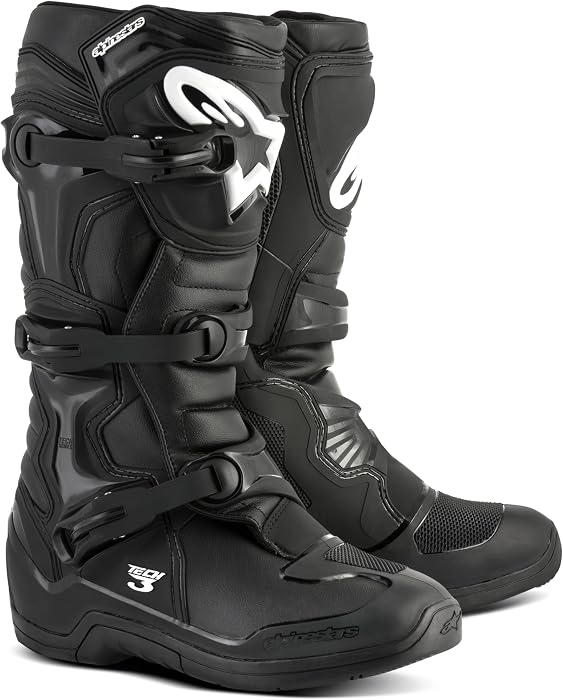
Set the Tech 3 beside the Element and you can see where the money goes: a one-piece injected TPU shell with a shin plate, calf protection, a heel counter, and an ankle support structure, held on by three buckles instead of a zip and a lace.

The details are the ones that matter over a season. The buckles carry a memory lock, so they keep the fit you set when you pull the boots off between motos, a microfiber gaiter keeps grit out of the liner, and the padded interior is comfortable enough for a full day. Fit runs true, though a very wide foot may need to go up a size.

Here is the trade, and it is a big one: this is a track boot. The shell that protects your ankle also takes away shifter feel, and a street rider usually has to raise the shift lever to make room for the toe. It is heavy too, at 3.49 kg on the spec sheet, which is fine over whoops and tedious in a parking lot. On a track or a trail that is a fair swap for the protection; on a commute it is armor you will resent.

Worth Noting

  • Little shifter feel for street riding
  • Buckle straps can fail early
Our Verdict

If your weekends happen on a track, the Tech 3 earns its place with a full TPU shell, three buckles, and padding that lasts a full day of riding.

Check Latest Price
5

Harley-Davidson Chipman Best Budget Leather Boot

Harley-Davidson FOOTWEAR Mens Chipman Motorcycle Casual Boots Ankle

Budget cruiser rides

Field Score 90/100
Weight
4 lb
Closure
Side zipper and laces
Shaft Height
Ankle-high
Upper Material
Leather
View on Amazon

This is the leather Harley boot for a rider watching the price, and it doesn't feel like a compromise. Genuine leather, a padded tongue and collar, room in the toe box, and a side zipper that turns a lace-up into a slip-on. It is the boot we point to when someone wants the cruiser look without paying the most in this group.

On the bike it behaves the way a cruiser boot should: the sole is solid underfoot on a peg, there is space in the toe for thick socks, and at four pounds it doesn't drag at a stop. Break-in is the thing to plan for, since the leather starts firm across the top of the foot and loosens over a handful of rides, so a boot that pinches slightly now will relax.

Where it sits here is simple: it is the least expensive leather boot in this roundup, and the money goes into leather and comfort rather than hardware. Riders who want a boot that disappears under a pair of jeans and still looks right at a stop are the ones it suits.

Worth Noting

  • Ankle coverage only, no shin protection
Our Verdict

The Chipman gives you genuine leather, a padded collar, and a side zip for less than the other leather boots here, which is the right call for a cruiser rider who wants the look.

Check Latest Price
6

FLY Racing Maverik LT

Fly Racing Men's Maverik LT Motocross Dirt Bike Boots

Lightweight motocross

Field Score 89/100
Closure
Quick-lock buckles
CE Rating
CE EN13634
Heat Shield
Rubber
Package Weight
4 lb
View on Amazon

The quick-lock buckles decide whether you get along with the Maverik LT. Seated clean and dry, they hold all day; packed with mud, they take both hands and some patience. That is the trade for a boot that otherwise does what a motocross boot should.

What it does well: a CE EN13634 rating, an articulated ankle that lets the boot flex forward over the pegs, a rubber heat shield where the boot meets the engine, and a lugged outsole that bites when you are pushing a stalled bike uphill. The fit leaves room at the toe without hugging the foot too tightly, which is more than some motocross boots manage.

Our reservation is that ankle. Articulated in the description, stubborn in practice: the boot doesn't give much, and the shifter feels vague until you learn where the lever sits. Riders who race or ride track regularly will get on with it, and riders who mostly commute are looking at the wrong boot entirely.

Worth Noting

  • Buckles are fussy when muddy
  • Little ankle flex makes shifting vague
Our Verdict

A CE-rated motocross boot with a heat shield and a roomy toe, worth a look if you ride track often and can live with buckles that need cleaning and patience.

Check Latest Price

How We Tested the Best Men's Riding Boots

We started by pulling together boots that covered the three main ways people ride: daily commuting on pavement, casual cruiser duty, and off-road or dual-sport use. We filtered the shortlist by safety ratings such as CE/EN 13634, ankle and shift protection, sole grip, and closure type, then ordered 12 pairs across a range of prices and sizes. Every pair went into the same six-month rotation.

My team wore them on commutes through wet city traffic and across slick garage floors, on weekend rides that mixed highway miles with gravel pull-offs, and during slow-speed practice in a parking lot where we deliberately put a foot down again and again. We walked each pair around a grocery store and up and down stairs after rides, noting where the sole flexed, whether the collar rubbed, and how easy it was to get in and out of the boot with riding gloves on. For the dirt-oriented pairs, we also spent time standing on pegs and kicking through muddy ruts.

We tracked stiffness over time: some boots softened nicely after a few weeks, while others stayed board-stiff or collapsed at the ankle. Zippers and buckles got opened and closed dozens of times, including after picking up grit, and we noted which ones jammed or needed two hands. Durability checks included scuffing the toe against pavement, flexing the sole at the ball of the foot, and inspecting stitching after each month. At the end, we judged appearance and value together—whether the pair still looked sharp after real use and whether the protection held up relative to what it cost.

How to Choose Men's Riding Boots

Match the boot to the riding you actually do

Three shapes cover this category. An ankle-height leather or textile boot with a side zipper is the street and cruiser choice: it covers the ankle, takes a shift pad, and lets you walk when you get off. A full motocross boot like the Tech 3 or the Maverik LT adds a hard shell, a shin plate, and buckles, which is what you want when the ground is dirt and the bike is meant to be dropped. Dual-sport riders usually land on the ankle boot plus knee guards.

The trap is buying the most protective dirt bike boot you can afford and then commuting in it. A buckled motocross boot has almost no ankle flex, so the shifter goes vague and every walk becomes a waddle. If most of your miles are pavement, you'll resent that armor within a week.

Getting the fit right, especially for wide feet

Try boots on with the socks you actually ride in, and don't assume your sneaker size carries over. Motocross boots get worn with thick socks and often with knee protection, so a snug calf is normal while a cramped toe box is not; that's where cold feet and pinched toes come from. Wide feet are the recurring complaint in this category, and some models simply don't come in widths, so fit the widest part of your foot and let the laces take up the rest.

A leather boot that runs a half size large is workable because the laces snug it down. A buckled boot that's too big is not: you run out of buckle adjustment and the whole boot rotates around your ankle.

Closures: zippers, laces, and buckles

A side zipper is the reason a lace-up leather boot gets worn instead of left by the door; set the laces once and the zip does the rest. It is also the part most likely to give trouble, so check that the slider runs smoothly past the ankle bone before you commit.

Buckles are stronger and fussier. A three-buckle motocross boot outlasts a zipper, but mud packs into the mechanism and a buckle that won't seat leaves the boot loose on your foot. Wipe the buckles out after a wet ride and you avoid most of that.

Leather, textile, and wet weather

Leather resists abrasion well and looks better with age, but it takes on water and dries slowly, so a soaked boot is heavier and stiffer the next morning. A water-repellent textile or microfiber upper sheds a shower and dries overnight. Neither counts as waterproof unless the listing says so, and most riding boots don't.

If you ride through winter, treat water resistance as something to check rather than a bonus, and dry wet boots away from direct heat, which cracks leather faster than rain does.

Where the money goes

In a motocross boot you're paying for the shell, the buckles, and the sole, roughly in that order; the jump from an entry boot to a premium one is mostly how much of the leg is wrapped in hard plastic and how well the hardware holds up. In a leather boot you're paying for the leather and the comfort, and a plainer boot often feels better on the first ride than an expensive one.

Spend on the boot that matches most of your riding, not the one that covers the most extreme day you might have once a year.

Frequently Asked Questions

Final Verdict

The IRON JIA'S MT016 is the boot we point most men to. It publishes a full EN 13634 rating, covers the ankle and the shifter, and stays comfortable when the ride ends somewhere you have to walk, which is more than most boots at twice the coverage claim manage.

If your riding is all pavement and you want leather instead of textile, the Harley-Davidson Hagerman is the plusher choice with no break-in. If your weekends are dirt and you want a hard shell around your ankle, the Alpinestars Tech 3 is the step up worth taking.