The 7 Best Waterproof Work Boots of 2026

Wet feet are a specific kind of misery: the squelch on the drive home, boots still damp at 6 a.m., the blister you didn't see coming. But a boot can keep water out and still be a bad boot — stiff, hot by noon, heavier than it needs to be. Over the past eight months my team has worn 12 pairs through full shifts, and that trade-off is what we were chasing.

What separates a boot that stays dry from one that only says so is construction. Full-grain leather with sealed seams behaves nothing like a rubber shell, and a safety-toe version of a boot you love can feel like a different boot — the cap eats room in the toe box, which is why so many people size up.

Fit matters more here than in most shoe purchases, because you're standing in these for ten hours and support stops feeling like comfort around hour seven. Appearance counts for something too, and value came down to how many seasons a pair could realistically give. Below are the picks, split by soft toe, safety toe, and hose-it-off work.

Our Top Picks

The 7 Best Waterproof Work Boots of 2026

1

Timberland PRO Direct Attach MaxTRAX Best Overall

Timberland PRO Mens Direct Attach MaxTRAX Soft Toe SRO Boot

Oily, wet floors

Field Score 93/100
Toe
Soft toe
Outsole
MaxTRAX slip-resistant
Water Protection
Waterproof
View on Amazon

A wet floor and an oily floor are two different problems, and this is the boot in the group that handles both. The MaxTRAX outsole is rated for slip resistance on oily and wet surfaces, which is the specification that put it first for anyone working a shop floor, a dock, a freezer aisle, or around equipment that leaves a film on the concrete. Most of the boots here have a lug pattern built for mud. This one is built for the surfaces where mud isn't the hazard.

The reason it's first is that there's no obvious hole in it. Traction is rated for the floors where people actually fall, the waterproofing is consistent rather than occasional, and the quality feedback is about as uniform as this category gets — the complaints that follow the other lace-up boots here, stiff uppers and soles that split, barely register. It also fits like a normal shoe, which sounds like faint praise until you've spent a week in a boot that doesn't.

Waterproofing handles rain, wet grass, mud, and a wash-down without drama. It is not a boot for standing water — a leather upper and a lining will eventually lose that argument, and if your day includes a flooded ditch or a stock tank, the rubber picks below are the right tool. There's no warmth rating on it either, so a hard freeze calls for thick socks or one of the insulated boots.

Sizing is the one thing to sort out before you order. It runs large on some feet and narrow on others, so buy where an exchange is easy rather than guessing at a half size up or down.

Worth Noting

  • Sizing is inconsistent for some feet
  • Not built for standing water or deep mud
Our Verdict

We recommend it first for wet, oily floors: slip-rated traction, reliable waterproofing, and a fit that needs no break-in make it the safest default here.

Check Latest Price
2

Carhartt Moc Toe Waterproof Best for Standing All Day

Carhartt Men's 6” Moc Toe Waterproof Work Boots

Concrete shop floors

Field Score 92/100
Upper
Oil-tanned leather
Height
6 inches
Outsole
Dual-density rubber wedge
Safety Rating
EH rated
View on Amazon

The wedge sole is the whole argument for the Carhartt if your workday happens on concrete. It's a flat, wide slab of dual-density rubber with no heel to catch on a pallet or a stair nose, and it spreads your weight instead of concentrating it under the ball of your foot the way a lug boot does. The oil-tanned leather is soft from the first wear, which is why the break-in misery that dogs almost every leather work boot barely shows up here. For a shop, a warehouse, or a truck bay, that combination is hard to beat.

Water is where we temper it. Rain, wet grass, slush, and a hose-down are fine; standing in a puddle is not, and water resistance is the least consistent thing about this boot — some pairs shrug off a wet week, others soak through at a seam. The sole is the other clock: the rubber wears thin and the lining at the heel goes before the leather does, so if you're racking up miles on asphalt, plan on replacing these while the uppers still look new.

It's EH rated, which matters on sites where that's specified. At a listed 4.5 pounds it is not a light boot, and it runs large — worth knowing before you order your usual size. None of that stops it from being the best choice here for a long day on a hard floor; it just means you buy it for the floor, not for the trail.

Worth Noting

  • Runs large for many feet
  • Sole and heel lining wear before the leather
Our Verdict

This is the boot for eight hours on a hard floor: a cushioning wedge sole, soft leather with almost no break-in, and an EH rating for sites that require one.

Check Latest Price
3

MUCK Arctic Sport Steel Toe Best for Cold, Wet Weather

MUCK Arctic Sport Steel Toe Waterproof Insulated Work Boot

Freezing wet work

Field Score 91/100
Toe
Steel toe
Weight
4.5 lb
Insulation
Insulated
Water Protection
Waterproof
View on Amazon

Cold and wet at the same time is the hardest combination to dress for. A February morning with a hose in your hand and slush underfoot is the exact job the Arctic Sport was built for: a rubber shell, insulation, and a steel toe, in a boot tall enough to walk through whatever the weather left behind.

The 16.5-inch shaft opening is one of the roomier ones here, and that number decides whether a tall rubber boot is comfortable or a wrestling match. It goes on over bibs and thick socks, and the ridge at the heel lets you kick it off without using your hands. Warmth is the reason to choose it over everything else on this page — insulated rubber holds heat through a long shift in weather that leaves a leather boot stiff and cold.

What we watch with any rubber boot is the shell. When one of these fails, it fails at the sidewall or the outsole, and a pinhole turns a waterproof boot into a bucket. The Arctic Sport is no exception: the sides and the sole are where these give out, and the pairs that last are the ones hosed off and dried out of the sun rather than left in a truck bed. We still rank it first for freezing, filthy work, because nothing else here pairs a steel toe with this much warmth.

Worth Noting

  • Shell and outsole wear through with hard use
  • Premium price for a rubber boot
Our Verdict

For freezing, filthy work, this is the pick: an insulated rubber shell with a steel toe and a calf opening roomy enough to pull on over bibs.

Check Latest Price
4

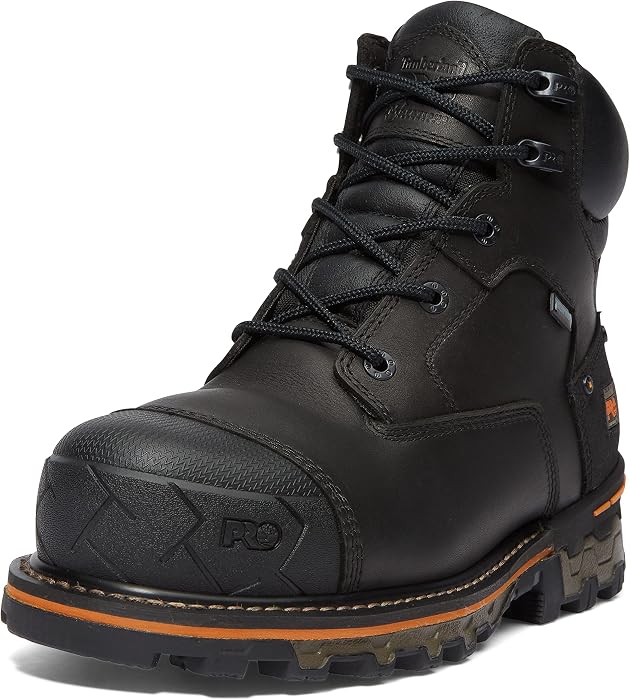
Timberland PRO Boondock Composite Toe Best Composite Safety Toe

Timberland PRO Men's Boondock 6 Inch Composite Safety Toe Waterproof Industrial

Cold safety-toe work

Field Score 90/100
Toe
Composite safety toe
Height
6 inches
Weight
4.5 lb
Insulation
Insulated
View on Amazon

If the job requires a safety toe and you don't want steel hanging off the end of your leg all day, this is the pair to look at. The Boondock pairs a composite cap with a 6-inch waterproof upper and insulation, and fit is the strongest evidence in its favor: the widest body of positive fit feedback of any boot on this page. That matters in a category where fit is the complaint you hear most.

It's built for cold sites — insulated, waterproof, and finished in leather that still looks like a boot after a winter of concrete dust and mud. The composite cap is the practical choice if you walk through a metal detector or spend the day in an unheated building, and it takes the sting out of a dropped load without steel's weight.

Where it costs you is on the scale. The listed weight is 4.5 pounds, at the heavy end of this group, and the first week or two feels like it; the toe box is bulky and the insole flattens out well before the leather does. If you're on your feet on a hard floor all day, the Carhartt is the kinder boot. If you're on a site that demands a safety toe in January, this is the one.

Worth Noting

  • Heavy and bulky out of the box
  • Insoles pack down before the leather wears
Our Verdict

The composite-toe pick for cold sites: it carries the widest body of positive fit feedback here and insulates well, at the cost of real weight.

Check Latest Price
5

TIDEWE Neoprene Rubber Boots Best Value Rubber Boot

TIDEWE Neoprene Rubber Boots

Mud, chores, riding

Field Score 87/100
Toe
Reinforced
Shaft
13-inch circumference
Neoprene
6 mm
Comfort Rating
-4°F to 50°F
View on Amazon

The comfort rating reads -4°F to 50°F, and that range tells you most of what you need to know: this is a winter boot that gives up somewhere above fifty degrees. Below freezing, in slush, in a wet feedlot, it is the warmest thing here for the money.

Six millimeters of neoprene is the reason. It flexes with your foot instead of clumping around the ankle, and it holds heat even when the outside of the boot is soaked. The shaft measures 13 inches around, narrow enough to tuck under jeans and narrow enough to sit in a standard stirrup without fighting the leather. The reinforced toe takes a knock from a gate or a bucket, and cleanup is a hose and thirty seconds.

Fit is the risk. The shaft runs snug on a heavy calf, the sizes read differently from your usual boot size, and the maker says as much on the listing — check the chart with a tape measure rather than ordering what you wear in a lace-up.

The other clock is the sole bond. These are molded rather than stitched, and separation at the sole is the failure to expect if you wear them hard every day. We rank it as the value pick anyway, because it covers more kinds of messy country work than anything else at its price — mucking, feeding, hunting, riding, gardening — and it does it warm.

Worth Noting

  • Snug through the calf for larger legs
  • Sole can separate with daily hard use
Our Verdict

Our value pick for country chores: 6mm neoprene rated to -4°F keeps you warm through mud, muck, and cold stirrups without a leather boot's price.

Check Latest Price
6

Dunlop Chesapeake Best Lightweight

Dunlop Chesapeake Rubber Boots for men and women

Light yard chores

Field Score 86/100
Toe
Plain toe
Shaft
13.5-inch circumference
Weight
16 oz
Material
PVC
View on Amazon

A PVC boot isn't a leather boot, and the Chesapeake doesn't pretend to be one. What it is: 16 ounces on your foot, a 13.5-inch calf opening wide enough to pull on over jeans without unlacing anything, and a one-piece waterproof shell you can hose off at the doorstep. That's why a pair tends to live by the back door, in the truck bed, or in the barn aisle rather than on a shelf.

For power washing, chicken coops, garden beds, and quick trips through wet grass, that's all you need, and it's the least expensive way to get there in this group. We rank it as the lightest boot on the page and the easiest to live with for short jobs. What you give up is longevity: PVC stiffens with age and cold, the shell splits at the flex point over the instep, and a season of daily trade work is more than this boot is built for.

Sizing is the thing to get right, because it's inconsistent — the same size draws both too-big and too-small results depending on the foot, so buy where an exchange is easy. The wide calf is the real feature if you're pulling these on over work pants. And the tread is a mud tread rather than a ladder tread, so keep them off wet steel and smooth concrete.

Worth Noting

  • Sizing is inconsistent between pairs
  • PVC stiffens and splits with age
Our Verdict

The lightest, cheapest way to stay dry for short wet jobs: 16 ounces, a wide calf, and a shell you can hose off at the door.

Check Latest Price
7

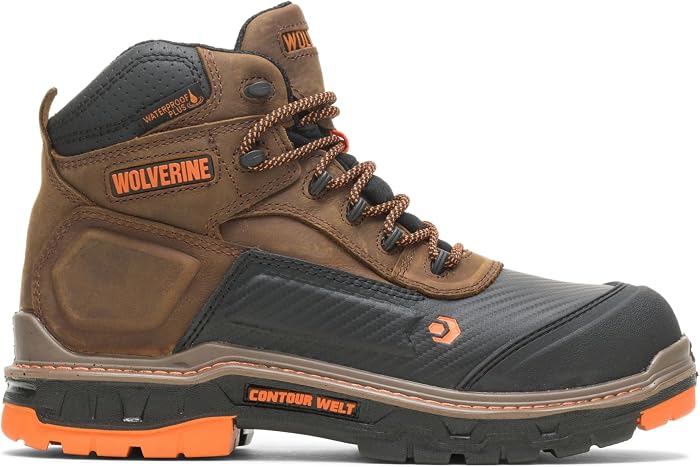
Wolverine Overpass Composite Toe Best for Ladders and Grating

Wolverine Men's Overpass Composite Toe Waterproof Work Boots

Ladders and grating

Field Score 85/100
Toe
Composite safety toe
Weight
1.75 lb
Water Protection
Waterproof
View on Amazon

On the spec sheet the Overpass reads like a lighter Boondock: composite toe, waterproof, and 1.75 pounds against the Timberland's 4.5. On a ladder, that gap is the whole ballgame — you feel every ounce at the top of a climb, and a boot this light is easier on your knees by the end of a shift. Where it loses the comparison is what happens around month six.

The outsole is the failure point. Cracking and separation at the sole is where these give out, and once the sole lets go, so does the waterproofing — a boot that walks water in is worse than one that never claimed to keep it out. Until then, comfort is the strongest part of it: long shifts on hard ground don't beat up your feet the way you expect from a boot this light and this cheap relative to the alternatives.

Buy it for the weight and the toe, then, and go in knowing you may replace them sooner than a heavier boot. If you spend more time on ladders and grating than in mud, that trade is worth making. If you're in wet ground all day, the Carhartt or the Direct Attach will outlast it.

Worth Noting

  • Soles crack and separate under hard use
  • Water protection goes when the sole does
Our Verdict

Worth it if you climb: a composite toe at 1.75 pounds is a different day on a ladder, as long as you accept the sole may crack first.

Check Latest Price

How We Tested the Best Waterproof Work Boots

We built the shortlist from roughly 60 pairs and cut it by reading construction details instead of marketing copy: whether the upper was full-grain leather with sealed seams, whether the boot relied on a membrane or a factory treatment, whether the safety-toe version was built on the same last as the soft-toe, and whether it came in more than one width. Anything with a glued-down sole and no repair path got dropped. That left 12 pairs, which we wore for eight months.

Those boots went to work: ten-hour days framing a residential build, muddy grading, two concrete pours, a warehouse floor with a lot of standing, one overnight maintenance shift, and rainy commutes in between. A few of us wore pairs through spring yard work and a wet weekend of fishing, and the rubber pair got hosed off after every use.

Water resistance got tested the boring way — standing in four inches of puddle water for half an hour, walking through wet grass at dawn, then checking socks. We weighed every boot out of the box, then weighed a soaked pair after a shift in steady rain to see how much water the leather took on, and we logged hot spots and blisters through the first two weeks of break-in. Each tester tried their normal size and a half size up with thick socks, and we watched who slid on a wet concrete apron. Durability made itself known on its own schedule: we checked toe caps, heel wear, and seam stitching at the three-month mark and compared that against what each pair cost.

How to Choose Waterproof Work Boots

Start With Where the Water Is

Ask what the water is doing before you compare anything else. Standing water — a flooded ditch, a stock tank, a wash-down bay — calls for a molded rubber or neoprene shell with no seams below the waterline. Rain, wet grass, slush, and splash call for leather with a waterproof lining, which breathes better and supports the foot longer. We sort the picks on exactly that line: the TIDEWE and the Dunlop are shells, while the Carhartt and the Timberland boots are leather. Buying leather for standing water is the most common way people end up with wet socks and a bad opinion of a good boot.

Match the Shaft to Your Leg, Not the Picture

Shaft height is really two decisions. The first is coverage: a 6-inch boot handles splash and mud to the ankle, while a mid-calf or taller rubber boot keeps everything below the knee dry. The second is fit, and it's the one people skip. A shaft opening is a fixed circumference — 13 inches on the TIDEWE, 16.5 on the MUCK — and it does not stretch over a heavy calf or heavy trousers. Measure your calf at its widest point wearing the pants you work in, then compare that number to the listing before you order.

Decide Whether You Actually Need a Toe Cap

Nothing in this search requires a safety toe, so treat it as a job requirement rather than an upgrade. If your site mandates one, composite is the lighter, non-metallic option and steel is the tougher one; both add bulk. If nothing mandates it, a soft toe is more comfortable, breaks in faster, and costs less — the Direct Attach and the TIDEWE both go without. An EH rating, which the Carhartt carries, is a separate claim about electrical hazard protection, and it is worth confirming if your site specifies one.

Read the Sole for the Floor You Stand On

Traction is where waterproof boots actually hurt people, and the right tread depends entirely on the surface. A deep mud lug bites in a feedlot and skates on smooth concrete; a flat wedge sole like the Carhartt's is stable on a shop floor and close to useless in a barnyard. In between sits a rubber outsole rated for slip resistance on oily and wet surfaces, like the Direct Attach's MaxTRAX. Match the tread to the worst surface you stand on, not the most common one.

Weigh What Wears Out First

Every boot here fails somewhere, and the trick is picking a failure you can live with. Rubber and PVC shells split at the flex point or let go at the sole bond; leather boots wear through the outsole, pack down the insole, or open at a seam. Weight belongs in the same calculation: 16 ounces and 4.5 pounds are different workdays, and the heavy boots here earn their weight in warmth and protection rather than in longevity. Think about how many months you expect, not how many years.

Frequently Asked Questions

Final Verdict

The Timberland PRO Direct Attach MaxTRAX is the boot we point most people to: a slip-resistant outsole for the floors where accidents happen, waterproofing that handles a wet week, and a fit that needs no break-in.

If you spend the day on concrete, the Carhartt's wedge sole is the better cushion. If your winter work is wet and below freezing, the MUCK Arctic Sport's insulation and steel toe are worth the extra money. For mud, muck, and stirrups, buy the TIDEWE and keep a hose handy.