The 6 Best PVC Pipe Cutters of 2026

A hacksaw will get you through a PVC pipe. What it won't give you is an edge you can trust: the blade wanders, the cut lands a degree or two out of square, and you spend the next five minutes paring a burr off the rim so the fitting slides on and the cement holds. A good cutter handles all three in one squeeze.

The real difference is how the jaw works. Ratchet cutters take several squeezes and multiply your grip; single-stroke models bite through in one pass but ask more of your hand; a cordless shear does the work for you. Stated capacity is the other spec people misread — most hand cutters top out near 1-5/8 inch, plenty for residential work and useless on a two-inch main.

I've cut plenty of pipe with whatever was in the truck, but over six months my team and I worked through 14 cutters on a basement repipe, a second-floor bath, and cold-weather irrigation repairs. The picks below are the ones still cutting clean after the rest started crushing pipe.

Our Top Picks

The 6 Best PVC Pipe Cutters of 2026

1

RIDGID RC-1625 Ratchet Pipe Cutter Best Overall

RIDGID 23498 Model RC-1625 Aluminum Ratchet Action 1/8" to 1-5/8" Plastic Pipe

All-around hand cutting

Field Score 93/100
Blade
X-CEL quick-change
Warranty
Lifetime against defects
Cut Style
Ratchet action, burr-less
Cutting Capacity
1/8 to 1-5/8 in. OD
View on Amazon

Anyone who cuts plastic pipe more than a couple of times a year should start with the RC-1625. The frame is aluminum, the capacity runs from 1/8 to 1-5/8 inches outside diameter, and the blade tracks in a rigid jaw instead of flexing, so pipe ends come out flat and ready for primer rather than angled and in need of a file.

The ratchet is the other half of what you are paying for. Instead of one hard crush you get a series of short squeezes, and that is what makes 1-1/2-inch schedule 40 manageable and keeps a morning of cuts from wrecking your grip. The handles are marked in 1/2-inch increments, a detail we ended up using every few cuts to set a stub to length without hunting for a tape measure.

Replacing the blade takes seconds with RIDGID's X-CEL system, and a lifetime warranty against defects covers the body, so the long-term cost is edges and time. This is the priciest hand cutter in the group. That premium buys square cuts and low effort, and it is easy to justify for a tool that lives in your bag.

It does stop at 1-5/8 inches, so 2-inch work belongs to the SHALL or the Milwaukee. Below that ceiling there is nothing here we have had to work around, which is a rarer thing in this category than it should be.

Worth Noting

  • Blade does not retract on its own
Our Verdict

We recommend the RC-1625 to anyone cutting plastic pipe more than once or twice a year: the squarest, easiest cuts here, with a blade you can replace.

Check Latest Price
2

Milwaukee M12 PVC Shear 2470-20 Best Cordless for High Volume

Milwaukee M12 12-Volt Cordless PVC Shear (2470-20) (Power Tool Only

High-volume cordless work

Field Score 92/100
Blade
Stainless steel, aluminum jaw
Power
M12 12-volt, tool only
Weight
4.71 lb
Cutting Capacity
Up to 2 in. Schedule 80 PVC
View on Amazon

Two inches of schedule 80 is the line this shear crosses and the hand cutters here do not. Milwaukee uses a shear mechanism rather than a ratchet: a stainless blade closes against an aluminum jaw, driven by a trigger, so how big the pipe is stops being a question of how strong your hand is.

It is built for rhythm. The blade returns quickly between cuts, which is the difference between a job that flows and one that stutters when you have a few dozen pieces to make, and the jaw leaves PVC, CPVC, PEX, ABS, non-metallic conduit, and rubber hose clean enough that deburring is usually a formality. Water and rust are not a worry with a stainless blade and aluminum jaw.

Where it makes sense is a van or a bench with the battery already on the charger. If you are cutting 2-inch all day, the savings in forearm and time are the entire argument, and the trade-offs stop mattering. If your work is 3/4-inch repairs, a good ratchet cutter is lighter, less expensive, and just as clean.

Worth Noting

  • Bare tool; battery and charger sold separately
  • Heavy at 4.71 lb for overhead work
Our Verdict

Buy the M12 shear if a long run of cuts matters more than budget — nothing else here takes 2-inch schedule 80 without your forearm doing the work.

Check Latest Price
3

RIDGID PC-1250 Pipe Cutter Best for Small Pipe and PEX

RIDGID 23488 Model PC-1250 Single Stroke Plastic Pipe and Tubing Cutter

Small pipe and PEX

Field Score 91/100
Blade
Reversible
Weight
4.2 oz
Cut Style
Single stroke, spring-loaded
Cutting Capacity
1/8 to 1-5/8 in. OD
View on Amazon

No ratchet, on purpose. The PC-1250 is a single-stroke cutter: you set the spring-loaded jaws and close them once, and the handles pop back open for the next piece. On 1/2- and 3/4-inch pipe and on PEX that is the fastest thing going, which is why this pattern ends up in so many service pouches. The whole tool weighs 4.2 ounces.

It reaches 1/8 to 1-5/8 inches outside diameter, and the blade is reversible, giving you a second edge before you spend anything on a replacement. RIDGID backs the body with a lifetime warranty. Between the reversible blade and the weight, we think this is the easiest cutter here to justify keeping around even as a second tool rather than your only one.

The limit is mechanical. Without a ratchet, the squeeze gets heavier as you approach the top of the range, so a 1-1/2-inch main is slow going with this in a way it is not with the RC-1625. Buy it for small pipe and tubing and it is excellent; buy it to prove a point on a big main and you will be reaching for the ratcheting model.

Worth Noting

  • No ratchet assist near its top size
Our Verdict

Our pick for 1/2- and 3/4-inch pipe and PEX: one squeeze instead of a dozen, and a reversible blade that doubles its working life.

Check Latest Price
4

KNIPEX Bix Pipe Cutter 90 22 10 BK Best for Drain Pipe and Tight Spots

KNIPEX Bix Cutter for Plastic Pipes

Drain pipe and conduit

Field Score 90/100
Blade
Rotating block, 2 spares included
Weight
2.47 oz
Wall Thickness
Up to 2.4 mm rigid
Cutting Capacity
20 to 50 mm OD
View on Amazon

The Bix does not cut the way anything else here cuts. There is no ratchet and no chip: the pipe is sheared between a rotating knife block and a fixed jaw, so what is left is a clean ring instead of a drift of PVC shavings. That stops sounding like a marketing phrase the first time you cut a drain line above a finished ceiling, where the shavings have nowhere to go but down.

Capacity is 20 to 50 millimeters outside diameter, with a wall limit of 2.4 millimeters on rigid pipe and 3.5 millimeters on soft or foamed-core material. In practice that means drain pipe, electrical conduit, and sealing sleeves rather than schedule 40 pressure pipe. The knife block rotates so the blade sits in the middle for pipe and outside for sleeves of 2 to 3 millimeters.

What won us over is the size. At 2.47 ounces it rides in a jacket pocket, and two spare blades come in the box, so a dull edge does not end the tool's life. For anyone working overhead in a tight bay, that combination of reach and no mess is worth more than raw capacity.

Worth Noting

  • Not built for schedule 40 pressure pipe
Our Verdict

For drain pipe, conduit, and sealing sleeves in tight spots, we like the Bix: shaving-free cuts, two spare blades, and it disappears in a pocket.

Check Latest Price
5

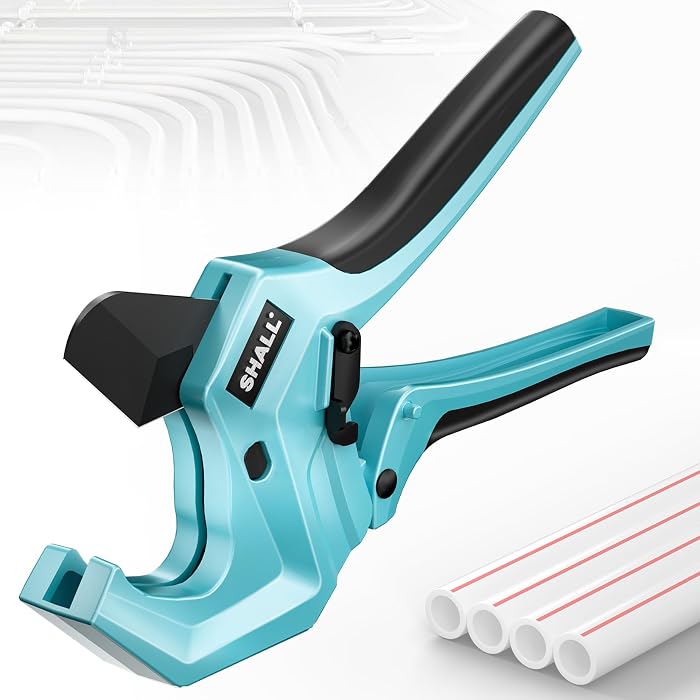
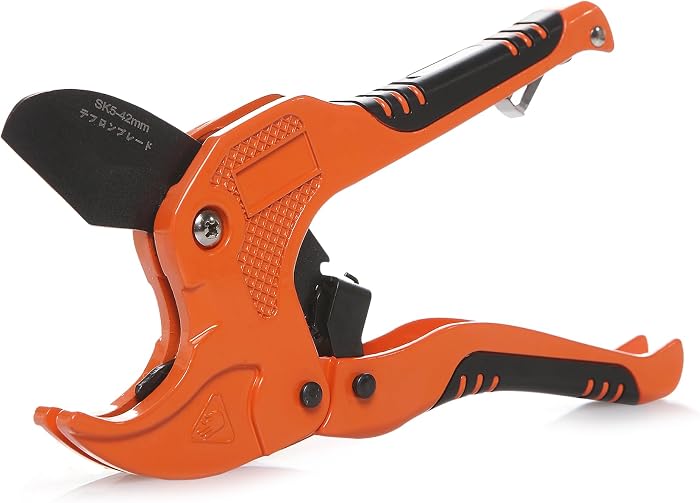
SHALL 2-1/2 in. Ratchet Pipe Cutter Best for Large-Diameter PVC

SHALL 2-1/2 in. Ratchet Pipe Cutter

Large-diameter PVC

Field Score 89/100
Blade
SK5 steel, Teflon coated
Weight
1.3 lb
Cut Style
One-hand ratchet drive
Cutting Capacity
Up to 2-1/2 in. OD
View on Amazon

Two and a half inches of outside diameter is more than any other hand cutter on this page will take, and that is the reason the SHALL earns a place. We reach for it on 2-inch schedule 40 and on ABS, where the alternative is a cordless shear, and it goes through in a series of ratchet squeezes you can work with one hand while the other holds the pipe.

The build is better than most of the inexpensive ratchet cutters in this group. The body is die-cast aluminum, the SK5 blade carries a Teflon coating, and the V-shaped cradle centers the pipe before the edge bites so the blade does not skate on the first squeeze. A bi-material handle and a safety lock round out the details you notice after an hour of work.

It is a big tool, and that cuts both ways. The leverage is exactly what lets it take 2-inch pipe, and the same length makes it awkward between joists or inside a cabinet. For a homeowner with one large project — a shop air run, a pool line, a long fence — it covers sizes the smaller cutters cannot touch without spending cordless money.

Worth Noting

  • Cuts can run off square at full capacity
Our Verdict

We keep the SHALL for the pipe the other hand cutters here cannot take: 2-inch and 2-1/2-inch PVC, cut one-handed with a squeeze.

Check Latest Price
6

Zantle Ratchet Pipe Cutter Best Budget

Zantle Ratchet Pipe Cutter

Occasional home repairs

Field Score 88/100
Safety
Stainless steel latch
Weight
12.3 oz
Cut Style
One-hand ratchet drive
Cutting Capacity
Up to 1-5/8 in. OD (41 mm)
View on Amazon

The Zantle is the least expensive way onto this page, and it covers the basics: a one-hand ratchet drive rated to 1-5/8 inches outside diameter, a stainless latch that keeps it shut in a drawer, and a fish-shaped handle that stays put in a wet hand. At 12.3 ounces it is heavier than it looks, but small enough to live in a bucket of fittings.

For irrigation repairs, garden hose, and drain work, we think it is a sensible buy. You are clamping or gluing the joint anyway, the cut takes seconds instead of a minute with a hacksaw, and there is no pile of plastic dust to sweep up afterward. Treat it as an occasional-use cutter rather than the tool for a whole repipe, and it will earn its keep.

Worth Noting

  • Cuts can run off square on 1-inch PVC
  • Blade is the part that gives out
Our Verdict

We recommend the Zantle for occasional repairs and irrigation, where a slightly imperfect end gets glued or clamped anyway.

Check Latest Price

How We Tested These Pipe Cutters

We started by pulling specs on a couple dozen cutters and narrowing from there: stated capacity, jaw type — ratcheting, single-stroke, or powered shear — blade material, and whether the maker sells replacement blades at all. Anything that couldn't be re-bladed got dropped, since a cutter with a dead blade is a paperweight. Fourteen made the cut, ranging from a bare-bones ratchet to a cordless shear that arrived without a battery.

Testing ran six months alongside real work: a basement repipe, new lines up to a second-floor bathroom, and a handful of outdoor irrigation repairs in cold weather, where PVC gets brittle and a dull jaw will crack a pipe instead of cutting it. We cut half-inch through two-inch PVC and CPVC, plus PEX and plastic hose, in a vise, overhead on a ladder, and flat on a concrete floor.

Every cut got the same look. We checked squareness against a speed square, ran a thumb around the inside rim for burr, and peered into the pipe for shavings that would later find a valve. We made repeat 45-degree cuts for offsets, tried one-handed squeezing while the other hand held pipe overhead, and kept going with each blade until it started crushing pipe instead of slicing it.

We also tracked what arrived: whether a spare blade was in the box, whether the cordless tool needed a battery and charger bought separately, and how easy replacements were to find afterward. That's usually the line between a cheap cutter and a good value one.

How to Choose a Pvc Pipe Cutter

Read Capacity as Diameter Plus Wall Thickness

A jaw that swallows a 1-5/8-inch thin-wall drain pipe can bind on the same diameter in schedule 40, and a cutter built for pressure-rated PVC can crack a foamed-core pipe. Read both numbers. The KNIPEX Bix spells out 2.4 millimeters of wall for rigid pipe, which is a clear signal that it belongs on drain lines and conduit rather than a water main.

If your work is schedule 40 or 80, choose a ratchet cutter with a substantial frame or step up to a powered shear. If it is thin-wall drain, conduit, or sealing sleeve, a shear-style cutter with a wall rating is the neater tool.

Ratchet, Single Stroke, or Powered Shear

Three mechanisms, three kinds of work. A ratcheting cutter takes the pipe in short squeezes, so it copes with 1-1/2-inch pipe and does not punish a weak grip; it is the right default for repairs. Single-stroke tube cutters such as the RIDGID PC-1250 close in one motion and spring back open, which is faster on 1/2- and 3/4-inch pipe and PEX but heavy going near their limit.

A cordless shear does the squeezing for you and earns its keep on repeat cuts, at the cost of batteries and weight. Match the mechanism to the volume of work, not to the size of the pipe alone.

Square Cuts Are What You Are Actually Buying

A solvent-welded joint needs a flat, perpendicular end. An angled cut leaves a wedge-shaped gap that primer and cement will not fill reliably, and on a pressurized line that gap is where the leak starts. That is why blade stability separates a good cutter from a cheap one.

Seat the pipe square in the cradle, keep the tool straight instead of rocking it, and turn the pipe a quarter turn if the blade starts to drift. Before you prime anything, stand the end on a flat surface or check it with a square and look for daylight.

Plan for Blades, Not Just the Tool

Every cutter here dulls eventually, and the difference between a tool you keep and one you throw away is whether a new edge can go in it. RIDGID's X-CEL blade changes without tools, the PC-1250's blade reverses for a second life, and the Bix ships with two spares.

Before you buy, confirm that a replacement blade is sold separately and that fitting it is a thirty-second job. That single question decides whether the tool outlives its first edge.

Weight and Reach Decide Where It Lives

The right cutter is the one you have with you. At 2.47 ounces the Bix rides in a jacket pocket and reaches into a cabinet or a joist bay where a full-size ratchet will not fit; at 4.71 pounds the Milwaukee shear stays on the bench or in the van.

If most of your cuts happen overhead or inside a wall cavity, favor light and short. If they happen at a bench with a stack of pipe beside you, favor capacity, leverage, and speed.

Frequently Asked Questions

Final Verdict

We recommend the RIDGID RC-1625 as the default. It makes the squarest, lowest-effort cuts of any hand cutter here, the blade swaps in seconds, and a lifetime warranty means you are only ever buying edges.

If your work is mostly 1/2- and 3/4-inch pipe and PEX, the PC-1250 gets through it faster and weighs almost nothing. If you are cutting 2-inch all day and already own the batteries, the Milwaukee shear is the one that saves your forearm.