The 4 Best Rotary Tools of 2026

A rotary tool is a small motor spinning a bit at up to 35,000 rpm inside something shaped like a fat pen. The whole purchase comes down to whether that motor holds its speed when you lean into a piece of walnut or bogs down and scorches the edge.

I keep one within reach on the shop bench and another in a kitchen drawer for sharpening, cutting a stripped screw, and sanding a patch of trim. Over the past six months, we ran 12 corded and cordless models through that same mix of work, weighing power, versatility, and value against the things listings skip: what your wrist feels like after 20 minutes, how fast a battery sags, and whether the tool still runs true after weeks of use.

Here's what I'd tell a first-time buyer: maximum rpm is the number printed biggest and it matters least. Control at low speed, a collet that swaps bits without a wrestling match, and a light that lands on the work are what you notice every single time. The picks below earned their spot on the bench.

Our Top Picks

The 4 Best Rotary Tools of 2026

1

Dremel 4300-5/40 Rotary Tool Kit Best Overall

Dremel 4300-5/40 Rotary Tool Kit w/LED Light

All-around shop work

Field Score 95/100
Chuck
Universal 3-jaw
In The Box
5 attachments, 40 accessories, bag
Speed Range
5,000-35,000 RPM
Power Source
Corded, 120 volts
View on Amazon

The chuck is what sold us. A universal 3-jaw chuck takes anything from a 1/32-inch drill bit to a 1/8-inch cutoff wheel without a collet swap, so you move between a wheel, a sanding drum, and a polishing point in one sitting without hunting for a sleeve or a wrench. Add 5,000 to 35,000 RPM with electronic feedback — it holds speed when the bit loads instead of sagging — and you have the tool we point to for someone who wants one rotary tool and no excuses.

The kit backs it up. Five attachments come in the bag: a pivot light that rotates to throw light into a cut, a shield, a sanding and grinding guide, a cutting guide, and a garden tool sharpener. The guides are the part we care about, because a cutting guide keeps a cutoff wheel tracking straight instead of wandering, and the sharpener turns dull pruners and a spade edge into a five-minute job. Forty accessories is a modest count beside the bigger kits, but the mix is sensible — burrs, drums, wheels, and mandrels you will actually mount rather than a hundred thin discs that disappear in a weekend.

The slow end is what makes it useful beyond metal. At 5,000 RPM you can shape leather, antler, or polymer without the bit grabbing and skidding, and the pivot light earns its keep on the underside of a cut where a work light cannot reach. The storage bag is soft-sided and what comes inside it varies, so treat it as a bag, not a bench organizer. The body is 1.2 pounds, light enough to hold through a long session.

Worth Noting

  • Corded
  • Some units fail early; two-year warranty is the backstop
Our Verdict

For most people this is the rotary tool to buy, and it's the one we recommend: a single chuck for every accessory, a motor that holds speed under a cutoff wheel, and five attachments that do real work.

Check Latest Price
2

Dremel 8250-5 12V Cordless Best Cordless

Dremel 8250-5 12V Cordless Rotary Tool

Cord-free jobs

Field Score 92/100
Motor
Brushless
Weight
13.8 oz
Speed Range
5,000-30,000 RPM
Power Source
12-volt battery, 3.0Ah included
View on Amazon

Cordless rotary tools usually ask you to give something up, and the 8250 asks mostly for money. In exchange you get a brushless 12-volt motor, a 3.0Ah battery and charger, and a digital display that shows the speed you dialed rather than leaving you to guess from a thumbwheel. Dremel rates it above the corded 4300 for power and at double the runtime of the older 8220; what we can say from handling both is that it does not feel like a cordless compromise.

Two details stand out. It is lighter than the corded pick — 13.76 ounces against 1.2 pounds — which is the reverse of what most cordless conversions deliver. And the 30,000 RPM ceiling sits a hair under the corded tool's 35,000, a gap that shows up only when you push a cutoff wheel through thick stock; sanding, engraving, and polishing do not know the difference. The moment the job leaves the outlet — a fence line, a trailer bed, the top of a ladder — the trade pays for itself.

The kit is lean: the tool, one 3.0Ah battery, a charger, five EZ Lock accessories, and a tool bag. EZ Lock changes are quick, and the nose still takes standard collets, so the accessory drawer you already own fits. The bag is soft, which is fine on a bench and less so rattling around in a truck box.

Worth Noting

  • Ships with one battery; a spare is extra
  • Barrel is over 2 inches across for smaller hands
Our Verdict

If the job sits away from an outlet, this is the cordless rotary tool we reach for: brushless power, a readable speed display, and standard collets that take your existing bits.

Check Latest Price
3

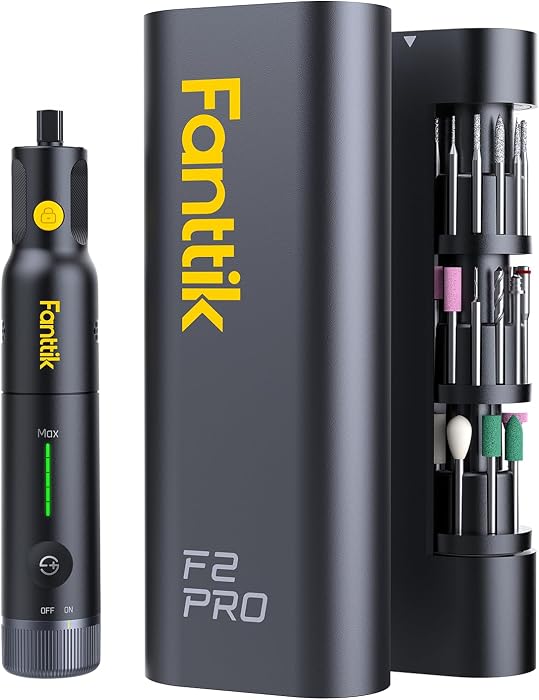
Fanttik F2 Pro Cordless Best for Fine Detail Work

Fanttik F2 PRO Cordless Rotary Tool Kit for 3D Printer Sanding with 5 Speed

Fine detail work

Field Score 91/100
Weight
7.8 oz
Accessories
55 pieces
Power Source
4-volt battery, USB-C charging
Speed Settings
5 steps, 5,000-25,000 RPM
View on Amazon

The lid is the cleverest thing here. A 360-degree magnetic hub rotates the accessories toward you, so 55 bits sit visible and upright instead of in a bag you have to dig through, and the tool clicks into the same aluminum case. We are won over by that kind of design detail, but it is more than tidiness — when you are swapping bits constantly on a print, a holder you can see beats a pouch you cannot.

As a tool it knows its lane. The 4-volt motor runs 5,000 to 25,000 RPM in five steps and weighs 7.8 ounces, so it handles like a fat pen: cleaning support material off a 3D print, knocking resin flash off a miniature, polishing a buckle, engraving a leather strap. Lean on a cutoff wheel in steel and it bogs down — that is the 4300's job. The rear light that turns red below 30 percent charge is a small thing that keeps a stall from arriving mid-pass.

Charging runs over USB-C, so a power bank or a truck's port works, and the LED at the nose is shadow-free where the bit meets the work. The case holds the tool, the hub, and a small accessory box, which is the whole point: one thing to carry to the bench. For the small work this tool is for, we have not wanted anything else.

Worth Noting

  • No spare battery in the case
  • Five speed steps instead of a dial
Our Verdict

For 3D prints, resin, leather, and small metal, this is the detail tool we pick up: light, slow at the bottom end, and organized enough to keep 55 accessories in view.

Check Latest Price
4

Milwaukee 12V Cordless Rotary Tool Best for Rough Cordless Work

Milwaukee 12V Cordless Rotary Tool

Rough cordless work

Field Score 90/100
Collet
1/8 inch
Power Source
12-volt cordless
Accessory Fit
All current rotary accessories
View on Amazon

This one is for a narrow, clear job. Twelve volts of cordless power, a 1/8-inch collet that takes the standard shank, and a motor Milwaukee builds for load rather than finesse. If your rotary work is deburring, knocking rust off a hinge, or cutting a bolt flush, that is most of what you need and none of what you do not.

Our hesitation is information. No speed range is published, so if a slow finish on plastic or leather matters to you, confirm it before you buy — and confirm what is in the box, since a bare tool at a kit price is a bad surprise. What we do trust is the collet: 1/8 inch is the size most rotary accessories are made in, so the bits you already own fit, and a 12-volt body has more behind it than the 4-volt compacts. For rust, welds, and bolts, that is enough.

Worth Noting

  • Speed range isn't published
  • 1/8-inch collet only; smaller shank bits need another collet
Our Verdict

We see it as a second rotary tool for rough cordless work with standard 1/8-inch accessories, once you confirm the speed range and what ships in the box.

Check Latest Price

How We Chose and Tested the Best Rotary Tools

We started with spec sheets and a few hundred owner reviews, sorting the field by corded versus cordless, voltage and battery capacity, spindle lock and collet design, speed range, and what actually comes in the case, then cut anything with a pattern of switch failures or a collet that needed two wrenches. Twelve tools made the bench, from compact 12-volt bodies to full-size corded kits.

Each one lived in my shop and my kitchen drawer for six months and got used for the jobs these tools really get: trimming a sticking cabinet door, cutting rusted bolts and hardened nails, sanding between finish coats, engraving a house number, and cleaning support material off 3D prints.

I weighed every tool with its battery installed and ran a 20-minute sanding session with each, noting where my hand cramped and whether the nose fit into a corner. I timed bit changes with a stopwatch, counted the accessories people actually use, like drums, mandrels, and cut-off wheels, and judged each built-in light by whether it lit the bit or threw a shadow over it. Every tool cut the same bolt and the same hardened nail so I could hear where the motor bogged down, and I drained each battery to cutoff while sanding, then clocked the recharge. Over the months I dropped them on concrete, checked collets for wobble, and kept notes on heat at the housing.

How to Choose a Rotary Tool

Corded or Cordless Comes First

Almost every other difference follows from this one. A corded tool pulls constant power, so the bit keeps turning at the speed you set even when it is buried in oak or steel; a cordless tool runs as long as the pack does and softens as it drains. That gap has narrowed — the Dremel 8250 is rated within striking distance of the corded 4300 — but it has not closed, and the small 4-volt bodies fall well short of both.

If your work is a bench, a vise, and a pile of parts, buy corded and put the savings into accessories. If it is a fence line, a trailer bed, or the top of a ladder, cordless is worth the premium.

Read Both Ends of the Speed Range

The top number gets the attention; the bottom one decides what you can do delicately. Cutoff and grinding work wants 25,000 to 35,000 RPM, while plastic, resin, and leather want something near 5,000 so the bit cuts instead of smearing. A single-speed 12,000 RPM tool is a polisher and a nail grinder, nothing more.

Look for electronic feedback or a brushless motor as well. Those are the two features that keep RPM steady when the bit loads, and they are the difference between a rotary multi-tool that cuts and one that stalls.

Chucks, Collets, and Accessory Fit

Collets are the small split sleeves that grip the bit, and they come in 1/32, 1/16, 3/32, and 1/8 inch. Most accessories are made with a 1/8-inch shank, so a tool with only that collet runs most of what you own — but you will be swapping sleeves every time you pick up a small drill bit.

A 3-jaw or keyless chuck takes any of them without a change, which is the biggest convenience upgrade in this category and the reason we lean toward tools that include one. If you plan to alternate between a cutoff wheel and a detail bit in the same session, pay for the chuck.

Weight, Grip, and Nose Diameter

There is a reason pen-style tools exist. A full-size body runs about 1.2 pounds corded and closer to a pound cordless, and holding one nose-down for an hour of engraving is work. A slim 7- or 8-ounce body is easier to control for detail, at the cost of motor.

Nose diameter matters too: the narrower the front, the closer you can get into a curve or a mortise. If your hands are small, or your projects run long, put the tool in your hand before you commit.

What's in the Box, and What's Filler

Accessory counts inflate fast. A 200-piece kit is usually 150 thin cutoff wheels and sanding discs, which are consumables you will burn through and replace. What changes what the tool can do are the attachments: a cutting guide that keeps a wheel tracking straight, a sanding guide that holds an angle, a shield for wire-brush work, a garden tool sharpener.

Compare kits by attachments first, then by the burrs, drums, and mandrels you will mount more than once. A modest box with real guides beats a big box of discs.

Frequently Asked Questions

Final Verdict

For most people, the Dremel 4300 is the rotary tool to buy. The 3-jaw chuck saves you the collet fumbling that makes cheap kits annoying, the motor holds speed through a cutoff, and the attachment set does real work on garden tools and straight cuts.

If the job sits away from an outlet, the 8250 gets you nearly the same performance without a cord. And if your projects are 3D prints, resin, and leather, the F2 Pro is the lighter, slower tool you will actually pick up.