The 8 Best Sleeping Pads of 2026

A sleeping pad is the one piece of gear that decides whether a night outdoors leaves you rested or wrecked, and the tradeoff is built into every model. Pads that roll down to the size of a water bottle tend to leave your hip aching by 2 a.m.; the ones that feel like a real mattress eat half your pack. Over the past eight months, my team and I have slept on 14 of them — closed-cell foam, self-inflating, hand-pump air, and memory foam — to find the ones that get that balance right.

The spec most first-time buyers skip is R-value, the insulation rating: below about 3 you have a summer pad, and 4 and up is what carries you into shoulder season. Inflation matters just as much — a pad that takes five minutes of huffing isn't one you'll look forward to setting up after a long hike — and so do packed bulk, whether it still feels firm at 2 a.m., and whether the straps actually keep it rolled. What you pay counts too, since past a certain point you're buying ounces and warmth, not comfort. The picks below were judged on all of it.

Our Top Picks

The 8 Best Sleeping Pads of 2026

1

Gear Doctors ApolloAir Best Overall

Gear Doctors® ApolloAir 5.2 R-Value [22oz] Ultralight Insulated Inflatable

Backpacking and camping

Field Score 93/100
Weight
1.1 lb
R-Value
5.2
Inflation
Pump sack
Dimensions
72 x 22 x 3.25 in
View on Amazon

The ApolloAir is the rare pad that doesn't make you choose between a light pack and a warm night. It weighs 1.1 pounds, packs to roughly the size of a tall water bottle, and still carries an R-value of 5.2 with 3.25 inches of thickness. That combination is why it's our top pick: it works for three-season backpacking, cold tent nights, and car camping where you still want a small footprint.

The included pump sack is the detail we appreciate most after a long hike. It fills the pad without a lung-busting mouth inflation session, and the large valve dumps air quickly in the morning. The 22-inch width is normal for a backpacking pad, so don't expect room to sprawl; the horizontal chambers give it a stable, flat surface that we prefer to pads that let you roll toward the edge.

The 40D nylon and TPU-coated shell feel purposeful rather than delicate, and the pad comes with a repair patch. The 250-pound weight capacity is fine for most solo sleepers, but heavier campers should check it before ordering. Any inflatable this light carries puncture risk, so use a clean tent floor and keep the patch in the stuff sack. Compared with the Oxylus, the ApolloAir is lighter and warmer but relies on inflation rather than foam. Compared with the Z Lite, it is far more comfortable but not indestructible.

The pump sack and repair patch live with the pad, so there's no separate kit to remember.

Worth Noting

  • Punctures possible on rough ground
Our Verdict

The ApolloAir is our top pick for campers who want one pad for backpacking and cold tent nights, thanks to its 1.1-pound weight, 5.2 R-value, and pump-sack inflation.

Check Latest Price
2

Therm-a-Rest Z Lite Sol Best Closed-Cell Foam

Therm-a-Rest Z Lite Sol Camping and Backpacking Sleeping Pad

Minimalist backpacking

Field Score 92/100
Type
Closed-cell foam
Weight
14 oz
R-Value
2.6
Dimensions
72 x 20 x 0.75 in
View on Amazon

The Z Lite Sol is not the pad to choose if you want to sink into cushioning. At 0.75 inch thick, it is a closed-cell foam mat, and it feels like one. But that is the point: there is no valve, no seam, and no overnight deflation to worry about.

For minimalist backpacking, that reliability is worth the trade. At 14 ounces, it straps to the outside of a pack and unfolds in seconds. The ThermaCapture coating and dimples push its R-value to 2.6, enough for summer and mild shoulder seasons, and the denser bottom layer stands up to rough ground. We also like the accordion fold, which keeps the pad neat when it is strapped on.

The 20-inch width is the real limit. If you roll at night, you will feel the edge, and the thin foam will not hide a root. The folded block is also bulkier than an air pad, so it takes up more pack space than its weight suggests. Those trade-offs are easy to forgive for a summit pack or a just-in-case pad. It also doubles as a sit pad at lunch, which is more than we can say for most inflatables.

Worth Noting

  • Narrow 20-inch sleeping surface
  • Thin 0.75-inch cushion
Our Verdict

For a foam pad that cannot leak, packs in seconds, and handles rough ground, we point you to the Z Lite Sol.

Check Latest Price
3

Teton Outfitter XXL Best for Car Camping and Cots

Teton Outfitter XXL Sleeping Pad for Cot

Cot camping

Field Score 91/100
Fill
Open-cell foam
Cover
Canvas shell
Weight
9 lb
Dimensions
82 x 38 x 2.5 in
View on Amazon

The Outfitter XXL is less a backpacking pad than a mattress for a cot, and that is exactly why it earns a place. At 82 by 38 inches, it covers an XXL cot edge to edge, with 2.5 inches of open-cell foam and a canvas shell that feels like a real camp bed.

The canvas cover is a practical choice for a pad this size: it wipes clean and does not have the clammy feel of an air mattress. It also slips off for easy cleaning, which is a real advantage on a pad that sees campfire smoke and muddy boots. We like that it can be used on the ground or strapped to a cot, and the roll straps with compression buckles make storage manageable. The 38-inch width gives you room to roll, which is rare in a pad.

The trade-off is weight and bulk. Nine pounds and a large roll mean it stays in the truck, and the pad is overkill for a solo hiker. For car camping, a guest room, or a cot that has become too firm, it is a comfortable upgrade. The canvas shell and open-cell foam also avoid the leak risk of an inflatable, which matters on a cold, quiet night.

Worth Noting

  • Nine-pound bulk limits hiking
Our Verdict

If you sleep on a cot or want a bed-like surface for car camping, the Outfitter XXL is the one we choose, provided you can live with its 9-pound bulk.

Check Latest Price
4

CYMULA Memory Foam Pad Best Memory Foam for Car Camping

CYMULA Memory Foam Pad – Memory Foam Camping Mattress Pad

Car camping

Field Score 90/100
Cover
Waterproof, non-slip
Weight
7.5 lb
Material
Memory foam
Dimensions
72 x 24 x 3 in
View on Amazon

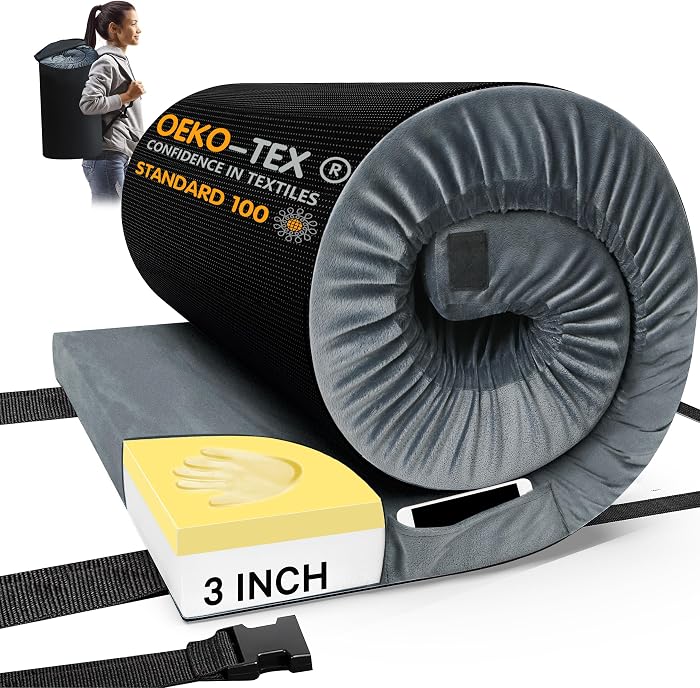
The CYMULA pad is for the camper who has woken up on the ground after an air mattress lost its seal. It is a 3-inch memory foam slab, 72 by 24 inches, with a waterproof, non-slip bottom and a soft fleece cover. At 7.5 pounds, it is car-camping gear, not a backpacking pad.

We like the feel of the memory foam for car camping and guest-room floor sleeping. It supports without the balloon-like bounce of an air pad, and the non-slip bottom keeps it from sliding across a tent floor. The 3-inch thickness is enough to keep hips off a tent floor, but it is still a floor pad; pair it with a cot if you want bed height. The 24-inch width is fine for one sleeper, but it is not a roomy pad; if you sprawl, the Kingfun's 30-inch surface is the better fit.

It rolls into the included bag with straps, though the roll is bulky; don't expect it to disappear into a pack. The OEKO-TEX certification and fiberglass-free construction are reassuring for a foam product used indoors. The adjustable buckle on the cover is a small thing, but it helps keep the pad rolled in storage.

Worth Noting

  • Bulky 7.5-pound roll
  • 24-inch width is snug
Our Verdict

We like the CYMULA for car camping and guest-room floor sleeping, where its memory foam avoids the air pump and the leak worries.

Check Latest Price
5

Gear Doctors Oxylus Best Self-Inflating

Gear Doctors® Oxylus 4.3 R-Value Insulated Air Foam Self Inflating Sleeping Pad

Cold-weather camping

Field Score 89/100
Weight
2.2 lb
R-Value
4.3
Inflation
Self-inflating
Dimensions
72 x 22 x 1.5 in
View on Amazon

Self-inflating pads are the quiet overachievers of camp bedding: you open the valve, let the foam pull in air, and add a few breaths to firm things up. The Oxylus does that with a 4.3 R-value and a 1.5-inch foam core, at 2.2 pounds.

We like the 72 by 22-inch surface, which is longer than some ultralight pads, and the polyester cover and open-cell foam feel more like a camping mattress than a balloon. The carry bag and repair patch are included, and the setup is simple enough to do in the dark. It packs down to a size that fits in most trekking packs, though not as small as the ApolloAir.

This is the best self-inflating choice here for cold-weather campers who do not want to blow up a pad. Its 4.3 R-value is a meaningful step up from summer foam, and the 2.2-pound weight is still reasonable for short backpacking trips. The 1.5-inch thickness is the limit for side sleepers, but the easy setup and warmth are worth more on a frosty morning. The repair patch stores in the carry bag, so a puncture does not end the trip.

Worth Noting

  • 1.5 inches limits side sleepers
  • Packs larger than ultralight pads
Our Verdict

The Oxylus is our pick for cold-weather campers who want self-inflating convenience, a 4.3 R-value, and a packable 2.2-pound build.

Check Latest Price
6

FUN PAC Camping Pad Best Budget with Built-In Pump

FUN PAC Camping Sleeping Pad

Budget car camping

Field Score 88/100
Weight
1.5 lb
Capacity
400 lb
Inflation
Built-in foot pump
Dimensions
78 x 27 x 3 in
View on Amazon

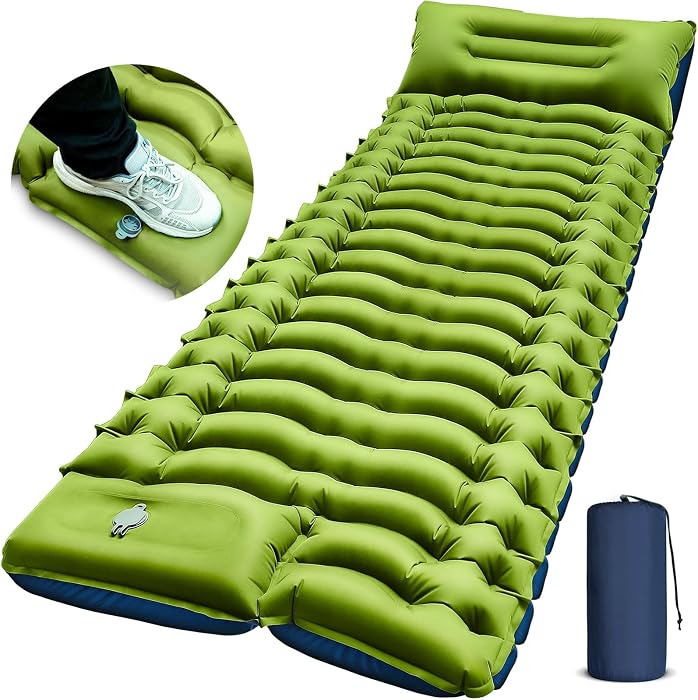
The FUN PAC's built-in foot pump is the feature that makes it stand out in a crowded budget field. You step on the chamber for 30 to 60 seconds, and the 78 by 27-inch pad is ready; no separate pump, no mouthful of nylon air.

The 3-inch thickness and 27-inch width give it more room than most pads at this end of the market, and the side buttons let you join two for a double bed. At 1.5 pounds, it is light enough for a short backpacking trip, though the packed roll is not as tiny as an ultralight pad. The 40D nylon and TPU shell have a sturdy, wipe-clean feel, and the 400-pound capacity is generous for a budget pad.

This is a strong budget pick for car camping and casual backpacking. The foot pump is genuinely convenient, and the wide surface is forgiving for side sleepers. For a long backcountry trip, we prefer the lighter ApolloAir and its more secure valve.

Worth Noting

  • Air retention can be inconsistent
Our Verdict

We like the FUN PAC for budget car camping and casual trips, where its wide 27-inch surface and built-in foot pump make setup easy.

Check Latest Price
7

Trekology UL80 Best for Budget Backpacking

TREKOLOGY Ultralight Backpacking Sleeping Pad

Budget backpacking

Field Score 87/100
Weight
1.2 lb
R-Value
1.6–2.0
Inflation
Mouth or pump
Dimensions
75.2 x 22.4 x 3.9 in
View on Amazon

Four inches of thickness at 1.2 pounds is the promise of the Trekology UL80, and that combination is why it stays in the budget conversation. It packs to roughly 7.3 by 4.7 inches, so it fits in a daypack or a bike pannier.

The raised sides and S-curve channels are meant to keep you centered, and the 75.2 by 22.4-inch surface is long enough for taller sleepers. The valve is large and inflates by mouth in minutes, though a pump is sold separately. The 40D nylon has a water-resistant coating that handles morning dew.

The estimated R-value of 1.6 to 2 is a summer-and-mild-fall number, not a cold-weather one. The pad is light for its thickness, and the carry bag is included. We also like the 4-inch cushion for side sleepers who do not want to feel the ground through a thin mat. The 253.5-pound capacity is fine for most solo sleepers, though heavier users should check the limit.

The UL80 is a good budget backpacking pad for warm-weather trips. The thickness is genuinely comfortable, and the packed size disappears into a pack. The low R-value is the limit: it is a summer pad, not a three-season one. If you sleep cold, the ApolloAir is the better spend.

Worth Noting

  • Low R-value for cold nights
  • Air retention can be inconsistent
Our Verdict

We keep the Trekology UL80 in the budget conversation for warm-weather backpacking, with four inches of cushion and a compact packed size.

Check Latest Price
8

Kingfun Memory Foam Pad Best for Wide Car Camping

Kingfun Memory Foam Pad – 3 Inch CertiPUR-US Memory Foam Camping Mattress Pad

Wide car camping

Field Score 86/100
Cover
Waterproof, non-slip
Material
Gel memory foam
Dimensions
75 x 30 x 3 in
Certification
CertiPUR-US
View on Amazon

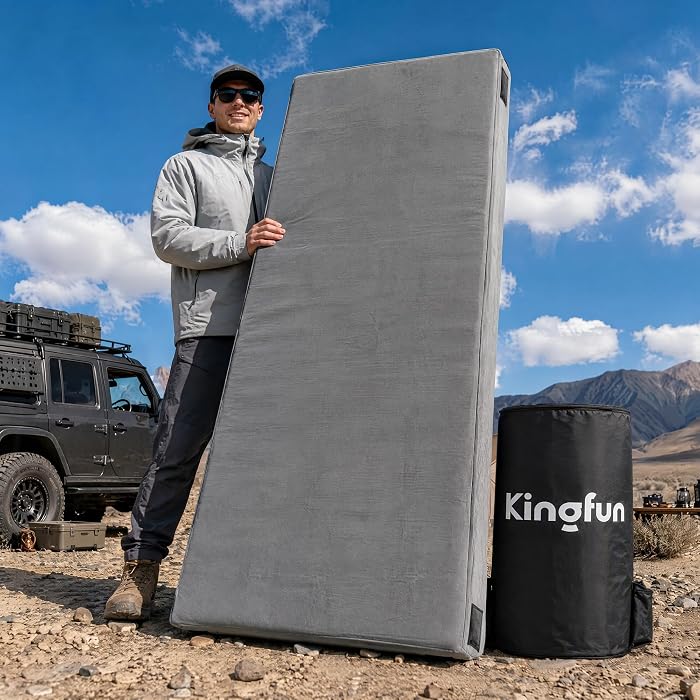
Thirty inches is the number that makes the Kingfun pad interesting. Most single sleeping pads are 20 to 25 inches wide; this one gives a restless sleeper room to turn over without hanging off the edge. It is 75 inches long and 3 inches thick, with a gel-infused memory foam top over support foam.

The velboa cover is soft and water-resistant, and the anti-slip bottom is a practical touch on a tent floor or a truck bed. The two-layer foam gives it a more mattress-like feel than an air pad, though it is still a floor pad, not a cot mattress. The 30-inch width is the reason to choose it over the narrower CYMULA.

It rolls into the included travel bag, but this is car-camping gear: the pad is bulky, and the foam needs time to fully expand after unpacking. Set it up before your trip rather than at camp. The 75-inch length is standard for an adult pad, so taller sleepers should check the fit before they commit. The CertiPUR-US certification is a sensible detail for a pad that may also serve as a guest bed.

We like the Kingfun if width matters more than pack size. It is a comfortable, roomy pad for car camping, guest beds, and truck sleeping, and the gel-infused foam is a different feel from the CYMULA's memory foam. The 30-inch surface is the reason to choose it over a narrower pad.

Worth Noting

  • Carry straps and bag are weak points
Our Verdict

The Kingfun is our wide-pad pick for car campers and guest beds, with 30 inches of room and a comfortable gel-infused memory-foam surface.

Check Latest Price

How We Tested Sleeping Pads, From Backyard to Living Room Floor

We started by pulling every pad we could find with a stated R-value, a listed packed size, and enough customer history to trust, then sorted them by price and by type — foam, self-inflating, hand-pump air, and memory foam. Pads with a pattern of leak complaints got cut before they ever shipped. That left 14, which we tested over eight months in the backyard, on a few overnights in the mountains, and on my living room floor during the weeks when the weather didn't cooperate.

Inflation was the first thing we timed. I ran a stopwatch from stuff sack to fully firm and counted breaths or pump strokes, and noted which ones fought back — a built-in foot pump is convenient right up until you're stomping on one in the dark. Then we slept on them on our backs, sides, and stomachs, paying attention to whether a hip or a shoulder reached the ground by morning. Each pad went into the tent firm at 8 p.m. and got squeezed at 2 a.m. and again at sunrise so we could see which ones had gone soft.

For portability, I weighed every pad on a kitchen scale and packed it beside a sleeping bag in a 40-liter pack to see how much room it really stole; I also rolled each one up after a workday and watched whether the straps held or slid off. Size claims got checked against our own measurements, including whether a tall sleeper's feet hung off the end. Durability came down to weeks of valve handling, grit on the floor, and seam wear. Finally, we set each pad's price against what it delivered — comfort, warmth, and ounces saved — because the most expensive pad isn't automatically the one you'll want to sleep on.

How to Choose a Sleeping Pad

Start With How You Get to Camp

The first decision is not thickness or R-value; it is whether you are carrying the pad. A backpacking pad needs to be light and pack small, and the ApolloAir is the clearest example here at 1.1 pounds and a bottle-sized roll. If your car does the work, you can trade packability for a wider, thicker surface like the Teton Outfitter XXL or a memory-foam CYMULA. A sleeping pad is not one product: a camping mat for a backpacker is a different animal from a memory-foam slab for a truck bed. The trap is buying a 'compact' car pad and assuming it will disappear into a backpack; a 7.5- to 9-pound foam pad is a vehicle item.

Treat Warmth and Cushion as Separate Choices

R-value measures resistance to heat loss, so it matters most when the ground is cold. A summer foam pad like the Z Lite Sol has an R-value of 2.6, while the ApolloAir and Oxylus go above 4 for shoulder-season and cold nights. Thickness is a different question: 1.5 inches is enough support for some sleepers, but side sleepers usually want 3 inches or more. Width is the third piece. A 20-inch pad is light but tight; 25 to 27 inches feels roomier; 38 inches is cot territory. Match the width to how much you move at night.

Choose an Inflation Style You Will Live With

Inflatables pack small but depend on a valve, a pump, and a clean floor. A pump sack like the ApolloAir's is faster than mouth inflation and keeps moisture out of the pad. Built-in foot pumps, as on the FUN PAC, are convenient for car camping but add a mechanism that can fail. Self-inflating pads like the Oxylus split the difference: open the valve, let the foam do most of the work, and top it off with a few breaths. Closed-cell foam is the zero-maintenance option, but it does not pack small. Pick the inflation style you will actually use on a tired night, not the one that looks clever in the listing.

Plan for Air Loss and Storage

Every inflatable can leak, and the risk goes up when a pad is stuffed into a pack without a repair kit. Inflate a new pad at home, leave it overnight, and check the valve and seams before a trip. Store foam pads rolled loosely rather than compressed in a hot car. If you want to avoid the leak question entirely, the Z Lite Sol is the pad here that cannot deflate. A repair patch is not a sign of weakness; it is the difference between a slow leak and a ruined night.

Frequently Asked Questions

Final Verdict

For most campers, we recommend the Gear Doctors ApolloAir. It is light enough for backpacking, warm enough for cold tent nights, and comfortable enough for car camping, and the pump sack makes setup painless. If you sleep on a cot, the Teton Outfitter XXL is the better shape; if you want a pad that cannot leak, the Z Lite Sol is the sure thing. The rest of the list fills in budget, self-inflating, and memory-foam needs without making you compromise on the basics.