The 8 Best Tent Stakes of 2026

The worst sound in camping isn't a raccoon. It's the flap-flap of a tent wall that just lost a stake at 2 a.m. — the cheapest thing in your pack turns out to be the only thing standing between a calm night and a soggy scramble in the dark. A good stake drives into hard ground without bending, holds through wind and loose soil, and comes back out without a fight.

My team and I spent four months driving 15 stakes across eight styles — steel pegs, screw-in anchors, plastic — into packed dirt, lake sand, and wet spring grass, and I've stopped trusting the words "heavy duty" on their own. Length matters less than shaft shape, and a stake that fits your tent's loops matters more than an extra inch. We weighed each one and checked whether it slid back into its own storage bag.

If you're upgrading from the wire hooks that came taped to your tent, nearly everything below is an improvement. These are the ones that held, came out cleanly, and didn't cost enough to think twice about.

Our Top Picks

The 8 Best Tent Stakes of 2026

1

RIY 12-Inch Steel Tent Stakes (8-Pack) Best Overall

RIY 12-Inch Steel Tent Stakes (8-Pack) – 8 Pack Tent Stakes Heavy Duty 12 inch Steel Tent Pegs for Camping

All-around camping

Field Score 97/100
Length
12 inches
Weight
4.32 oz
Material
Forged steel
Pack Size
8 stakes
View on Amazon

Forged steel, twelve inches long, with a head wide enough to take a real hammer blow: that combination is why this is the set we reach for first. The stakes that come with most tents are short, thin, and soft, and they fold over the first time you hit a stone. These drove into ground that was more gravel than soil without the shaft taking a set, and the flat head gave us somewhere to aim.

The length is the part that matters most in practice. Twelve inches puts the grip below the loose inch or two of soil that dries out and blows away, which is what lets a tent or a canopy ride out a gust that would walk a shorter stake out of the ground. In dry sand or powder snow, length alone won't save you; a broad blade or a spiral does that job, and these are a plain shaft. Read the ground, not the label.

What you trade for that is carry weight. Eight of these in the pouch is a lump in a pack, so they live in the truck rather than on our backs, and for car camping, a wall tent, or a hunting blind that's the right trade. The pouch is a small thing we ended up appreciating: eight loose spikes in a truck bed are eight spikes you'll be looking for later.

Worth Noting

  • Black finish is hard to spot at dusk
Our Verdict

If you want one set that handles a family tent, a canopy, and ground that fights back, these forged 12-inchers are the ones we tell people to buy.

Check Latest Price
2

Eurmax 10-Inch Galvanized Tent Stakes (10-Pack) Best for Pop-Up Canopies

Eurmax USA 10-Pack Secure Protection Galvanized Tent Stakes

Pop-up canopies

Field Score 96/100
Length
10 inches
Weight
2.3 lb
Includes
Four 10-foot ropes plus stopper
Pack Size
10 stakes
View on Amazon

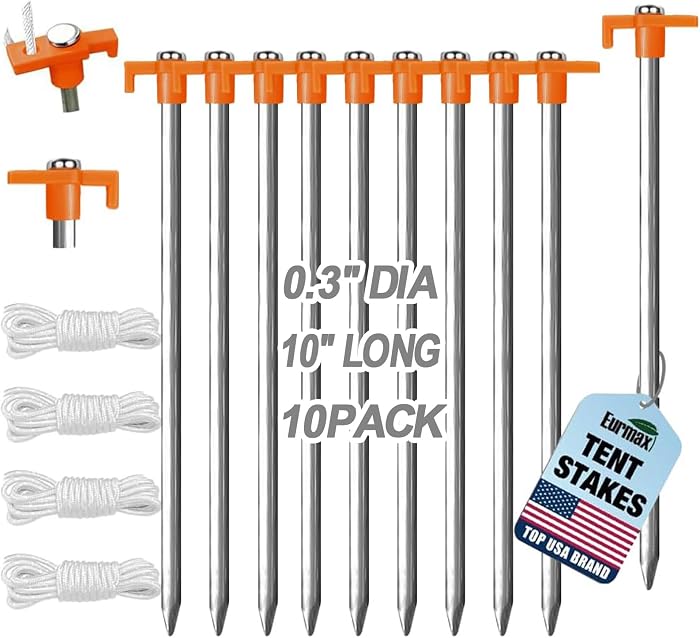
Ten inches instead of twelve, ten stakes instead of eight, and four pre-cut ten-foot ropes with a stopper in the bag: this is the set we hand someone staking a pop-up canopy rather than a tent. A canopy needs a line at every leg, and having the cord already cut saves the parking-lot scramble through a bag of tangled rope.

What we appreciate most is that the whole job arrives at once, and the stakes are stout enough to deserve the company. Galvanized shafts, a big flat head a mallet finds without looking, and a bright orange top that stands out against grass. They set into lawn and hard-packed dirt without taking a bend, and the coating has stayed clean through wet weather.

The limit is length. Ten inches is a middle stake: right for canopy legs and tarp corners, short of what we want under a cabin tent in soft ground. If your bag has to serve both jobs, buy this for the canopy and a longer steel set for the tent, because the price here leaves room to own both.

Worth Noting

  • Ropes are canopy length, not tent length
Our Verdict

A complete canopy kit, with ten stout galvanized stakes and the ropes already cut, that we hand people staking a pop-up rather than a tent.

Check Latest Price
3

MSR Groundhog Tent Stake Kit Best for Backpacking

MSR Groundhog Tent Stake Kit

Backpacking

Field Score 95/100
Length
7.5 inches
Weight
0.46 ounce per stake
Material
7000-series aluminum
Pack Size
6 stakes
View on Amazon

At 0.46 ounces a stake, six of these weigh less than one of our steel picks, which is the entire argument for carrying them up a hill. The three-sided Y-beam does the rest: a triangular cross-section resists bending in a way a round aluminum peg doesn't, and the edges give loose soil something to hold instead of a smooth shaft to slide past.

The details are what we noticed after a few setups. The notch at the head seats a guy line without the knot slipping off, the reflective pull loop lets you hook a finger and pull instead of digging with a spare stake, and the aluminum doesn't rust, so a wet pack isn't a problem. The tips have stayed sharp enough to start in firm ground and to find the seam between rocks.

It's the most expensive way to buy six stakes in this group, and for a shelter you carry up a hill we think it's the right spend: aluminum, a proper welded pull loop, and a shape that survives being driven with a rock when the mallet is back at the car. Buy it as a backpacking kit and keep a steel set in the truck for basecamp.

Worth Noting

  • 7.5-inch length pulls in sand and silt
Our Verdict

The backpacker's stake: under half an ounce each, with a Y-beam that grips loose soil and a pull loop you'll be glad of in the rain.

Check Latest Price
4

MSR Cyclone 10-Inch Tent Stakes (4-Pack) Best for Sand and Soft Soil

MSR Cyclone 10-Inch Tent Stakes (4-Pack)

Sand and soft soil

Field Score 94/100
Length
10 inches
Weight
1.2 ounces per stake
Material
7000-series aluminum
Pack Size
4 stakes
View on Amazon

A smooth stake in dry sand is a straw in a bucket: it goes in easily and comes out just as easily. The Cyclone answers that with a spiral blade you turn into the ground, so the sand has a thread to grip instead of a wall to slide down. It's the one stake here we take to a beach or a desert camp without a backup plan.

Ten inches of 7000-series aluminum, a little over an ounce each, four to a kit, with a reflective pull loop at the top. Driving one is a twist rather than a swing, slower than hammering and exactly why it holds: the blade cuts its way in instead of shouldering loose ground aside. In compacted soil the same spiral makes for harder work, and a mallet earns its place.

Four stakes is a small kit and it costs as much as a big bag of steel, and we think that's the right shape for this product. Buy it when the ground is the problem, coastal sand, river silt, screed-like desert soil, and let a steel set handle the campsite. For ordinary dirt and grass the spiral is a complication you're paying extra for.

Worth Noting

  • Four-stake kit costs as much as a large steel set
Our Verdict

Buy these for sand, silt, and loose desert soil, where a spiral blade holds what a smooth shaft lets go of overnight.

Check Latest Price
5

Cheardia 9.75-Inch Tent Stakes (20-Pack) Best Bulk Value

Cheardia 9.75-Inch Tent Stakes (20-Pack) – 20 Pack Tent Stakes Heavy Duty

Bulk value

Field Score 93/100
Length
9.75 inches
Material
Galvanized iron
Pack Size
20 stakes
Shaft Diameter
7 mm
View on Amazon

Twenty stakes in one bag changes how you stake a site. Instead of rationing four pegs around a tent and hoping, you can put two in each corner at opposing angles, tie the guy lines off properly, and still have spares for the tarp, the dog's tie-out, and the cooler cover.

Each one is 9.75 inches of galvanized iron with a 7mm shaft and a T-shaped top. That top is the design detail we like: a flat face for the mallet, a hook that stops the stake running past the loop, and a hole below it for a puller or a claw hammer when the ground tightens up. The orange coating has stayed bright, which matters when there are twenty of them scattered across a site at dusk.

They go in by hand in soft ground and take a mallet in firmer soil, and the heads haven't mushroomed or rusted through a wet spring. For a tent, a tarp, or a canopy in ordinary campsite dirt, that's all we ask of a stake, and the puller that comes with them is a nicer touch than the price suggests.

Twenty for the money of a few specialty pegs is the argument, and it holds for a household that stakes a tent, a tarp, and a set of holiday decorations over a year. We keep the bag in the truck and top it up when a few go missing, which with twenty in a bag is not a crisis.

Worth Noting

  • 7mm shaft bends in baked or rocky ground
Our Verdict

Twenty bright stakes for the price of a few specialty pegs, the set we buy when the whole campsite needs anchoring at once.

Check Latest Price
6

x-vesolje Screw-In Tent Stakes (12-Pack) Best for Quick Setup

x-vesolje Screw-In Tent Stakes (12-Pack) – 8" Heavy Duty Screw in Tent Stakes 12 Pack Drill in Ground Anchors

Fast drill-in setup

Field Score 92/100
Length
8 inches
Storage
Hard case
Included
13 mm hex socket
Pack Size
12 stakes
View on Amazon

There's no hammer in this kit because there doesn't need to be one. Each stake has a hex head that takes the included 13 mm socket, so you chuck it in a drill or impact driver and wind it into the ground from a standing position. For anyone who has knelt in the mud swinging a mallet at a canopy leg, that's a different job altogether.

We like it most for setups that come down the same day: awnings, trampolines, dog tie-outs, a ground blind that goes up before dawn. The thread holds better than a smooth shaft in loose ground, the orange heads stay visible, and the case keeps the socket with the stakes, which is the sort of detail that decides whether a tool gets used twice or never.

Eight inches is the catch. That's a canopy and trampoline length, not a tent-in-a-storm length, and the method wants ground a bit will bite into, so solid rock or dry, loose sand defeats it. Treat this as the fastening kit and keep long steel stakes for the shelter itself.

Worth Noting

  • Needs a drill or impact driver to install
Our Verdict

The fastest way we've found to anchor a canopy or awning: chuck the included socket in a drill and wind them in standing up.

Check Latest Price
7

LOYORTY 10-Inch Tent Stakes (40-Pack) Best for Large Group Setups

LOYORTY 10-Inch Tent Stakes (40-Pack) – 40PCS 10 Inch Heavy Duty Tent Stakes

Large group setups

Field Score 91/100
Length
9.8 inches
Material
Galvanized iron
Pack Size
40 stakes
Boxed Weight
3 lb
View on Amazon

Forty stakes is not a number most households need. It's the number for a scout troop, a wedding tent, a market stall, or a yard full of inflatables, someone staking a lot of anchors at once and not wanting to count them out one at a time.

They're 9.8 inches of galvanized iron with a sharpened tip and a plastic top, and they drive the way the maker suggests: angled at about 60 degrees, head left an inch and a half proud so a puller can get under it. The plastic top is what makes them visible and easy to grip, and it's also the part that takes the abuse when you lever one out of stiff ground.

Three pounds for the whole box tells you what kind of stake this is: mid-weight hardware, not a forged spike. For a weekend event or a seasonal yard display, that's the sensible way to buy forty anchors in one go. If you need eight stakes you'll trust for a decade, spend the money on the forged set instead.

Worth Noting

  • Plastic tops wear when levered out
Our Verdict

A bulk buy for anyone staking forty anchors at once, whether that's a troop, an event tent, or a yard full of decorations.

Check Latest Price
8

GDLPZM 9-Inch Plastic Tent Pegs (24-Pack) Best for Yard Decorations

GDLPZM 9-Inch Plastic Tent Pegs (24-Pack) – 24X 9 Inch Yellow Plastic Tent Pegs

Yard decorations

Field Score 90/100
Width
0.87 inch
Length
8.86 inches
Material
PP plastic
Pack Size
24 pegs
View on Amazon

Plastic stakes get dismissed, and for a tent in weather they deserve it. For holding down landscape fabric, plant cages, a garden net, or a light-up snowman, a plastic peg is often the better tool: it doesn't rust, it doesn't gouge a shin, and a mower that finds one loses a blade edge rather than a foot.

Nine inches of PP plastic, 24 to a bag, with a hook at the top and a hole for pulling. They push into soft ground by hand, take a mallet in firmer soil, and hold a tarp corner through a windy week; ours stayed put while a thin metal peg beside them worked loose.

The thing to check before you buy is width. At 0.87 inch across, these are wider than the grommet on plenty of tarps and tent loops, so if you're buying them for a tarp with small brass eyes, measure one first or plan to run the line over the top and stake beside it.

In the yard we think they're the practical choice: cheap enough to leave in the ground for a season, light enough to carry a hundred in a bucket, and easy to spot against soil at 24 to a bag. We keep a bundle in the shed next to the landscape staples and grab a handful whenever a tarp needs pinning.

Worth Noting

  • Snaps if levered sideways out of clay
Our Verdict

For garden fabric, plant cages, and holiday decorations, these light plastic tent pegs do a steel stake's job without the rust or the weight.

Check Latest Price

How We Tested Tent Stakes in Dirt, Sand, and Wet Grass

We started with the stakes campers actually buy: the multipacks that top a search, the sets that arrive with ropes and a storage bag, the screw-in anchors sold for canopies and inflatables, and a few premium aluminum pegs that cost more per stake than a budget pack. We sorted by material, length (anything under 8 inches got set aside for guy lines only), coating, and whether a bag or box was included. Fifteen stakes across eight styles made the cut.

Testing ran four months, from early spring into summer, across a dozen trips and backyard setups. We drove stakes into packed dirt at a developed campground, loose sand at a lake beach, wet grass under a party canopy, and gravel — with a mallet where the ground allowed and the palm of a hand where it didn't. Each one was set with a guy line under tension and checked again the next morning.

Stability meant tugging each line at an angle to watch for movement, then seeing what survived a windy night. For durability I logged every bent shaft, chipped coating, and jammed hook, and left a few sitting damp in a storage bin for a week to see which coatings rusted. Ease of use came down to small things: whether the top took a mallet without mushrooming, whether the hook held a line without slipping, and whether the stake pulled out by hand and went back into its own bag.

Size and fit got their own pass, measured against the stake loops on standard tents and canopies, since a hook that's too wide or a shaft that's too thick is a problem holding power can't fix. Value came last: what you get per stake, and whether the bag, ropes, or hex socket earned their place in the kit.

How to Choose Tent Stakes

Start With the Ground, Not the Stake

Ground decides more than any other factor. In firm grass and ordinary campsite soil, almost any decent stake holds. In dry sand, powder snow, or loose river silt, a smooth shaft pulls out no matter how hard you drove it, which is why broad-bladed and spiral stakes exist: they give loose ground something to grip instead of something to slide past. Hardpan and gravel want the opposite, a narrow, strong point that displaces little and a shaft that won't bend.

Ask what your shelter actually sits on before you shop. A summer of state-park campsites doesn't justify a sand specialist; a week on the coast does. Buy for the ground you camp on most and add the specialist set later.

Length and Shaft Diameter

Length does two jobs. It reaches below the loose, dry layer at the surface, often an inch or two of crumbly soil, so the grip sits in ground that hasn't been disturbed, and it gives the soil more surface to hold. Seven-inch pegs are fine for a canopy leg, a tarp, or an inflatable. A tent that has to stand through weather deserves nine inches or more, and twelve if the soil is soft.

Diameter matters as much, and it's where budget packs cut corners. A 4 mm shaft described as heavy duty will bend where a forged spike holds, and you feel the difference the first time you hit a stone. Read the shaft spec, not the phrase on the bag.

Material and Weight

Forged and galvanized steel suits car camping, wall tents, and anything left out in weather: it's heavy, and the weight is what keeps a head from mushrooming after a hundred hammer blows. Aluminum costs more per stake and gives up some brute strength, but a 7000-series Y-beam at under half an ounce is what makes a backpacking kit tolerable. Plastic tent pegs have a real job in the yard, light, rustproof, and cheap by the bag, as long as you don't ask one to hold a tent in wind.

Heads, Hooks, and Getting Them Back Out

The head is what you hit and what you pull. A flat T-top takes a mallet squarely and leaves a hole for a puller or a claw hammer; a curved hook is easier on the hand and stops the stake sinking too deep, but it can straighten under a hammer. Reflective pull loops are worth paying for if you camp in the rain, because they turn a five-minute dig into a tug. Whatever the design, drive at an angle away from the shelter and leave an inch of head proud so there's something to grab.

Count, Cord, and the Bits You Forget

Work the count out from the shelter, not the bag: four corners plus every guy line, plus a couple of spares. A canopy wants a line at each leg, and a tent with a fly usually takes more stakes than the manufacturer ships. Buy cord separately unless the kit includes it, keep a mallet with the stakes, and use a pouch so the points don't punch through your tent bag.

Frequently Asked Questions

Final Verdict

Buy the RIY 12-inch forged set if you want one bag of stakes that will handle a family tent, a wall tent, or a canopy in ground that fights back; the weight is what you pay for a shaft that won't fold. If you carry your shelter rather than drive it, the MSR Groundhog earns its higher cost per stake.

And if the trip is about sand, skip both and take the Cyclone.