The 7 Best Trailer Brake Controllers of 2026

A trailer brake controller is the small box that decides how hard your trailer brakes squeeze, and the two designs work nothing alike. Proportional controllers scale trailer braking to how hard you're slowing the truck; time-delay controllers ramp the trailer brakes up on a timer, regardless of what the truck is doing. Neither is wrong, but they feel completely different behind the wheel, and the wrong one for your setup turns every stop into a negotiation.

I've dragged a 5,000-pound utility trailer over enough mountain passes to know the sick feeling of a trailer shoving the truck through a corner, so my team and I spent the past seven months installing and living with 11 controllers to find the ones that stay calm. The install is where most shoppers get ambushed: some units show up with a plug-and-play harness for your truck, while others are a bare box and the harness is a separate purchase. We tracked that too, along with how reachable the gain and boost dials were while actually driving.

What follows covers proportional and time-delay, plain and feature-heavy, and every axle count from a single-axle utility trailer up to a four-axle equipment hauler. The goal is matching the controller to how you tow, not buying the most expensive box on the shelf.

Our Top Picks

The 7 Best Trailer Brake Controllers of 2026

1

Tekonsha Primus IQ Best Overall

Tekonsha 90160 Primus IQ

All-around towing

Field Score 95/100
Axles
1-3
Mount
Snap-in dash clip
Adjustment
3 boost levels
Braking Type
Proportional
View on Amazon

The first thing we look for in a brake controller is not a screen or a mounting trick; it's proportional braking, and the Primus IQ delivers it at a price that leaves room for the harness. Proportional control reads how hard you are braking and applies the trailer brakes to match, so a stop feels like one vehicle instead of a trailer shoving against the hitch. With 1-3 axle coverage and compatibility across Ford, GM, Ram, Toyota, Jeep, and more, it is the easiest default to recommend for a mixed fleet or a first travel-trailer setup. We also like the three boost levels: they add braking authority for a loaded trailer without making you re-rig the controller.

The install is about as simple as this category gets once the correct harness is connected. The snap-in dash clip holds the unit in place, and the plug-and-play port accepts the vehicle adapter without a soldering iron. The LED display shows settings, diagnostics, and alerts, which we appreciate at the hitch: a wiring problem is visible before you pull away. Order the vehicle-specific harness at the same time; that is the difference between a quick job and a frustrating one.

The Primus IQ is built around the core job rather than a remote-head layout, and that simplicity is part of the appeal. The display and boost button are on the unit, so you set them where you mount it. For a travel trailer, boat, or utility trailer with electric brakes, this is the one we point to first.

Worth Noting

  • Vehicle-specific harness sold separately
  • Full-size under-dash body
Our Verdict

For most tow vehicles, the Primus IQ is the proportional controller we recommend: smooth braking, three boost levels, and broad vehicle coverage.

Check Latest Price
2

REDARC Tow-Pro Elite Best Premium

REDARC Tow-Pro Elite Electric Trailer Brake Controller

Discreet premium installs

Field Score 91/100
Axles
1-3
Mount
Remote dash dial, hidden main unit
Power
12V/24V compatible
Braking Type
Proportional / user-controlled
View on Amazon

The Tow-Pro Elite solves the brake-controller problem most people notice after the first install: a box hanging under the dash. REDARC splits the system into a compact dash dial and a main unit that mounts out of sight, so the part you touch looks like it belongs in the truck. The dial handles gain, while the main unit does the sensing and calibration. It is a 1-3 axle controller with proportional braking for the highway and a user-controlled mode for low-speed or off-road work.

We think the Elite is the best choice here if you want a factory-look install and you are willing to spend the extra time routing the remote cable. The proportional mode is the one most drivers will leave it in; the user-controlled mode is a genuine advantage on a steep gravel road or a boat ramp, where you want a fixed amount of trailer brake rather than a response to deceleration. Active calibration and sway control round out the package.

The install asks more of you than a dash-only unit: you need to find a clean spot for the main box and route the cable without pinching it. What you get back is a cabin that stays uncluttered and a controller that is easy to reach without being in the way. For a truck that doubles as a daily driver, that matters.

Worth Noting

  • Higher cost than the other proportional picks
Our Verdict

If you want a factory-look dash and an off-road braking mode, the Tow-Pro Elite is the premium controller we recommend.

Check Latest Price
3

REDARC Tow-Pro Liberty Best for Toyota Drivers

REDARC Tow-Pro Liberty Electric Trailer Brake Controller Kit for Toyota Tundra

Toyota trucks

Field Score 89/100
Mount
Dash dial
Harness
TPH-015 included
Vehicle Fit
Tundra 2015-2021, Tacoma 2016-2023
Braking Type
Proportional
View on Amazon

Toyota drivers have a narrower decision than everyone else, because the Tow-Pro Liberty kit is built around the Tundra and Tacoma. The kit fits Tundra 2015-2021 and Tacoma 2016-2023, and it includes the TPH-015 vehicle harness and a switch insert that fills the factory dash opening. Tundra 2022-2023 is the exception: that truck needs the TPH-021 harness, so check the model year before you order.

The controller itself is the same proportional design REDARC uses elsewhere, with a compact dash dial, active calibration, and sway control. We like the vehicle-specific approach because it removes the worst part of a brake-controller install: hunting for the right adapter and guessing which wire goes where. The dial is easy to reach and stays out of the way of your knee.

We think this is the right first stop for a Tundra or Tacoma driver who wants a factory-style install without piecing together a kit. The fit is the boundary: the 2022-2023 Tundra needs a different harness, so check the year before ordering. If your truck is on the list, the Liberty makes the install feel less like wiring and more like adding an option.

Worth Noting

  • Fits only select Toyota models and years
Our Verdict

Toyota Tundra and Tacoma drivers should start here: the Liberty kit includes the vehicle harness and a factory-style switch insert, so the install is mostly plug-and-play.

Check Latest Price
4

CURT TriFlex NEXT Best Low-Profile

CURT 51146 TriFlex Next Proportional Inertia Electric Trailer Brake Controller

Tight dash spaces

Field Score 88/100
Mount
Low-profile bracket
Sensor
Triple-axis accelerometer
Braking Type
Proportional
Trailer Brakes
2-8
View on Amazon

The TriFlex NEXT is the controller for a truck whose dash is already crowded. CURT's housing is slim and the bracket is shaped to keep it close to the panel, so it takes up less visual and knee space than a full-size box. We think it is the best low-profile proportional pick here if you want the controller mounted in the dash rather than on a remote dial. The triple-axis accelerometer is the technical reason it can work in a tight spot: it senses motion on three axes and adjusts power on grades.

The TriFlex NEXT is a proportional controller, so it applies trailer braking in response to how the truck is decelerating rather than ramping at a fixed rate. It handles 2-8 trailer brakes and uses a plug-and-play connection, which keeps the install familiar. The triple-axis sensor is the feature that makes it worth a look in a tight dash: it adjusts power on grades without asking you to re-level the unit.

The TriFlex NEXT is a straightforward proportional controller, not a remote-head design. What it offers is a proportional sensor in a package that stays out of the way, which is exactly what some trucks need. If your knee already brushes the lower dash, start here.

Worth Noting

  • Controls are fiddly to adjust while driving
Our Verdict

If dash clearance is tight and you want proportional braking without a remote dial, the TriFlex NEXT is the one we point to.

Check Latest Price
5

CURT Venturer NEXT Best Budget Time-Delay

CURT 51116 Venturer Next Electric Trailer Brake Controller

Budget time-delay

Field Score 87/100
Axles
1-3
Mount
Low-profile bracket
Adjustment
Power and ramp time
Braking Type
Time-delay
View on Amazon

The Venturer NEXT is the budget answer to a brake controller, but the savings come with a specific trade-off: it is a time-delay unit, not a proportional one. Time-delay controllers ramp braking at a fixed rate after you press the pedal, which is simple and predictable but less seamless in stop-and-go traffic. The Venturer NEXT handles 1-3 axles, lets you adjust power and ramp time, and uses a low-profile housing with no leveling required. That last detail is a real convenience if you move the controller between trucks or mount it at an angle.

We recommend the Venturer NEXT for occasional towing on a tight budget: a utility trailer, a small camper, or a second truck that only pulls a few times a season. The low-profile shape and no-leveling design make it easy to live with, and the controls are straightforward enough to set before a trip. If you tow heavy or often, the extra smoothness of a proportional controller such as the Primus IQ is worth the step up. It is not the controller we choose for a long mountain descent with a heavy camper; that is where proportional control earns its keep. For everyone else, this is the simple time-delay pick.

Worth Noting

  • Time-delay response is less smooth than proportional
Our Verdict

For occasional towing on a budget, the Venturer NEXT is the simple time-delay controller we recommend.

Check Latest Price
6

Timilge Proportional Controller

Timilge Proportional Controller – Proportional Trailer Brake Controller 8508211 Digital Electric LED Display

Low-cost proportional

Field Score 86/100
Axles
1-4
Mount
Under-dash
Wiring
4-wire
Braking Type
Proportional
View on Amazon

The Timilge is the lowest-priced proportional controller in this group, and it is small enough to disappear under the dash. At 8.4 ounces and roughly 4.3 by 2.8 by 1.1 inches, it takes up far less space than the full-size boxes. It covers 1-4 axles, uses a 4-wire setup, and includes a digital LED display, adjustable brake power and sync, and a boost mode. On paper, that is a lot of controller for the money.

The feature set is aimed at the fundamentals rather than the finish. The display shows voltage delivery to the trailer brakes, and the boost mode gives you a way to add authority for a heavier load. The wiring port accepts a vehicle-specific harness, which is the part to sort before installation; a clean plug-and-play job depends on getting the right adapter for your truck. We treat this as a budget unit, not a replacement for a premium controller on a heavy tow rig.

We recommend the Timilge when price is the deciding factor and the trailer is not a daily heavy load: a second truck, a utility trailer, or a camper that goes out occasionally. The compact body and 1-4 axle range make it easy to move between vehicles, and the boost feature is useful when the bed is loaded. Just budget for the harness and set the gain carefully before you rely on it.

Worth Noting

  • Vehicle-specific harness is a separate part
Our Verdict

The Timilge is the budget proportional pick for a second truck or occasional trailer.

Check Latest Price
7

Kohree Split Controller

Kohree Upgraded Trailer Brake Controller Kit

Remote gain display

Field Score 84/100
Axles
1-4
Boost
9 levels
Display
Remote LCD
Braking Type
Proportional
View on Amazon

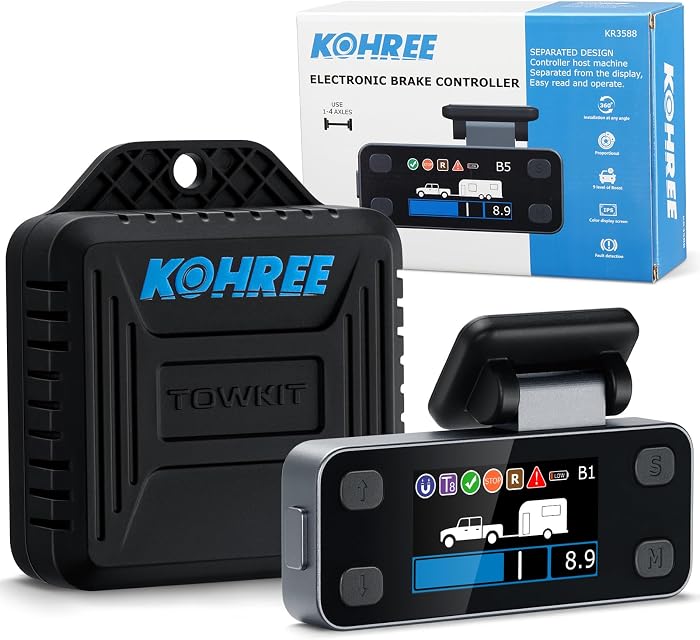
The Kohree takes a different approach to dash space: it splits the system into a controller and a separate LCD display that can sit on the windshield. The display shows the gain and status where you can see it, while the main unit stays out of the way. That is a useful idea for a truck with a deep dash or a driver who does not want to look down at a knee-level box.

The controller is proportional and covers 1-4 axles, with nine levels of boost. Kohree also uses two 32-bit chips in each part of the system, one set in the display and one in the controller, for processing and validation. We are not going to pretend that chip count is the reason to buy it; the reason is the remote display and the wide boost range.

The split design has a practical cost: you have to mount the display, route the Type-C cable, and find a home for the controller. The kit includes the wiring connections and cable, but the installation is more involved than a single under-dash unit. That is the trade-off for the layout.

We recommend the Kohree for a driver who wants the gain readout up high and the controller out of the way. It is a design-first pick rather than the default: the Primus IQ is the safer all-around choice, and the Tow-Pro Elite is the premium factory-look option. If the remote display solves a real problem in your cab, the Kohree earns a look.

Worth Noting

  • One-year warranty limits long-term coverage
Our Verdict

If you want the gain readout up high and the controller out of the way, the Kohree's split display is the design we recommend.

Check Latest Price

How We Tested Trailer Brake Controllers

We started with roughly 30 listings and cut anything that couldn't handle the axle count of a typical car hauler or camper, then filtered by whether a truck-specific plug-and-play harness already existed for the vehicles most people tow with. That left 11 controllers, which we bought at retail and installed ourselves over seven months across a half-ton pickup, a mid-size SUV, and an older truck with a bare four-wire hookup.

One person did every install alone, and we timed it from opening the box to first power-up. We wrote down what actually came in the kit: which units included a harness, which needed an adapter bought separately, and which had us splicing wires under the dash. Each controller got mounted where a driver can hit the manual override without leaning out of the seat, and we checked whether the gain and boost adjustments could be changed at a stoplight.

Every unit ran the same loop: a long 6 percent descent with about 5,000 pounds behind us, stop-and-go traffic, wet pavement, and a gravel ramp where we backed a boat trailer into the water. We watched for trailers that pulled crooked under hard braking, wheels that locked on gravel, brakes that stayed engaged a beat too long after we let off, and how far each controller had to be dialed back for an empty trailer. Two of us scored each run separately and compared notes.

Value was judged last, once the driving was done, by asking whether the extra money bought smoother, more predictable trailer braking or just a bigger display.

How to Choose a Trailer Brake Controller

Proportional vs. time-delay

Proportional control is the feature we prioritize when a trailer will be behind the truck often. A proportional controller reads how hard you are braking and applies the trailer brakes to match, so a stop feels like one vehicle instead of a trailer pushing against the hitch. Time-delay controllers ramp braking at a fixed rate; they are simpler and cheaper, but they can feel less seamless in stop-and-go traffic. If you tow a camper or equipment trailer regularly, pay for proportional. For a utility trailer that goes out a few weekends a year, the Venturer NEXT makes the time-delay case.

Match the axle and brake rating

Count the trailer's axles and brakes before you compare features. A controller rated for 1-3 axles is not the right part for a 4-axle trailer, even if the plugs look the same. The Primus IQ and Tow-Pro Elite are 1-3 axle units; the Timilge and Kohree list 1-4. Match the rating to the trailer you actually tow, then confirm the unit is an electric brake controller designed for your trailer's brakes. A higher axle rating does not make a controller smoother; it only widens the trailers it can support.

The harness makes or breaks the install

The harness is the part that decides whether installation is a short job or a Saturday under the dash. Most controllers here use a vehicle-specific adapter that plugs into the factory wiring; the Primus IQ's harness is sold separately, while the Tow-Pro Liberty kit includes the Toyota harness and switch insert. Order by year, make, model, and trim, and check whether the harness is in the box before you start. We prefer a vehicle-specific harness over splicing every time; it makes a controller easier to remove and easier to troubleshoot.

Dash space and adjustment

Dash space is a real constraint, not a cosmetic one. A full-size under-dash box can crowd a driver's knee, while a remote-head design such as the Tow-Pro Elite leaves only a dial on the panel and hides the main unit. The TriFlex NEXT takes the low-profile route, and the Kohree splits the display from the controller. Sit in the driver's seat and check clearance before you mount anything. If you tow different loads, prioritize easy gain and boost adjustment; a controller you cannot tune is a controller you stop trusting.

Reliability and support

Long-term reliability matters more here than in most accessory purchases because the controller is part of your stopping system. We look for a proven design, clear support, and a warranty the maker will stand behind; the lowest price is not the place to chase an unknown brand if you tow every week. For occasional use, a budget controller can make sense, but check the return policy and keep the receipt. A controller that quits is not a bargain, especially when a loaded trailer is behind you.

Frequently Asked Questions

Final Verdict

For most drivers, the Tekonsha Primus IQ is the trailer brake controller we recommend: proportional braking, three boost levels, and broad vehicle coverage make it the easiest default to live with. Order the vehicle-specific harness with it. If you want a factory-look install and an off-road mode, the REDARC Tow-Pro Elite is the upgrade; Toyota drivers should start with the Liberty kit; and a tight budget points to the Venturer NEXT for occasional time-delay towing.