The 8 Best Combination Squares of 2026

A combination square is three tools pretending to be one: a 90-degree reference, a 45-degree miter, and a ruler that slides so you can carry a measurement across a board at any depth. That trick only works when the head is machined dead true and the lock holds the blade exactly where you set it. Everything else — the level vial, the graduations, the weight in your hand — is a bonus on top.

I've watched an inexpensive square drift a hair off true after one season rattling around a toolbox, and I've borrowed cast-iron ones that were still dependable after a decade of drops. So over the past six months, my team and I worked through 14 of them the way a woodworker actually would: marking, crosscutting, checking door frames, and knocking them off the bench.

Here's what first-time buyers get wrong — the ruler is the cheap part. The head and the locking mechanism decide whether a square stays accurate, and the etched markings decide whether you can still read them two years in. The picks below run from a 6-inch that lives in an apron pocket to a 16-inch that will true up a deck frame.

Our Top Picks

The 8 Best Combination Squares of 2026

1

Starrett 11H-12-4R Best Overall

Starrett Steel Combination Square with Square Head

Precision shop layout

Field Score 95/100
Included
Scriber and spirit level
Graduations
8ths, 16ths, 32nds, 64ths
Blade Length
12 in.
Head Material
Cast iron
View on Amazon

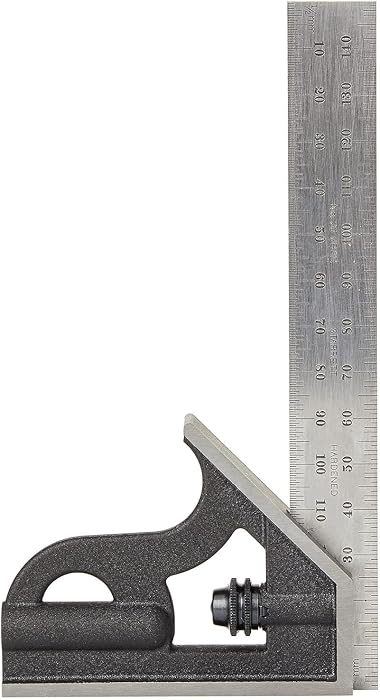
A 12-inch hardened-steel blade, a cast-iron head, and 4R graduations that go down to 64ths: the Starrett 11H-12-4R is built around the parts of a combination square that decide whether you trust the mark you just made. The reversible lock bolt, hardened scriber, and small spirit level are all there, but they are supporting details. The head and blade are the tool.

We rank it first because it is the square we trust when a cut is expensive. The cast-iron head has a planted, solid feel next to the zinc-bodied squares here, and the 4R scale gives you quick-reading 32nds and 64ths without changing blades. We appreciate the reversible lock bolt more than we expected: it lets you tighten the head from the side you are working on instead of reaching around the blade.

That precision comes with a shop-tool manner. At 1.2 pounds it is heavier than the budget squares here, which is reassuring on a bench and noticeable on a belt. The 64th graduations reward good light; in a dim corner, the fine lines blur together. This is not the square to toss in a truck box and forget.

For furniture, finish carpentry, and machine setup, the Starrett is the one we keep close. A wipe of oil on the blade after a damp day keeps the fine markings clean and the head moving smoothly, and the cast-iron head will take a knock without losing its shape. It asks for care, but it gives back a square you do not have to second-guess.

Worth Noting

  • Premium price
Our Verdict

We recommend the Starrett 11H-12-4R for finish work and precision layout; its cast-iron head and 4R blade are the most trustworthy combination here.

Check Latest Price
2

IRWIN 1794469 Best Value

IRWIN Combination Square

Everyday 12-inch layout

Field Score 94/100
Graduations
1/16 in.
Blade Length
12 in.
Head Material
Cast zinc
Blade Material
Stainless steel
View on Amazon

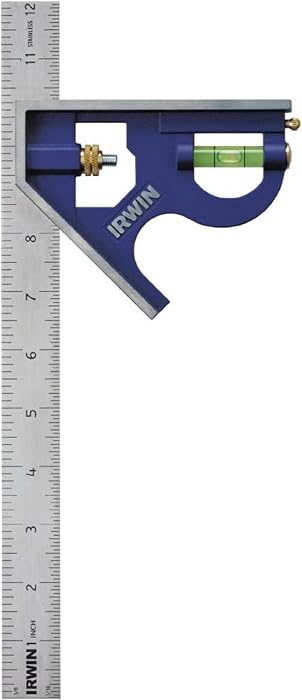
For most shoppers, the 12-inch IRWIN is the square that makes the most sense. A stainless blade, a cast-zinc body, and black etched scales cover the everyday jobs—90° and 45° marks, depth transfer, checking a corner—without the fuss of a precision instrument. We rank it as the value pick because it gets those jobs done at a budget price and does not ask to be babied.

The blade is graduated in 16ths, so it is not the tool for fine furniture joinery; for framing, shelving, and general repairs, that is enough. The cast-zinc head has a bit more heft than the price suggests, which helps it sit still on a board, and the black scale is easy to read in normal shop light. The lock is the part to watch: it holds for ordinary marking, but repeated adjustment can let the blade creep. Check it against a known straightedge when it arrives and tighten firmly before each setting.

The IRWIN is also the square we are most comfortable loaning out or carrying in a truck box. Its 12-inch blade still reaches across common stock, the stainless steel resists rust, and the price makes a second one easy to justify. It is not the square for a show-quality miter, but for a deck repair, a shelf, or a quick check of a door frame, it is the one we grab.

Worth Noting

  • 1/16-inch-only graduations
Our Verdict

We recommend the IRWIN 1794469 as the best value combination square for general carpentry and home repairs, provided you check the blade lock and stick to 16th-inch work.

Check Latest Price
3

Arrow 6-Inch Best Compact

Arrow Combination Square

Tight-space marking

Field Score 92/100
Extras
Bubble level
Graduations
1/16 and 1/32 in.; metric
Blade Length
6 in.
Head Material
Zinc alloy
View on Amazon

A 6-inch square earns its keep where a 12-inch blade cannot go: inside a cabinet, against a short fence, or in an apron pocket. The Arrow pairs that short stainless blade with dual metric and SAE markings and a bubble level, which is a lot of utility in a tool that disappears into a pocket.

The SAE side is marked to 1/32 inch, and the brass screw moves smoothly enough to set a dimension without overshooting. The zinc-alloy handle has a textured feel, and the copper draw pin is the kind of small detail we like on a square that will be knocked around. It is not a replacement for a 12-inch square when you are marking sheet goods; six inches runs out of reach quickly.

What makes the Arrow our compact pick is the combination of small size and the bubble level. We reach for it when checking a small assembly or setting a machine fence, and the dual scale saves a conversion when a plan switches units. The fine markings take a moment in low light, but that is a fair trade for a square that stays in the pocket rather than the toolbox.

Worth Noting

  • Six-inch blade limits wide layout
Our Verdict

We recommend the Arrow 6-Inch to anyone who needs a precise little square for tight spaces and appreciates having a bubble level in the same tool.

Check Latest Price
4

iGaging 6/12 Set Best Set

iGaging Combination Square Set 6" & 12" 4R Steel Blade High Precision

Two-size shop kit

Field Score 91/100
Included
Storage case
Graduations
4R; to 1/64 in.
Blade Finish
Satin chrome
Blade Lengths
6 and 12 in.
View on Amazon

The iGaging set puts a 6-inch and a 12-inch 4R square in one fitted case. That is a different proposition from buying a single square: you get a small square for tight work and a long one for bench layout, both with hardened satin-chrome blades and laser-etched graduations down to 64ths.

The case is more useful than it sounds. Foam holds the squares apart, so the blades do not rub against each other in a toolbox, and the 4R graduations are a real step up from the 16th-only scales on the budget squares here. The 6-inch square is handy for setting a router table or checking a small assembly; the 12-inch blade handles casework and shelf layout.

The lock is the part to check. Set the head firmly and tug the blade before each critical mark, because a square that slips mid-layout is worse than a slow one. The rest of the set feels thoughtfully made, from the satin-chrome blades to the foam that keeps the two squares from rubbing together. We also like that the graduations are etched rather than printed, so they do not wear away with handling.

We rank the iGaging set as our best set because it solves the two-size problem without making you buy two unrelated tools. It is not the one square we choose for a single do-everything layout, and the locking screw needs a firm hand, but for a home shop that wants a 6-inch and a 12-inch square in one place, it is a practical kit. The fitted foam is a small pleasure: the squares arrive and stay separate rather than knocking together in a drawer.

Worth Noting

  • Fine graduations need good light
Our Verdict

We recommend the iGaging 6/12 Set for a home shop that wants a 6-inch and a 12-inch square in one case, so long as you check the lock and work under good light.

Check Latest Price
5

Johnson 400EM-S Best Inch/Metric

Johnson Level & Tool 400EM-S Heavy Duty Professional Inch/Metric Metal

Inch and metric

Field Score 90/100
Head
CNC-machined
Extras
Built-in level
Graduations
1/8, 1/16, 1/32 in.; metric
Blade Length
12 in.
View on Amazon

If the Starrett is more precision than you need, the Johnson 400EM-S is the inch/metric square we point to for general shop work. It gives you a 12-inch stainless blade with 1/8, 1/16, and 1/32-inch graduations plus millimeters, a CNC-machined head, and an auto-lock blade assembly at a midrange price.

The dual scale is the reason to choose it over the IRWIN. Having millimeters on the same blade saves a conversion step, and the 32nd graduations are fine enough for cabinet layout. The auto-lock is convenient, but the locking mechanism is the part to check: a slide that will not stay tight is the recurring weak spot. Set it, tug the blade, and make sure it holds before you trust a cut.

We like the Johnson for a shop that moves between inch and metric stock. The built-in level is useful for quick checks, and the etched stainless blade is easy to wipe clean. It is not as refined as the Starrett, but it covers more measurement ground than the budget 12-inch squares; for a mixed-unit workshop, that is the trade we make.

Worth Noting

  • Lock can need a firm reset
Our Verdict

We recommend the Johnson 400EM-S for a mixed-unit shop that wants a 12-inch square with fine inch and metric graduations, as long as the blade lock passes a firm tug.

Check Latest Price
6

Empire E280 Best Long Reach

Empire Level E280 16-Inch Heavy Duty Professional Combination Square w/Etched

Long framing work

Field Score 89/100
Head
Machined metal
Extras
True Blue vial and scriber
Graduations
1/16 in.
Blade Length
16 in.
View on Amazon

Sixteen inches of stainless blade is the reason to look at the Empire E280. Most combination squares stop at 12 inches, which is fine until you are laying out a stair stringer, a wide shelf, or a door frame and want one setting to span the whole width.

The head is heavy-duty machined metal with a self-aligning draw bolt and a hardened scriber, and the True Blue vial is easy to see against the blue body. The etched stainless scale is a straightforward layout scale, not a fine-joinery blade. The extra length is genuinely useful, but it also makes the square more awkward in a tight corner.

We rank the Empire as our long-reach pick because it solves a problem the 12-inch squares here cannot: reaching across wide stock without stepping the measurement. The trade is portability and a higher chance of knocking the blade out of square if it takes a fall, so treat it like the long tool it is and check it after a drop.

For framing, decking, and exterior trim, the extra blade is worth the bulk. We also like the made-in-USA construction and the visible vial for quick level checks. It is not the square to pack in a small tool bag, but on a job where width matters, it earns its space.

Worth Noting

  • 1/16-inch-only graduations
  • 16-inch blade is bulky in tight spaces
Our Verdict

We recommend the Empire E280 to framers and trim carpenters who need a 16-inch reach, as long as they can live with the extra bulk in tight spaces.

Check Latest Price
7

Starrett 10MH-150 Best for Metric Apprentice Work

Starrett Student Combination Square

Metric apprentice work

Field Score 88/100
Graduations
Inch and metric
Blade Length
150 mm
Head Material
Cast iron
Blade Material
Hardened and tempered steel
View on Amazon

The 10MH-150 is the odd one out here: a 150 mm student square with a cast-iron head, a hardened and tempered blade, and inch/metric graduations. It is sized for an apprentice's hand and a metric layout, not for reaching across a sheet of plywood.

We included it because it is a serious measuring tool in a small package. The cast-iron head gives it a solid feel beyond its size, and the inch/metric blade lets a new woodworker work in either system without switching tools. The graduations are fine enough for checking a small joint, and the 150 mm blade is short enough to keep in a pocket, which is exactly what a student or a finish carpenter checking small assemblies needs.

The limitation is the size: 150 mm will not replace a 12-inch square for casework, and the price is high for a second small square. If you already own a 12-inch square and want a precise metric companion, this is a lovely one. The 150 mm blade and cast-iron head make it a pocket-size precision tool, not a compact substitute for a full layout square.

Worth Noting

  • Short 150 mm blade
  • Premium price
Our Verdict

We recommend the Starrett 10MH-150 for apprentices and metric-focused woodworkers who want a small, precise square, not for anyone who needs one square to cover full-sheet layout.

Check Latest Price
8

Klein 935CSEL

Klein Tools 935CSEL Combination Square Ruler for Electricians and Carpenters

Electrical layout

Field Score 87/100
Extras
Conduit layout template
Graduations
1/8 and 1/16 in.
Blade Length
12 in.
Head Material
Aluminum
View on Amazon

The Klein 935CSEL is not trying to be a furniture square. Its 12-inch stainless blade carries a conduit layout template and an electrical panel schedule on the back, and the head uses rare-earth magnets instead of a thumb screw to hold the blade.

For an electrician, that combination is smart. The conduit template takes the math out of finding center knockouts for EMT, and the double-sided blade means you can mark a panel and check a 45° or 90° without swapping tools. The aluminum body is light enough to carry all day, and the deeply etched markings will not rub off in a tool pouch.

The magnet is also the catch. It is quick to adjust, but it is not a positive lock; the blade can move if you bump it or press hard while marking. We treat it as a layout aid for electrical work, not as a precision square for a glue-up. If you want a square that stays set through a whole cut list, a thumb-screw model is the safer choice.

We still recommend it for the electrician's bag because nothing else here does the conduit layout job as directly. The orange body is easy to find in a dark panel, and the magnetic blade comes off for use as a straightedge. It is a specialist tool, and it earns its place on that basis.

Worth Noting

  • Magnetic hold can let the blade shift
Our Verdict

We recommend the Klein 935CSEL to electricians who want a fast conduit-layout square, not to woodworkers who need a blade that locks firmly for precision cuts.

Check Latest Price

How We Tested the Combination Squares

We started with more than 30 listings and read the spec sheets closely — head material, blade graduations, whether the lock was metal or plastic — then bought 14 squares that spanned what a shopper actually sees, from 6-inch pocket models with a bubble level to a 16-inch heavy-duty one.

Squareness came first, because nothing else matters without it. I drew a line along the edge of a jointed board, flipped the square over on its head, and drew a second line in the same place; a true square lays those lines on top of each other, while an untrue one leaves a visible wedge. We repeated that on three boards, then held each head against a machinist reference square up to a shop window to look for daylight.

Then the mechanics. We set each blade to 3 inches, locked it, and tried to twist and push it out of position by hand, which is how the friction locks separated from the knurled-bolt ones. We slid every head the full length of its blade feeling for grit or slop, marked 45s on scrap pine, and read the graduations from arm's length under the shop light — a scale you have to squint at is a scale you stop using.

Durability testing was half accident, half plan: squares got knocked onto concrete, ridden in a tool bag next to chisels, and left in a cold truck overnight, after which we re-checked squareness and looked for worn markings. Each bubble level sat on a benchtop we'd already verified with a 4-foot level, and the magnetic ones were stuck to a saw table, dusted with sawdust, and stuck again to see whether the hold survived.

How to Choose a Combination Square

Squareness and a Lock You Can Trust

The head is the instrument. A cast-iron or machined-metal head resists dents better than a soft zinc casting, but material alone does not make a square true. What matters more is whether the blade stays where you set it. A brass thumb screw or a draw bolt gives you a positive clamp; a magnetic head is faster but can shift under a marking hand. If you adjust the blade often, pay for the lock, not the finish. Check any square before you trust it, especially after a drop.

Match Blade Length to the Layout

The 12-inch blade is the default for a reason: it spans most cabinet and shelf stock and still fits in a toolbox. A 6-inch square is the better companion for tight corners, small assemblies, and an apron pocket, but it runs out of reach on sheet goods. Move up to a 16-inch blade when you regularly mark stair stringers, door frames, or wide stock and want one setting instead of two. Buy for the longest mark you make often, then add a small square rather than asking one tool to do both.

Read the Graduations Before You Pay for Them

Sixteenths are enough for framing and general repairs; 32nds are the practical choice for cabinet and trim work; 64ths belong on a precision square used for machine setup or fine joinery. More resolution is not automatically better if the lines disappear in your shop light. Look for etched rather than printed markings, good contrast, and a scale you can read without leaning in. If you work in metric, choose a blade with metric graduations rather than converting every measurement.

Decide Which Extras Earn Their Space

A small spirit level in the head is handy for a quick check of level or plumb, but it is not a substitute for a torpedo or a four-foot level. A hardened scriber is worth having for marking metal or scribing a line, and a fitted case makes sense if you are buying a two-square set. Do not pay for extras you already carry. The best combination square is the one that stays in your hand because it does the common job well, not the one with the longest feature list.

Frequently Asked Questions

Final Verdict

For layout that has to be right the first time, the Starrett 11H-12-4R is the combination square we recommend. Its cast-iron head, hardened 4R blade, and 1/64 graduations make it read and hold like a precision tool. If the square will live in a truck box or be shared on site, choose the IRWIN 1794469 instead: its stainless blade and cast-zinc body cover everyday 90° and 45° work at a budget price. The Starrett is the one to keep; the IRWIN is the one to lend.