The 8 Best Speed Squares of 2026

A speed square is the cheapest tool in the truck and the one most likely to ruin an expensive afternoon. When the corner is a degree off, nothing goes wrong on the first cut — it goes wrong three rafters later, when the stringer won't meet the deck. I've blamed my saw for more than one cut that turned out to be the square's fault.

Over four months, my team and I put 16 squares through stud layout, stair stringers, fence repairs, and siding. What separated them was less about brand than whether the corners were truly square, whether the degree scale was readable in a dim garage, and how they held up after a dozen drops off a ladder. Most people want 7 inches; an 8-inch reaches across wider boards.

Here's what nobody tells a first-time buyer: the math lives on the face of the square. A clean rafter table and crisp degree markings save more time than any feature on the package, and the little instruction book in the box matters more than you'd think. The picks below are the ones we kept reaching for.

Our Top Picks

The 8 Best Speed Squares of 2026

1

Swanson S0101 Speed Square Best Overall

Swanson S0101 Speed Square

All-around carpentry

Field Score 97/100
Size
7 in
Material
Die-cast aluminum
Graduation
1/8 in
Included Book
Blue Book
View on Amazon

A speed square has one job before it has a dozen: the 90-degree corner has to be true. The Swanson S0101 starts there, with a CNC-machined aluminum body and a matte finish that keeps the etchings readable without glare. The 7-inch body, deep 7/8-inch heel, and 1/4-inch scribe bar are the classic layout, and the included Blue Book walks through the marks most of us learn by watching someone else.

That complete package is why it is our top pick for general carpentry. The S0101 does not ask you to learn a dense scale or check a vial; it gives you the two angles you use most, a heel that seats on the board, and markings that stay legible in sunlight. For a first speed square or a daily driver, that is the right balance of capability and simplicity.

The heel is the part we appreciate most in use. It seats against the edge of a board and stays there while you mark a crosscut or line up a circular saw, which makes the square feel like an extension of the board rather than a loose tool. The 1/4-inch scribe bar is the sleeper feature; it turns the square into a quick marking gauge for rips and parallel lines. The matte body is also easier to read outdoors than a polished square.

The 7-inch size is the right compromise for most crosscuts, 45s, and trim work. On wide siding or long stair stringers, the reach runs short, and that is where the 8-inch Speedlite earns a place. The aluminum body feels solid without being cumbersome. What we keep coming back to is the value of the whole kit: a true square, readable marks, and a little book that helps you use more of them.

Worth Noting

  • Heavier than composite squares
Our Verdict

For most framing, trim, and DIY layout, the Swanson S0101 is the speed square we recommend first.

Check Latest Price
2

Swanson Speedlite Square Best Budget

Swanson Speedlite® Square

Siding and trim

Field Score 96/100
Size
8 in
Weight
3.2 oz
Material
High-impact composite
Graduation
1/8 in
View on Amazon

Eight inches of reach in a 3.2-ounce body is the whole argument for the Speedlite. It is the square we reach for when we are marking 8-inch siding, trimming out a window, or working overhead and do not want extra weight in one hand. The bright orange body is easy to find on a cluttered bench or in the grass, and the center-line guide and beveled edge make it more useful than a plain triangle. That makes it our budget pick for siding and trim.

The composite body is the trade-off. It is light and will not mar soft trim the way a metal square can, but it is not as durable as aluminum and should not be treated as a framing-crew daily driver. The 1/8-inch notches are handy for scribing, and the 8-inch size gives you a little more registration on wide boards.

We like the Speedlite as a second square rather than the only one. It is the one that lives in the siding pouch, where the low weight and high-visibility color matter more than a machined finish. If you want one square for everything, the Swanson S0101 is the better default. If your work is mostly wide trim and you want to keep a square handy without noticing it, this is the one.

Worth Noting

  • 8-inch body can crowd tight cuts
Our Verdict

The Speedlite is our pick for siding, trim, and anyone who wants a capable square without extra weight.

Check Latest Price
3

DEWALT Square Best for Jobsite Durability

DEWALT DW SQRE QUICK

Jobsite durability

Field Score 95/100
Weight
4.59 oz
Material
Extra-thick extruded aluminum
Dimensions
10.3 x 7.3 in
Graduation
1/8 in
View on Amazon

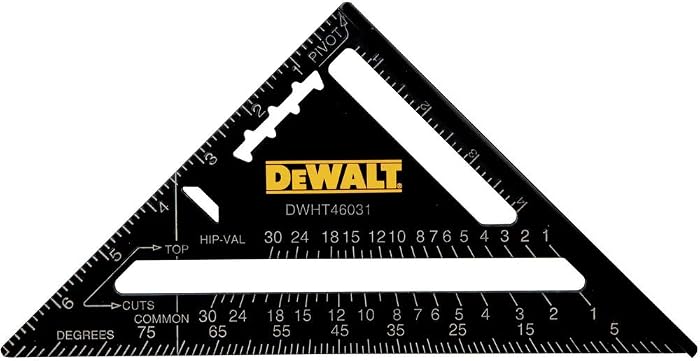
The DEWALT square is the one that feels most like a jobsite tool in the hand. Its extra-thick extruded aluminum body has a stiffer, more substantial feel than the lighter squares here, and the black-and-white markings are crisp and easy to read. The lip is generous enough to register on a board edge, which matters when you are marking a crosscut one-handed.

That solid feel is why it earns a runner-up spot. The 1/8-inch graduations are clear, the body does not flex when you press it against a board, and the edges are clean enough to use as a saw guide. The 10.3-by-7.3-inch footprint gives it a little more surface area than a compact 7-inch square, which is helpful on wider stock but less so in a crowded tool bag. That is the trade-off: more presence in the hand, more space in the pouch.

The layout is simple and readable, and it does not ask you to learn a dozen extra scales. If you want a square that feels solid and you mostly cut 90s and 45s, this is a strong choice. If you want scribe notches or a level vial, the Johnson models are the better fit. The DEWALT is the one we hand to someone who wants a no-nonsense square that can take a knock.

Worth Noting

  • Only 1/8-inch graduations for layout
Our Verdict

The DEWALT is the one to pick if you want a square that feels like a serious jobsite tool and can take a knock.

Check Latest Price
4

IRWIN Hi-Contrast Square Best Readability

IRWIN Tools Rafter Square

Easy reading

Field Score 94/100
Size
7 in
Material
Aluminum
Dimensions
9.25 x 7.48 in
Graduation
1/16 in
View on Amazon

The IRWIN's 1/16-inch graduations are the detail that separates it from most of the 1/8-inch squares here. On trim, cabinet parts, and any cut where you are splitting a pencil line, that extra resolution gives you a cleaner reference. The high-contrast blue finish with painted numbers is the other reason it stands out: the markings are easy to read without the glare of bare aluminum.

The aluminum body is rust-proof and rigid, and the deep markings have stayed legible in our shop. We also appreciate that the square is set up to work as a protractor and a saw guide, not just a 90-degree crosscut tool. The 9.25-by-7.48-inch body gives it a little more surface area than a compact square, which helps when you are lining up a saw, though it takes up more room in a pouch.

That combination of fine markings and high contrast is why the IRWIN is our pick for finish work. It is not the first square we recommend for a rough framing crew, because the finer scale is more than that work needs. We also check the inch scale against a steel ruler when a new square arrives; a printed scale can be off, and a sixteenth is enough to show up in a cabinet joint. If the numbers are true, the IRWIN is a pleasure to read.

Worth Noting

  • Pricier than the top pick
Our Verdict

The IRWIN is our pick for finish work and anyone who wants finer markings and high contrast in a 7-inch square.

Check Latest Price
5

Johnson RAS-1B Johnny Square Best for Framing Layout

Johnson Level & Tool RAS-1B Johnny Square Professional Aluminum Rafter

Framing layout

Field Score 93/100
Size
7 in
Weight
7.84 oz
Material
Aluminum
Graduation
1/8 in
View on Amazon

The Johnson RAS-1B has the feature we did not expect to use as often as we did: scribe notches at 3-1/2 and 5-1/2 inches. They let you hook a pencil and pull a line along the edge of a 2x4 or 2x6 without resetting a tape, which is exactly the kind of small convenience that makes a square feel tailored to framing.

The rest of the tool is straightforward: CNC-machined aluminum edges, 1/8-inch graduations, a low-glare powder coat, and a thick edge for saw guidance. The integrated distance and angle scales cover hip, valley, and jack rafters, and the 2x4 dimension markers are right where you need them. We found the markings clear and the body solid in hand.

The extra scribe notches are the part we keep reaching for; they turn a simple square into a marking gauge for rip cuts and stud layout. The scale package is denser than a beginner needs, and the face takes a little getting used to. For framing, stairs, and repeat layout, though, that density is the point.

The RAS-1B is our framing-layout pick because it does the layout work a basic speed square cannot. The dense scale and extra notches are worth the learning curve for framing and stairs, and the body feels solid enough for daily use. If you mostly need a clean crosscut square, the Swanson is simpler. If you want a square for framing and stair work, the RAS-1B earns its place.

Worth Noting

  • Powder coat can chip at corners
  • Marking paint can wear with use
Our Verdict

The Johnson RAS-1B is our framing-layout pick, with scribe notches and roof scales that earn their keep.

Check Latest Price
6

Johnson MACH-1 Johnny Square Best Premium

Johnson Level & Tool 1904-0700V 7-1/4" Johnny Square® MACH-1™ Smart Mark™

Premium layout

Field Score 92/100
Size
7-1/4 in
Weight
9.28 oz
Material
Aluminum
Graduation
1/8 in
View on Amazon

A level vial in a speed square sounds like a gimmick until you are setting a post or checking a rafter by yourself. The Johnson MACH-1's vial has 320 degrees of visibility and reads level and plumb, so it can replace a torpedo level for a quick check. The 7-1/4-inch body adds a little reach over the 7-inch squares here, and the 1-inch heel stays seated on split or irregular materials.

The Smart Mark cutouts are the other reason to step up. They put fast marks at common stud and joist dimensions, and the 22.5-, 30-, 45-, and 60-degree slots cover the angles that show up in stairs and roof framing. The scale is dense, which is the point: this is a layout tool, not a plain crosscut square.

We found the markings accurate and the body rigid, and the level vial means one less tool to carry for a quick check. The density is also the catch. If you only cut 90s and 45s, you are paying for marks you will not use, and the face takes a minute to learn.

The MACH-1 is our premium pick because it packs a level, angle slots, and stud-layout cutouts into a square that still fits a tool belt. That is a lot of capability, and it is worth it for finish carpenters, deck builders, and anyone working alone. If your work is mostly crosscuts, the simpler Swanson is the better buy. If the job has more than one angle in it, the MACH-1 is the one we reach for.

Worth Noting

  • Costs more than the other picks
Our Verdict

The MACH-1 is the premium pick for finish carpenters and solo builders who want layout marks and a level in one tool.

Check Latest Price
7

Stanley QuickSquare Best Adjustable

STANLEY 7 in. QUICKSQUARE Adjustable Arm Rafter Square (46-053)

Custom angles

Field Score 91/100
Size
7 in
Weight
8.8 oz
Material
Aluminum
Adjustable Arm
Included
View on Amazon

The Stanley QuickSquare is for the angles that do not fit a fixed 45 or 90. The adjustable arm locks at custom angles, and the body works as a saw guide, bevel, and protractor, so you can set a repeat angle and keep moving. The brass adjustment screw locks firmly, and the heavy-duty aluminum body has a black-and-yellow finish that is easy to spot in a toolbox. The 7-inch body is the right size for trim and deck cuts, and the adjustable arm adds range without turning it into a full framing square. That adjustability is why it is our pick for trim and deck work with odd angles.

The catch is the 90-degree stop. We check it against a known square before a finish cut, because an adjustable arm can be set just past square and a half-degree error shows up over a long run. Once it is set, the arm holds, and the protractor scale is handy for repeated cuts. This is not the square for someone who only wants to crosscut 2x4s; a fixed 7-inch square is faster and simpler. For the carpenter who keeps meeting porch rails or trim angles that are not quite 45, the QuickSquare earns its place.

Our Verdict

The Stanley QuickSquare is the adjustable pick for trim and deck work where angles rarely stop at 45 degrees.

Check Latest Price
8

Mr. Pen Square 2-Pack Best for Spare Squares

Mr. Pen Metal 7 Inches Rafter Square

Spare squares

Field Score 90/100
Size
7 in
Material
Aluminum
Graduation
1/8 in
Pack Count
2
View on Amazon

The Mr. Pen set is the only two-pack here. You get two 7-inch aluminum squares with 1/8-inch graduations, rust-proof and weather-resistant construction, and engraved markings. The pair is light enough to keep one in the shop and one in the truck, and the flat bodies slide into a tool bag without adding bulk.

The squares are best for framing, decking, and general DIY, not cabinet-grade layout. The numbers are a little clunky compared with the best markings here, and the finish is plain. We check the 90-degree corner on both when they arrive; if one is off, the second square is not much help. That is the trade-off with a budget two-pack: you get convenience and a spare, but you give up some refinement.

The Mr. Pen set is our pick for a spare or a second square because it solves a practical problem: you can leave one where you work and stop carrying the same square back and forth. It is not the square for fine cabinet work or for someone who wants the crispest markings. If you want one square that feels precise and stays readable for years, spend for the Swanson or IRWIN. If you want two decent squares for the truck and the bench, this set makes sense.

Worth Noting

  • Only 1/8-inch graduations for layout
Our Verdict

The Mr. Pen set is the practical choice when you want two decent aluminum squares for the truck and the bench.

Check Latest Price

How We Tested the Speed Squares

We built the shortlist from squares that turn up on job sites and in woodworking forums, then narrowed it to aluminum and composite models in the two standard sizes, including a couple of adjustable-arm versions and a multi-pack. Anything with a gimmick we couldn't see a use for got cut before it reached a bench.

Every square got the same first test: we traced a line along the 90-degree edge, flipped the tool over, and traced it again. Any gap between those two lines is double the error, so a pencil width tells you a lot. We repeated the flip test on the 45, then checked each tool against a machinist's reference square. We also noted whether the fence sat flush against a board, whether the body rocked, and on adjustable models, whether the pivot held its setting after being tightened and knocked around.

Then they went to work — stud layout in a garage, stringers on a deck rebuild, fence repairs, and marking siding and trim, in morning light and under one bulb at nine at night. We read the degree scale and rafter table from arm's length and noted which ones made us squint, and whether hi-vis color actually helped in low light or just made the tool easier to find. Each one was dropped off a sawhorse and wiped with a rag dampened with mineral spirits to see whether the numbers and finish survived.

At the end we looked at what each square gave you for the money — extra scales, a level vial, a second square in the pack — against how it performed and how often it left the toolbox. Value only counted where accuracy and durability held up first.

How to Choose a Speed Square

Check the 90-Degree Corner First

Every other mark on a speed square depends on the 90-degree corner, so check it before you trust a cut. Hold the square against a known straightedge, scribe a line along the blade, then flip the square and scribe the same line from the same reference. If the second line lands on the first, the corner is true; if you see a wedge of daylight, return it. We prefer a plain square that is true to a feature-heavy one that is not, because a half-degree error compounds over a long rafter or a cabinet run.

Pick a Size That Matches Your Cuts

A 7-inch square is the default for crosscuts, 45s, and general framing because it fits a tool belt and registers on common lumber. Step up to 8 inches for 8-inch siding, wide trim, or overhead work where reach helps; the Swanson Speedlite is the obvious example here. A 7-1/4-inch body adds a little more surface without much bulk. Bigger is not automatically better: a long square can be awkward in tight cabinet work, and the extra reach is wasted if the tool will not fit where you need it.

Choose Markings You Can Read and Keep

Etched or laser-engraved markings wear better than painted numbers because the scale is cut into the metal, not sitting on top of it. Contrast matters as much as permanence: a matte or blue finish with dark numbers is easier to read outdoors than polished aluminum, especially at midday. Graduation is the other choice. Most framing work is fine at 1/8 inch; 1/16-inch graduations help on trim, cabinets, and any cut where you are splitting a pencil line. If you work in low light, look for a high-contrast finish rather than assuming bare metal is easiest to see.

Match the Material to the Work

Aluminum is the default for daily framing because it resists dents, stays rigid, and holds its corners through drops. Composite squares are lighter and often brighter, which makes them easy to find and pleasant for siding and trim; they are also less durable and can be damaged by saw contact, so keep the blade clear. We do not think every buyer needs the heaviest square. If the tool lives in a pouch and comes out for siding, a composite body is a sensible trade; if it gets used as a saw guide every day, aluminum is the safer long-term buy.

Pay for the Layout Aids You Will Actually Use

Scribe notches, a built-in level vial, and an adjustable arm are the features that separate a basic triangle from a layout tool. Scribe notches are the most broadly useful: they let you pull a parallel line along a 2x4 or 2x6 without a tape. A level vial is worth it if you often work alone or check plumb on existing structures. An adjustable arm earns its keep on trim and deck work with repeated odd angles, but it adds a setup step and a squareness check. Buy the features your work repeats, not the longest list.

Frequently Asked Questions

Final Verdict

For most buyers, the Swanson S0101 is the speed square to put in the tool bag. It arrives with the two things that matter most: a machined 90-degree corner and markings that stay readable, plus a Blue Book that helps you use the rest of the tool. That combination makes it the easiest recommendation here.

If you work with 8-inch siding, choose the Speedlite for reach and weight. If you need custom angles, the Stanley QuickSquare is the one to check against a known square. For a two-square setup for the truck and bench, the Mr. Pen pair is the practical choice.